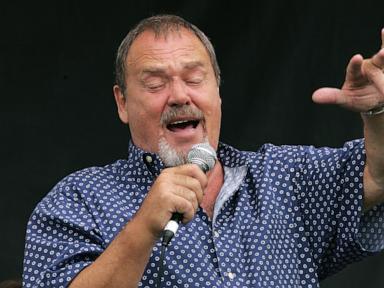
The air in the room always changed when he opened his mouth. It wasn’t a sound you merely heard; it was a physical force that hit you square in the chest, a thick, brass-infused wall of raw blue-eyed soul that demanded your absolute attention. When David Clayton-Thomas sang, the world stopped arguing and listened. Now, at 84, that monumental voice has gone quiet, leaving behind a legacy that fundamentally rewrote the rules of American popular music.
To understand the magnitude of his passing, you have to understand the sheer impossibility of his life.
Long before he was hoarding Grammy Awards or commanding the stage at Woodstock, he was just a terrified, angry kid freezing on the unforgiving winter streets of Toronto. Born David Henry Thomsett in wartime England, he moved to Canada as a child and ran away from an abusive home at the tender age of fourteen. Imagine a boy sleeping in parked cars, stealing food just to keep his ribs from meeting his spine, and cycling through a brutal succession of reformatories and penitentiaries. By his late teens, he was serving time in the notorious Burwash Industrial Farm.
Prison is where the music found him.
Someone left an old acoustic guitar in a cell block. David picked it up. He taught himself to play until his fingers bled and calloused over. When he sang out into those cold stone corridors, the inmates stopped yelling. The guards paused in their rounds. He discovered a power within himself that had nothing to do with fists or blades. He found his escape hatch.
The Night the Horns Met the Street
When he finally walked out of those prison gates for the last time, he didn’t look back. He took his mother’s maiden name, became David Clayton-Thomas, and began tearing through the Toronto music scene like a thunderstorm. He played the coffeehouses, the strip bars, the gritty clubs where people threw bottles if they didn't like the tune. He learned how to command a room by sheer force of will.
Then came the call that changed everything.
Down in New York City, a groundbreaking band called Blood, Sweat & Tears was falling apart. Their brilliant but erratic founder, Al Kooper, had departed after their debut album. They had a magnificent horn section, a rhythm unit that swung like a pendulum, but they lacked a center. They needed a vocalist who wouldn't get drowned out by a wall of trumpets and trombones. They needed a heavyweight fighter.
Bobby Colomby, the band’s drummer, flew up to Canada to hear this legendary street singer everyone was whispering about. He walked into a smoky club, heard three bars of that gritty, gospel-tinged baritone, and knew the search was over.
The chemistry was explosive.
Consider what happens next: a group of highly educated, jazz-trained musicians joins forces with a self-taught ex-con who sings from the gut. It shouldn't have worked. On paper, it was a disaster waiting to happen. But the moment they went into the studio to record their self-titled 1969 album, magic struck.
When the Underground Captured the World
The album didn't just sell; it devoured the cultural conversation.
In an era dominated by psychedelic guitars and trippy lyrics, Blood, Sweat & Tears brought something entirely different to the turntable: sophisticated, complex jazz arrangements married to the driving, primal thud of rock and roll. And right at the center of it all was David, sweating through his shirt, gripping the microphone like he was trying to choke it, pouring every ounce of his troubled past into every single syllable.
"Spinning Wheel."
"You've Made Me So Very Happy."
"And When I Die."
Three massive hits. One after another. The album stayed on the Billboard charts for over two years. It went quadruple platinum. At the 1970 Grammy Awards, this eclectic band of jazz-rockers walked away with Album of the Year, beating out none other than The Beatles’ Abbey Road. Think about that for a second. A kid who had been written off by society as a juvenile delinquent was now standing on top of the entertainment universe, holding a trophy over the heads of John, Paul, George, and Ringo.
But the real struggle lies elsewhere, far away from the glitz of the awards podium.
Fame is a fickle beast, especially when you achieve it overnight. The band found themselves thrust into a grueling schedule of endless touring and intense public scrutiny. They played the legendary Woodstock festival in 1969, their brass notes echoing across the muddy New York hills, cementing their place in rock history. Yet, the pressure was immense. Internal frictions began to develop. The jazz purists wanted to go one way; the pop sensibilities wanted to go another.
David left the group in the early 1970s to pursue a solo career, returned a few years later to breathe life back into the franchise, and spent decades keeping that iconic sound alive for generations of fans. He never lost his edge. Even as the hair turned gray and the lines deepened on his face, the voice remained a force of nature.
The Long Road to Peace
In his later years, David settled back into a quieter life, but he never truly stopped creating. He wrote an autobiography that laid bare his painful youth, proving that he was just as honest with a pen as he was with a microphone. He showed us that your past does not have to dictate your future, that a person can take the broken, jagged shards of a shattered childhood and forge them into something beautiful, enduring, and universally loved.
News of his passing at 84 brings a profound sense of closure to an extraordinary era of musical innovation.
We live in an age where voices are often polished to a mirror shine by computers, pitch-corrected until they lose all human texture. David Clayton-Thomas was the antidote to that clinical perfection. His voice was full of gravel and grace. It had dirt under its fingernails. It carried the weight of prison walls, the smoke of late-night jazz clubs, and the joyful ecstasy of a man who knew exactly how lucky he was to be alive and singing.
He didn't just perform a song. He survived it.
The next time you hear the opening horn blast of "Spinning Wheel," don't just bob your head to the rhythm. Listen closely to the man leading the charge. Listen to the defiance, the resilience, and the sheer, unadulterated passion of a street kid who refused to be silenced.
The singer is gone, but the roar will never fade.