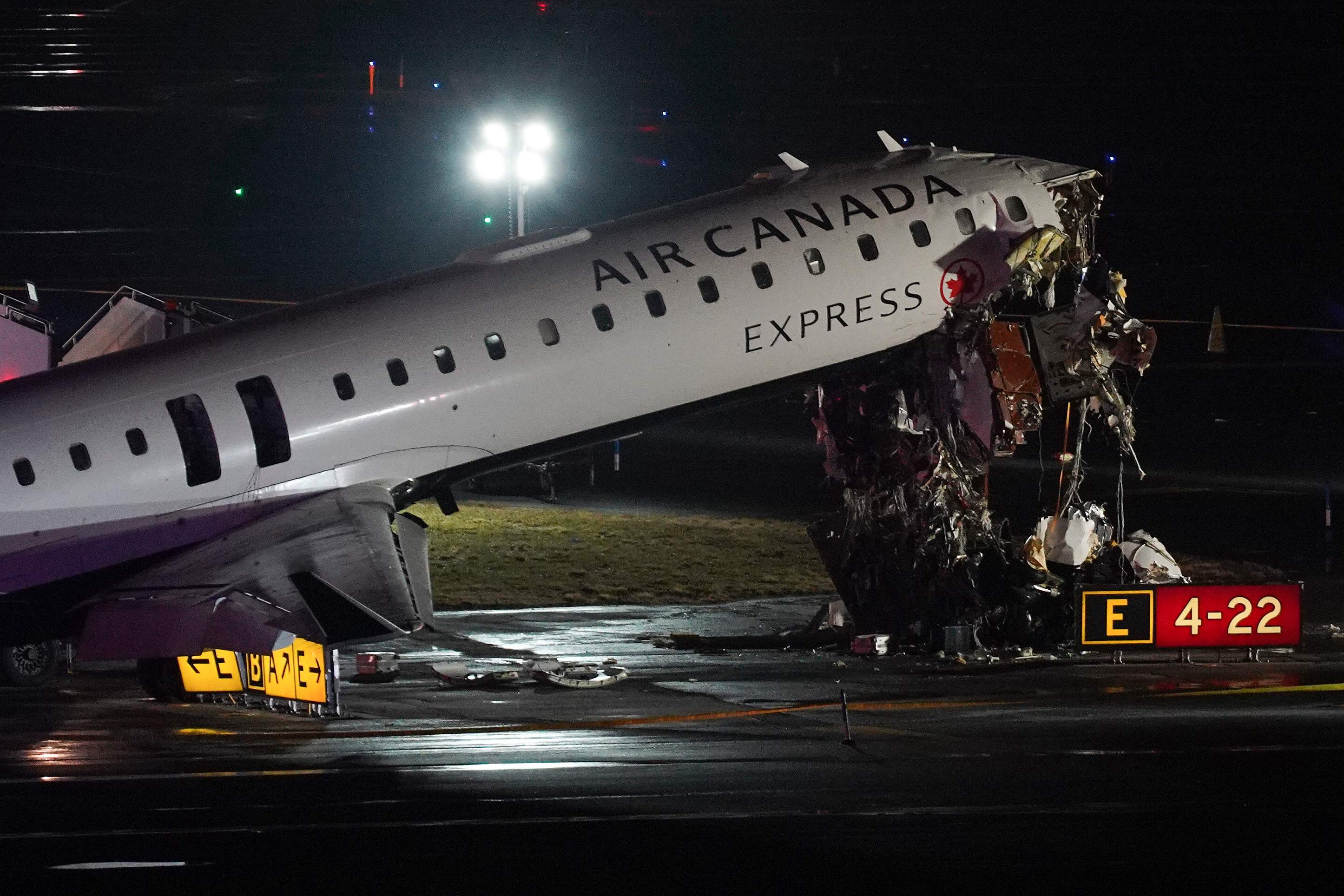
The headlines are screaming about tragedy. They are obsessed with the wreckage and the immediate loss of life. They want to talk about pilot error or mechanical failure at LaGuardia. They are looking at the dirt when they should be looking at the system.
The standard media narrative focuses on the final seconds of a flight. It treats an aviation accident like a lightning strike—random, tragic, and isolated. This is a fundamental misunderstanding of how modern flight works. In an era of high-end automation and triple-redundant systems, planes do not just fall out of the sky. They are pushed by a series of organizational failures that the public, and even many industry pundits, choose to ignore because the truth is far more uncomfortable than "pilot error."
The Pilot Error Fallacy
Whenever a crash occurs, the first thing people look for is the "human factor." It’s an easy out. If we can blame two people in the cockpit, we don’t have to look at the crumbling infrastructure of our air traffic control or the predatory scheduling practices of major carriers.
Labeling an event "pilot error" is the ultimate industry cop-out. It’s a lazy shorthand that stops the investigation exactly where it needs to begin. Modern cockpits are designed to be error-tolerant. If a single mistake by a human being leads to a hull loss, the system has already failed long before the wheels touched the tarmac.
I have spent decades watching airlines "optimize" their way into danger zones. They shave minutes off turn times. They push pilots to the edge of fatigue regulations that haven't been meaningfully updated to reflect the cognitive load of modern glass cockpits. When a crew is flying their fourth leg of the day into a notoriously difficult approach like LaGuardia’s Runway 13, you aren't looking at "performance." You are looking at a roll of the dice.
LaGuardia Is a Relic Not a Modern Airport
Let’s be brutally honest about the venue. LaGuardia is a postage stamp surrounded by water and skyscrapers. It was built for an era of aviation that no longer exists. While the terminals got a multi-billion dollar face-lift to look like a high-end mall, the actual operational geometry of the airfield remains a nightmare.
Short runways. Zero margin for overruns. A complex web of intersecting flight paths from JFK and Newark that forces controllers to choreograph a high-speed ballet with no room for a stumble. We pretend this is "standard operational procedure." It’s not. It’s an exercise in managed chaos.
When you hear people ask, "How could this happen at a major airport?" they are asking the wrong question. The real question is: "Why are we still surprised when a system pushed to 99% capacity finally hits the breaking point?"
The Automation Paradox
There is a dirty secret in the industry that no one wants to admit on camera. The more advanced our planes become, the more we degrade the manual flying skills of the people operating them.
Imagine a scenario where a pilot spends 95% of their career monitoring a screen rather than feeling the aircraft. We’ve turned aviators into systems managers. This works perfectly 99.9% of the time. But when the sensors freeze, or the software receives conflicting data, we expect these systems managers to suddenly transform back into stick-and-rudder aces in a fraction of a second.
The "lazy consensus" says automation makes us safer. It does, until it doesn't. When the automation quits, it hands back a broken airplane to a startled human who hasn't hand-flown a steep approach in six months. That transition is where people die. It’s not a lack of skill; it’s a lack of recent, relevant experience caused by the very technology designed to save us.
The Cost of the Race to the Bottom
We want $99 flights and 100% safety. Physics and economics do not work that way.
Airlines operate on razor-thin margins. To keep the lights on, they squeeze every possible utility out of their hardware and their people. This creates a "normalization of deviance." It’s a term used to describe how people within an organization become so accustomed to a risky behavior that they no longer see it as a risk.
- Skipping a non-essential maintenance item for one more flight? Normal.
- Flying into a storm cell because a diversion costs $20,000 in fuel and re-booking? Normal.
- Pushing a crew to the legal limit of their duty day? Standard practice.
The Montreal-to-LaGuardia route is a commuter workhorse. It’s routine. And routine is the greatest enemy of safety. It breeds a false sense of security that masks the underlying decay of the system.
Stop Asking About the "Black Box"
The media is currently obsessed with the Flight Data Recorder. They think the "Black Box" will tell us what happened. It won't. It will only tell us how it happened.
It will tell us the airspeed, the flap settings, and the engine thrust. It will give us the "what." It will never give us the "why" that matters. The "why" is found in the boardrooms where safety budgets are slashed. The "why" is found in the regulatory bodies that are too cozy with the companies they are supposed to oversee.
If you want to understand why two pilots are dead, don't look at the wreckage in Queens. Look at the spreadsheets in corporate headquarters. Look at the lobbyists in D.C. who ensure that pilot training requirements remain at the bare minimum to save on simulator costs.
The Uncomfortable Truth
The price of our hyper-connected, low-cost travel world is an occasional, catastrophic failure. We have built a system so complex and so tightly coupled that a single ripple can become a tidal wave.
We don't need more "safety briefings." We don't need another round of "thoughts and prayers." We need to stop lying to ourselves about the stability of the aviation infrastructure. We are flying 2026 technology into 1950s airports using a 1980s labor model.
The next time you book a flight, don't look at the safety rating of the airline. Look at the age of the airport, the weather on the route, and the labor relations of the carrier. That will tell you more about your survival than any FAA certification ever will.
The system isn't broken; it's performing exactly as it was designed to—prioritizing throughput and profit until the inevitable cost of doing business is paid in blood.
Fix the system or stop acting surprised when it fails.


