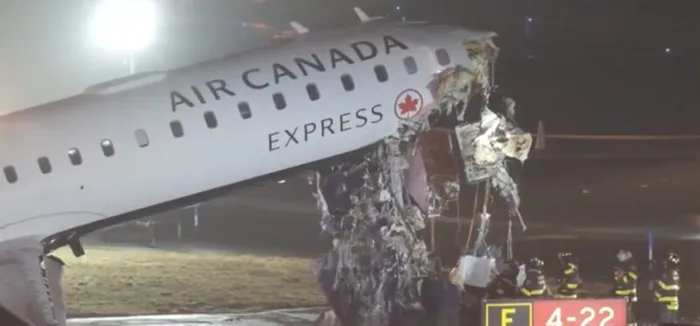
Two pilots are dead after a mid-air collision on the tarmac at LaGuardia Airport. It sounds like a contradiction. How does a mid-air happen on the ground? It's the nightmare scenario for every person in a cockpit. A private charter jet clipped a smaller regional aircraft during a high-speed taxi, leading to a catastrophic structural failure and a fire that ground crews couldn't suppress in time. This wasn't supposed to happen in 2026. Not with the billion-dollar tech we've pumped into New York's aviation infrastructure.
You’d think with GPS, ground radar, and AI-assisted tower commands, the days of "wrong place, wrong time" on a runway were over. They aren't. This tragedy at LGA proves that human error and congested taxiways are a lethal mix. When you're operating out of one of the most cramped airports in the world, the margin for error is basically zero. Expanding on this idea, you can find more in: Why the Green Party Victory in Manchester is a Disaster for Keir Starmer.
What actually happened on the LGA taxiway
Early reports from the National Transportation Safety Board (NTSB) suggest a breakdown in communication between the cockpit of the departing charter and the ground controller. LaGuardia is notorious for its "postage stamp" layout. It's tight. It's busy. On Tuesday morning, visibility was slightly hampered by patchy fog, but nothing that should've grounded flights.
The charter jet, a Gulfstream carrying three passengers, was cleared for taxi to Runway 4. At the same time, a regional jet was exiting the active runway after landing. According to preliminary data, the Gulfstream accelerated into a turn where the regional jet was still partially obstructing the taxiway. The wing of the Gulfstream sliced through the cockpit section of the smaller plane. Experts at The Washington Post have shared their thoughts on this matter.
The two pilots in the regional jet didn't stand a chance. It was a direct hit. Emergency responders were on the scene within ninety seconds, but the fuel spill triggered an immediate flash fire. While the passengers on both planes escaped with minor injuries, the impact zone was a total loss.
The myth of the fail-safe airport
We love to talk about how safe flying is. And it is. You're statistically more likely to get hurt driving to the airport than flying out of it. But that safety record relies on a very fragile chain of commands. When one link snaps, people die.
LaGuardia has undergone a massive multi-billion dollar renovation recently. It looks like a high-end mall now. It’s beautiful. But the runways? They're still the same old, cramped strips of asphalt hemmed in by the Flushing Bay. You can't just build more land. This means planes are constantly performing a high-stakes dance.
Why ground radar didn't stop this
People ask why the Airport Surface Detection Equipment (ASDE-X) didn't prevent the crash. This system is designed to alert controllers when two targets are on a collision course on the ground. It’s been standard at major US airports for years.
- System Lag: In some cases, there’s a three-to-five-second delay in target processing. At taxi speeds, that’s dozens of feet.
- Alert Fatigue: Controllers handle hundreds of movements an hour. If the system pings constantly for "near misses" that are actually standard tight maneuvers, the real warnings can get lost in the noise.
- Line of Sight: LGA’s construction has created new blind spots for both the tower and certain sensors.
If the pilots didn't see the obstacle and the controller didn't catch the closure rate on their screen, the tech becomes a moot point. It's a sobering reminder that we can't automate away every risk.
The problem with private charter "cowboys"
There’s a growing tension in the aviation world between scheduled commercial airlines and private charters. Commercial pilots fly the same routes, the same procedures, and the same gates every single day. It’s repetitive, which breeds safety.
Private pilots, however, are often flying into unfamiliar airports under intense pressure from wealthy clients to "make the slot." I'm not saying the Gulfstream pilot was reckless—the investigation will determine that—but the culture in private aviation sometimes prioritizes speed over the rigid, almost boring patience of commercial flying.
When you combine a pilot who might be less familiar with LGA’s specific ground quirks with a high-pressure departure window, you get mistakes. And at an airport like this, a mistake isn't a fender bender. It’s a funeral.
Why LaGuardia is a unique beast
Most airports have room to breathe. If you're at Denver International or Dallas/Fort Worth, the taxiways are wide. There’s grass. There’s space. LGA is built on a pier. If you go off the edge, you’re in the water. If you turn too wide, you’re hitting a terminal or another plane.
The FAA has been under fire for years regarding "runway incursions"—the technical term for planes being where they shouldn't be. Despite all the new lights and digital signage, the number of these incidents has actually stayed flat or increased in some sectors. Why? Because the volume of flights is higher than ever. We're trying to shove more metal through the same narrow pipes.
The fallout for New York travel
Expect chaos. LGA shut down operations for several hours following the crash, diverting dozens of flights to JFK and Newark. But the long-term impact is more significant. The NTSB investigation will likely take twelve to eighteen months. During that time, expect the FAA to implement even stricter taxiway separations at LGA.
What does that mean for you?
- Longer taxi times: Planes will be held at gates longer to ensure clear paths.
- Higher ticket prices: Fewer flights per hour means less supply and higher demand.
- Increased scrutiny on charters: Private jets might see restricted hours or more "follow-me" truck requirements.
Honestly, it’s a price worth paying if it keeps cockpits from being crushed.
How to track the investigation
If you’re a frequent flyer or just a nerd for aviation safety, you should follow the NTSB's public docket. They don't speculate; they just dump data. You'll eventually see the "black box" (Flight Data Recorder) transcripts. That’s where the truth lies.
Don't listen to the talking heads on cable news who haven't stepped foot in a cockpit. They'll blame the "outdated" ATC system within five minutes. The system isn't perfect, but the issue is usually a "Swiss cheese" model of failure—multiple small errors lining up perfectly to create a disaster.
The next time you're sitting on the tarmac for twenty minutes, don't huff and puff. That delay might be the only thing keeping your plane from becoming a headline.
Check the FAA’s Runway Safety portal for monthly updates on incursion stats at your home airport. If you're flying out of a major hub soon, give yourself an extra hour. The ripple effects of a fatal ground collision at a major hub like LGA will be felt across the entire East Coast corridor for weeks. Use a flight tracking app to monitor your specific tail number's history and delays before you head to the terminal.