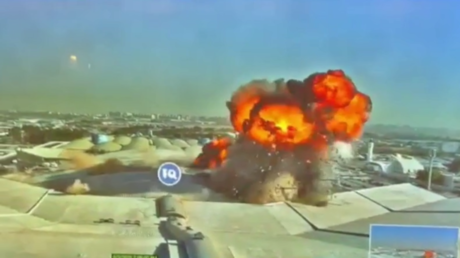
A security camera at Kuwait International Airport just captured the terrifying future of modern conflict. The raw footage, released by Kuwait’s General Directorate of Civil Aviation, doesn't look like the sanitized, long-range missile strikes you usually see on the evening news. It shows Terminal 1 instantly transforming into a war zone.
A massive fireball tears through the structure. The roof collapses. Thick black smoke blankets the area as panicked travelers run for cover. When the dust settled from the June 3, 2026 strike, one Indian national was dead, and 63 people lay wounded with horrific explosion injuries. You might also find this connected coverage insightful: The Cracks in the Granite Wall.
This isn't just another localized flare-up in a messy geopolitical neighborhood. The strike shattered a fragile, weeks-old ceasefire brokered on April 8 between Iran, Israel, and the United States. While the politicians trade frantic press releases and finger-pointing, the security footage tells a much starker story about how vulnerability has shifted in the era of automated warfare.
The Chilling Breakdown of the Terminal 1 Footage
If you look past the initial shock of the blast, the video exposes a massive gap in how we protect civilian spaces. As discussed in latest reports by TIME, the effects are significant.
Terminal 1 had only been reopened for two days after a months-long shutdown caused by earlier regional fighting. The footage shows a routine airport scene. People are standing with luggage, airport workers are moving through the halls, and a sense of fragile normalcy seems to have returned. Then, out of nowhere, the impact happens.
The velocity and angle of the strike suggest a deliberate path directly into the passenger hub. The blast completely guts sections of the building, sending heavy concrete and metal shearing into the public waiting areas. Kuwait's Health Ministry later confirmed that the 63 injured individuals suffered from blast trauma, shrapnel wounds, and amputations.
What makes this video a watershed moment is the sheer vulnerability on display. Air defense systems like the Patriot batteries stationed in the Gulf are designed to track high-altitude threats. They aren't perfectly built to stop low-flying, suicide drones slipping into civilian flight paths.
The Blame Game and the Patriot Missile Alibi
Predictably, the information war started before the smoke even cleared.
Kuwait’s military immediately labeled the incident a "brutal Iranian aggression," claiming they detected a wave of 30 ballistic missiles and drones launched toward their territory on Wednesday. But Tehran offered a completely different narrative. The Islamic Revolutionary Guard Corps claimed they never targeted the airport. Instead, they argued that a wayward American Patriot interceptor missile missed its actual target and plowed into the civilian terminal.
The U.S. Central Command fired back quickly, calling the Iranian claim flatly inaccurate. According to CENTCOM, two Iranian missiles broke apart or fell short, but multiple hostile drones intentionally targeted the civilian hub.
Kuwait's Incident Report vs. Iran's Counter-Claim:
• Kuwait Air Defense: Intercepted over a dozen missiles and drones.
• Casualties: 1 dead (Indian national), 63 injured (passengers and staff).
• Iran's Stance: Attributed terminal damage to failed US interceptor.
• US CENTCOM Assessment: Confirmed intentional drone strike on civilian infrastructure.
Who do you believe? Honestly, the physical evidence of the wreckage will eventually tell the tale, but the strategic intent is already obvious. Iran's state-run media noted that the aerial actions were designed to counter Western maneuvers, specifically targeting regions hosting American military assets. Kuwait, which hosts thousands of U.S. troops at places like Camp Arifjan, found itself directly in the crosshairs.
The Escalation Map on June 3
This airport strike didn't happen in isolation. It was part of a coordinated, bloody afternoon across the region that proves the April ceasefire is essentially dead.
- Kuwait and Bahrain under fire: While drones hit Kuwait International Airport, Bahrain's military was busy intercepting three missiles and another swarm of drones targeting the headquarters of the U.S. Fifth Fleet.
- U.S. retaliatory strikes: The U.S. military launched immediate counter-strikes against an Iranian military ground-control station on Qeshm Island.
- The naval front: In the Strait of Hormuz, the IRGC navy targeted a commercial vessel named the Panaya with missiles, claiming it was retaliation for a U.S. strike on an Iranian oil tanker earlier that day.
India’s Ministry of External Affairs issued a scathing condemnation of the airport attack, demanding an immediate halt to strikes on civilian populations. But with regional powers openly trading blows, those diplomatic statements carry very little weight on the ground.
Moving Past the Illusion of Safe Zones
If you manage logistics, corporate travel, or supply chains in the Middle East, the Kuwait airport video should completely change your risk assessment. The old rules of engagement—where commercial airports were treated as neutral ground—no longer apply.
You need to take immediate, practical steps to protect your people and assets.
First, stop relying on traditional commercial flight paths during active regional standoffs. Kuwait Airways had to quickly divert flights and scramble to run limited operations out of Terminal 4 because Terminal 1 was crippled. If you have personnel moving through the Gulf, establish secondary overland or alternative transit hubs through non-aligned states immediately.
Second, update your corporate emergency protocols to reflect drone vulnerabilities. Most standard corporate evacuation plans assume you can always get your people out via the nearest international airport. As we just saw, that airport can become ground zero in seconds. You need to map out alternative extraction routes that rely on decentralized ground transport rather than assuming the skies will remain open. The footage from Kuwait proves that in modern warfare, the buffer zone between civilian life and the front line has officially vanished.