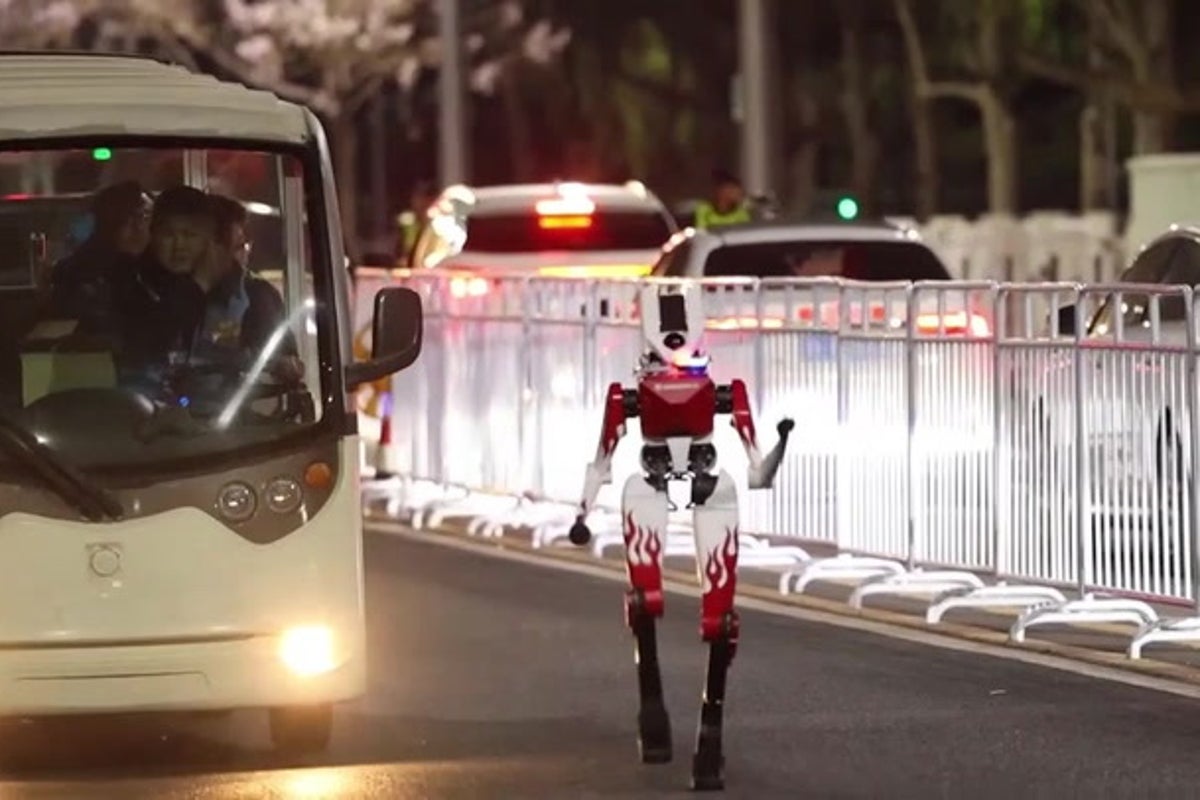
The deployment of approximately 100 humanoid robots for a half marathon in China serves as a high-velocity stress test for bipedal gait stability, thermal management, and power density. While mainstream coverage focuses on the spectacle of "racing" robots, the technical reality is an aggressive validation of mean time between failure (MTBF) in uncontrolled outdoor environments. This event transitions humanoid testing from laboratory "pristine state" simulations to "dirty state" operational reality, where asphalt friction coefficients, wind resistance, and irregular inclines expose the fragility of current control laws.
The Triad of Bipedal Endurance
The technical success of a humanoid completing 21.1 kilometers depends on the optimization of three specific subsystems: the energy-to-weight ratio, the perception-action latency, and the mechanical heat dissipation.
- Specific Energy Consumption (SEC): Most current humanoid prototypes struggle with an endurance ceiling of 60 to 90 minutes. A half marathon requires a sustained operational window of 2 to 4 hours depending on the target velocity ($v$). To achieve this, engineers must minimize the SEC, calculated as the energy used to move a unit of weight over a unit of distance. Heavy battery packs increase inertia, requiring more torque from the knee and ankle actuators, which in turn creates a feedback loop of increased power draw.
- Gait Robustness and Zero Moment Point (ZMP): Maintaining balance at a running pace requires the control system to ensure the ZMP—the point where the total inertia forces equal zero—remains within the support polygon (the footprint). In a racing context, the transition from a walking gait to a running gait introduces a "flight phase" where no feet are on the ground. This necessitates predictive physics engines capable of calculating landing impacts in milliseconds to prevent catastrophic structural failure.
- Thermal Throttling of Actuators: Continuous locomotion generates significant heat in the electric motors, particularly in the hip and knee joints. If the internal temperature exceeds the Curie temperature of the magnets or the thermal limits of the motor windings, the robot must throttle performance or shut down. This race serves as a real-world test for active cooling systems versus passive heatsink designs.
Structural Divergence in Chinese Humanoid Design
The cohort of robots in the Chinese marathon highlights a divergence in robotic architecture: the "Lightweight Agility" school versus the "High-Torque Reliability" school.
The lightweight models typically weigh between 30kg and 50kg. These units utilize high-speed, low-torque motors coupled with planetary gearsets. The advantage lies in reduced impact force during the stance phase, which preserves the longevity of the carbon-fiber limbs. However, these robots are susceptible to external perturbations, such as wind gusts or slight pavement cracks, which can easily knock their center of mass outside the recoverable zone.
The high-torque variants, often exceeding 70kg, prioritize balance through brute force. They use high-reduction strain wave gears (harmonic drives) that allow for precise positioning and the ability to absorb massive shock loads. The trade-off is a significantly higher energy cost. In a 21km race, the high-torque models are more likely to experience battery depletion before the finish line, whereas the lightweight models are more likely to suffer mechanical "trips" or sensor saturation.
The Bottleneck of Surface Adaptability
Standard laboratory floors provide a consistent friction coefficient ($\mu \approx 0.6-0.8$). Outdoor asphalt is a chaotic variable. It contains loose particulates, thermal expansion joints, and varying gradients.
A robot’s "Proprioceptive Feedback Loop" must adapt to these variables without the benefit of a pre-mapped environment. If the robot's foot slips, the Inertial Measurement Unit (IMU) detects an unexpected angular velocity. The controller must then decide—within a 5ms to 10ms window—whether to increase the torque to the stabilizing ankle or to initiate a "recovery step." Most failures in these public trials occur because the software’s "uncertainty threshold" is set too low; the robot chooses to fall safely rather than risk a high-energy recovery maneuver that could snap a structural strut.
Economic Implications of Mass Deployment
Deploying 100 units simultaneously is a logistical shift toward fleet management. It moves the industry away from the "bespoke artisan" model where one technician handles one robot.
- Reliability Engineering: At this scale, even a 5% failure rate results in five broken units. This forces companies to develop modular repair protocols and standardized diagnostic software.
- Data Harvest: 100 robots running for several hours generate petabytes of high-fidelity sensor data. This data is the "refined petroleum" for training Reinforcement Learning (RL) models. By capturing the exact moment of a fall across 100 different instances, engineers can train neural networks to recognize the precursor signals of instability with far greater accuracy than possible in a single-unit lab setting.
The Human-Robot Interaction Layer
The presence of human runners alongside these machines introduces a safety variable known as "Collision Avoidance Latency." Unlike a factory floor where robots operate in "work cells," a marathon is an open system. The robots must distinguish between static obstacles (trash cans, barriers) and dynamic agents (human runners).
This requires a sophisticated fusion of LiDAR for spatial mapping and Computer Vision (CV) for intent prediction. If a human runner pivots suddenly in front of a 60kg humanoid moving at 8km/h, the robot must execute a deceleration maneuver that accounts for its own momentum without tipping over. This "braking distance" for humanoids is a critical safety metric that has yet to be standardized by regulatory bodies.
Power Density as the Ultimate Constraint
The fundamental limitation remains the energy density of Lithium-ion batteries. To complete a half marathon, a humanoid requires approximately $1.5 kWh$ to $3 kWh$ of onboard energy, depending on its efficiency.
- Battery Mass Fraction: Increasing battery size improves range but increases the mass that the motors must move.
- The Actuator Efficiency Gap: Electric motors lose significant energy as heat during "static holding" (simply standing still). In a marathon, every second spent waiting at the start line or navigating a crowd is a direct drain on the range.
The move toward solid-state batteries or high-voltage (800V+) architectures will be necessary before these machines can transition from 21km exhibitions to 8-hour work shifts in industrial or domestic settings.
Strategic Execution for Manufacturers
To move beyond the "marathon stunt" phase, manufacturers must prioritize the decoupling of high-level task planning from low-level locomotive control. The current "end-to-end" RL approaches, while impressive in controlled demos, often fail in the "long-tail" edge cases of a public race.
The strategic play is the development of a "Gait Library"—a pre-validated set of movement primitives that the robot can switch between based on real-time surface analysis. This reduces the computational load on the primary processor, allowing more cycles to be dedicated to environmental perception and obstacle avoidance.
Companies that treat this race not as a marketing event, but as a systematic gathering of failure-mode data, will dominate the next iteration of the hardware cycle. The goal is not to win the race, but to identify the exact point of mechanical and algorithmic fatigue. Any unit that finishes without a "thermal event" or a "soft-reboot" of its control stack represents a viable blueprint for the first generation of commercially deployable general-purpose humanoids. Success is measured in the reduction of "Human Intervention per Kilometer," a metric that must reach near-zero before these systems can be integrated into the global supply chain.