The coffee in your mug is lukewarm. Outside, the morning commute is a low-frequency hum of internal combustion engines and tires gripping asphalt. For most of us, the world works because we assume it will. We assume the lights will flick on, the gas will flow, and the price of a gallon of milk won't double by Tuesday. We live in the grace period of a global machine so vast and intricate that we’ve forgotten how easily its gears can grind to a halt.
Now, shift your gaze. Travel four thousand miles east to a jagged coastline where the heat is a physical weight and the air smells faintly of salt and crude. Here, the map pinches. Between the Musandam Peninsula and the coast of Iran lies a strip of water just twenty-one miles wide at its narrowest point. This is the Strait of Hormuz. It is not just a geographical feature; it is the jugular vein of the modern world.
Every day, one-fifth of the world’s total oil consumption passes through this throat of water. Imagine a fleet of the largest machines humans have ever built—supertankers the size of horizontal skyscrapers—drifting through a passage where the actual shipping lanes are only two miles wide. If this pulse stops, the world catches a fever.
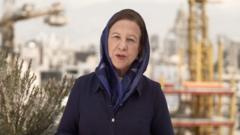
Vice President Mohammad Reza Aref recently stood before the cameras in Tehran and uttered a sentence that should make every treasurer and commuter lean in. He said the security of this water is not free. It was a blunt reminder that the peace we take for granted is actually a high-stakes subscription service, and the bill is coming due.
The Guardian at the Gate
Consider the perspective of a deckhand on a Bahamian-flagged tanker. From his vantage point, the horizon is a shimmering haze of blue and beige. He isn't thinking about geopolitics or the nuances of the 1982 Law of the Sea Convention. He is thinking about the heat and the strange, quiet tension of the Persian Gulf. He knows that his ship carries enough energy to power a small country for a week. He also knows that his safety depends on a delicate, unspoken agreement between nations that, on any other day, barely tolerate each other’s existence.
Iran views itself as the natural custodian of these waters. For decades, the Islamic Republic has played a complex game of chicken with the West, particularly the United States. To Tehran, the Strait is their backyard. To Washington, it is an international highway that must remain open at all costs.
When Aref speaks of "security," he isn't just talking about chasing off pirates. He is talking about the cost of maintaining a massive naval presence, the price of regional stability, and the unspoken demand for respect. Iran’s argument is simple: why should we bear the burden and the risk of policing these waters if the world treats us like a pariah?
It is a shakedown, yes, but one grounded in a terrifying reality. Iran has the capability to choke this passage. They don’t need a massive fleet to do it. A few hundred sophisticated sea mines, a swarm of fast-attack boats, and a battery of shore-based missiles could turn the Strait into a graveyard of steel.
The Fragility of the Flow
Let’s look at a hypothetical scenario to understand the stakes. Let’s call him Elias. Elias runs a small logistics firm in Rotterdam. He’s a man of spreadsheets and margins. On a Monday, a minor skirmish occurs in the Strait—a drone strike on a tanker, or a seizure of a vessel by the Revolutionary Guard.
By Monday afternoon, the insurance premiums for every ship in the Gulf triple. By Tuesday, oil speculators in London and New York have driven the price of Brent Crude up by fifteen percent. By Wednesday, Elias is staring at his fuel costs and realizing he has to tell his drivers they’re being furloughed because he can no longer afford to keep the trucks running.
This isn't a "what-if" from a Tom Clancy novel. It is the mechanical reality of our global economy. We are all Elias. We are all connected to that narrow strip of water by a thousand invisible threads of commerce.
The United States has long been the primary guarantor of this flow. The U.S. Fifth Fleet, based in Bahrain, exists almost entirely to ensure that those two-mile-wide lanes remain clear. But the cost of that "free" security is staggering. It’s measured in trillions of dollars over decades and a permanent military footprint that acts as a lightning rod for regional resentment.
The Cost of Sovereignty
When a nation like Iran feels backed into a corner by sanctions and diplomatic isolation, the Strait of Hormuz becomes its most potent leverage. Aref’s comments are a signal that the status quo is no longer acceptable to Tehran. They are tired of providing the "service" of a stable Gulf while their own economy is strangled.
"The security of the region must be provided by the regional countries," Aref noted. On the surface, it sounds like a reasonable call for local autonomy. In reality, it is a challenge to the American-led order. It is an assertion that if the world wants its oil to flow smoothly, it must reckon with the gatekeeper.
The tension is a feedback loop. Every time Iran maneuvers in the Strait, the U.S. increases its presence. Every time the U.S. adds a carrier strike group, Iran feels more threatened and increases its rhetoric. It is a dance on the edge of a razor. One miscalculation, one overzealous commander, or one mechanical failure on a ship could trigger a blockade that would plunge the global economy into a recession overnight.
Beyond the Barrel
We often talk about "oil" as if it’s just a commodity, something we put in our tanks. But it’s more than that. It’s the baseline for almost everything we touch. The plastics in your phone, the fertilizer that grows your food, the medicine in your cabinet—they are all derivatives of the flow that passes through the Strait.
When the price of security goes up, it’s not just the governments that pay. It’s the farmer in Iowa who can’t afford his harvest. It’s the factory worker in Vietnam whose plant shuts down because electricity costs have spiked.
The tragedy of the Strait of Hormuz is that its importance is its greatest curse. Because it is so vital, it can never truly be "secure." It will always be a site of contest, a place where the world’s superpowers and regional heavyweights jostle for position.
We live in a world of friction. We like to imagine that the digital age has made geography irrelevant, that we’ve transcended the limitations of land and sea. But we haven't. We are still tethered to the physical world, to the deep-water ports and the narrow channels.
Aref’s words were a cold splash of water. They remind us that the "free" world is an expensive illusion. The security of our way of life is a fragile thing, maintained by gray ships in distant waters and the temperaments of men in capital cities we will never visit.
The sun sets over the Strait, casting long, golden shadows across the decks of the tankers. They move slowly, laden with the lifeblood of civilizations, passing through a gateway that could close at any moment. The silence out there isn't peace. It’s a pause.
The machine continues to hum, for now. We return to our lukewarm coffee and our morning commutes, unaware of how much of our lives depends on a twenty-one-mile stretch of water where the bill is always, inevitably, rising.
The jugular remains exposed.