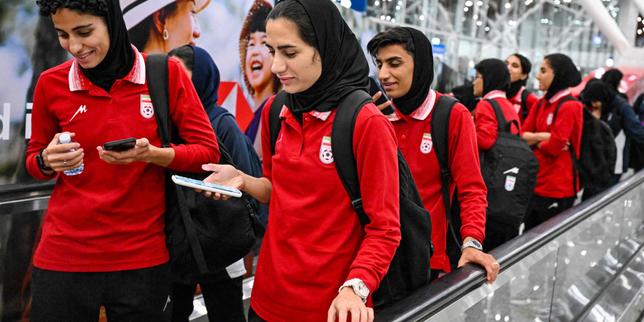
The grass at the training grounds in Australia feels different under a pair of cleats than the dust-choked pitches of Tehran. It is springier. More forgiving. For Behnaz Taherkhani and Maryam Yektaei, that turf represented more than a surface for a game. It represented a potential floor for a new life.
Imagine standing in a stadium where the roar of the crowd is filtered through the heavy weight of what you left behind. You are an elite athlete. You have spent your life perfecting a strike, a save, a tactical maneuver. But suddenly, the most important move you have to make isn't on the field. It is in a government office, staring at an asylum application that could sever your ties to your mother, your father, and the only home you have ever known.
This was the reality for these two pillars of the Iranian women’s national team. They didn't just travel to Australia to play; they traveled to breathe. But the air of freedom is often thinner than people realize. It carries the scent of exile.
The Weight of the Jersey
In international football, the jersey is a symbol of pride. For an Iranian woman, it is also a complex contract. To represent the Islamic Republic on the global stage is to carry a set of expectations that extend far beyond athletic performance. There are dress codes. There are behavioral codes. There is the constant, flickering awareness that one wrong word in a post-match interview could result in a permanent seat on the sidelines—or worse.
When Taherkhani and Yektaei first signaled their intent to seek asylum in Australia, the world saw a headline about political defection. The reality was a quiet, agonizing calculation. They were looking at a future where they could play without the hijab, where they could speak without a shadow, where the pitch was just a pitch.
But then, the wind shifted.
The decision to withdraw an asylum claim is rarely a change of heart about freedom. It is almost always a reckoning with the cost of it. To stay in Australia as refugees would mean becoming ghosts to their families. It would mean that every goal scored on foreign soil would be a reminder of the distance between them and the people who first taught them how to kick a ball.
The Geography of Fear
Consider the logistics of a backtrack. You have already crossed the line. You have told a foreign government that you are afraid to go home. Once that bell is rung, can it ever truly be unrung?
Reports indicate that the players held meetings with Iranian officials. Imagine the room. The sterile lighting. The tea that has gone cold. On one side, the promise of "safety" and "forgiveness" if they return. On the other, the terrifying unknown of a life in limbo. The Australian government, while a bastion of human rights in many eyes, is also a machine of bureaucracy. Asylum can take years. In those years, an athlete’s prime evaporates.
A goalkeeper like Yektaei relies on reflexes. A defender like Taherkhani relies on positioning. But how do you position yourself when your entire identity is being traded like a commodity?
The Iranian football federation and government representatives reportedly offered assurances. They spoke of a path back. They spoke of the national team. For a professional athlete, the siren song of the game is louder than almost any other. If they stayed in Australia, they might be free, but they might never play at that level again. If they went back, they could play, but would they ever truly be free?
Beyond the Scoreboard
The statistics of Iranian female migration tell a story of a talent drain. Over the last decade, dozens of high-profile athletes—from chess grandmasters to taekwondo champions—have fled. They leave because the friction between their ambition and their environment becomes unbearable.
When a player withdraws an asylum request, it isn't a victory for the status quo. It is a testament to the brutal effectiveness of soft power. Family is the ultimate leverage. If you are told that your defection will bring hardship to your siblings or parents, the grass in Australia starts to look less like a sanctuary and more like a cage.
The stakes are invisible because they are personal. We see the official statement. We see the flight itinerary. We do not see the midnight phone calls. We do not hear the whispers of "please, just come home, it will be okay."
People often ask why they would risk going back after making such a public stand. The answer lies in the specific type of loneliness that haunts an exile. To be a hero in a country that isn't yours is a hollow victory. To be a daughter in a country that demands your silence is a heavy burden. They chose the burden they knew over the loneliness they didn't.
The Final Whistle
The narrative of "the defector" is a clean one. It has a beginning, a middle, and a triumphant end. But the narrative of "the returnee" is messy. It is filled with compromise. It is shaded by the very real possibility that the "forgiveness" offered in a Sydney hotel room might vanish the moment the plane touches down at Imam Khomeini International Airport.
They are athletes. They are used to high-pressure environments. They are used to the clock ticking down and the need for a decisive action. But in this game, there is no referee to ensure the rules are followed. There is only the hope that the promises made to them are as solid as the ground they gave up.
Behnaz Taherkhani and Maryam Yektaei are now heading back to a reality that hasn't changed, even if they have. They carry with them the memory of an Australian sky and the knowledge of what it feels like to almost walk away. The game continues. The players return to their positions. But the stadium feels different now.
The silence that follows a withdrawn asylum bid is the loudest sound in the world. It is the sound of a dream being folded up and tucked away into a suitcase, right next to a pair of worn-out cleats and a jersey that suddenly feels much, much heavier.