The captain of a VLCC—a Very Large Crude Carrier—doesn’t see the world in maps or borders. He sees it in knots, depth, and the terrifyingly narrow sliver of blue known as the Strait of Hormuz. At its tightest point, the shipping lane is only two miles wide. Imagine a steel beast longer than three football fields, burdened with two million barrels of oil, trying to thread a needle while the eyes of a volatile region track its every vibration.
When the news cycle reports that French President Emmanuel Macron has "urged" Iran to cease regional attacks and restore navigation, the words feel distant. They feel like the polite clinking of silverware in the Élysée Palace. But for the crew on that tanker, those words are the difference between a routine watch and a ballistic nightmare.
The Strait of Hormuz is not just a geographical feature. It is the jugular vein of the global economy. One-fifth of the world’s total oil consumption passes through this gateway. If that vein is pinched, the pulse of the modern world skips a beat. Factories in Bavaria slow down. Commuters in Tokyo find the price of a morning drive suddenly untenable. The stakes are not abstract; they are measured in the heat of a kitchen and the cost of a gallon.
The Geography of Anxiety
In a recent, high-stakes diplomatic maneuver, Macron didn't just issue a press release. He reached out to Iranian President Masoud Pezeshkian with a message that was less about etiquette and more about survival. The French leader is playing a role that Europe has occupied for decades: the bridge builder standing on a crumbling span.
The request was twofold. First, an immediate halt to the support of proxies—groups like the Houthis in Yemen or Hezbollah in Lebanon—whose actions have turned the Red Sea and the Gulf of Oman into a shooting gallery. Second, a return to "freedom of navigation." It is a dry, maritime term that masks a chaotic reality.
Consider a hypothetical merchant sailor named Elias. He isn't a politician. He’s a father from the Philippines working a six-month contract. To Elias, "freedom of navigation" means not having to scan the horizon for fast-attack craft or drones. It means the GPS doesn't suddenly "spoof," showing his ship ten miles inland when he is actually in deep water. When navigation is compromised, the ocean stops being a highway and becomes a labyrinth of invisible tripwires.
The Dominoes in the Deep
Why does a president in Paris care so deeply about a strip of water thousands of miles away? Because the economy is a series of interconnected dominoes, and the first one sits right there in the Persian Gulf.
When Iran or its affiliates disrupt shipping, the cost of insurance for these vessels doesn't just rise; it explodes. Shipping companies are forced to reroute around the Cape of Good Hope, adding weeks to a journey and burning millions of dollars in extra fuel.
This isn't just a "business cost."
It is a hidden tax on every human being who buys goods shipped by sea—which is nearly everyone. We often talk about inflation as if it were a natural weather pattern, a storm that simply arrived. In reality, it is often manufactured in places like the Strait of Hormuz. Macron’s plea to Pezeshkian is a desperate attempt to stop that tax from rising further. He knows that a Europe already weary from energy shocks cannot afford a total blockage of the world’s most vital maritime corridor.
The Ghost of the Tanker War
To understand the tension, we have to look back. History has a way of repeating itself in these waters, echoing the "Tanker War" of the 1980s when hundreds of merchant ships were caught in the crossfire of the Iran-Iraq conflict. Back then, the world learned a brutal lesson: once the fire starts in the Strait, it is almost impossible to put out.
Iran’s leverage has always been its ability to "close" the Strait. It’s a threat they carry like a concealed blade. By disrupting navigation or seizing vessels, they send a message to the West: Our stability is tied to yours. If we suffer, the world’s engines will stutter.
Macron is attempting to convince Tehran that this leverage has reached a point of diminishing returns. The "regional escalation" he spoke of refers to the widening circle of fire involving Israel, Gaza, and the various militias across the "Axis of Resistance." He is telling the Iranian leadership that they are playing with a different kind of fire now—one that could consume the very diplomatic channels they spent years building.
The Human Cost of High Policy
High-level diplomacy often lacks a face. We see the photos of men in suits shaking hands or holding phones, but we rarely see the consequence of their failure.
The consequence is a cooling of global trade that freezes out the most vulnerable. It’s the small business owner who can’t get parts for a repair because the shipping containers are stuck in a backlog. It’s the family that has to choose between heating their home and buying groceries because the "energy risk premium" has been added to their monthly bill.
Macron’s dialogue with Pezeshkian is an admission of vulnerability. It is a confession that the West cannot simply force the waters to stay open through naval power alone. It requires a psychological shift in Tehran.
The French President emphasized that Iran has a "responsibility" to contribute to a general de-escalation. It was a pointed choice of words. Responsibility implies a seat at the table, a recognition of Iran’s power. But it also carries a warning: with that power comes the blame if the world’s veins are severed.
A Fragile Silence
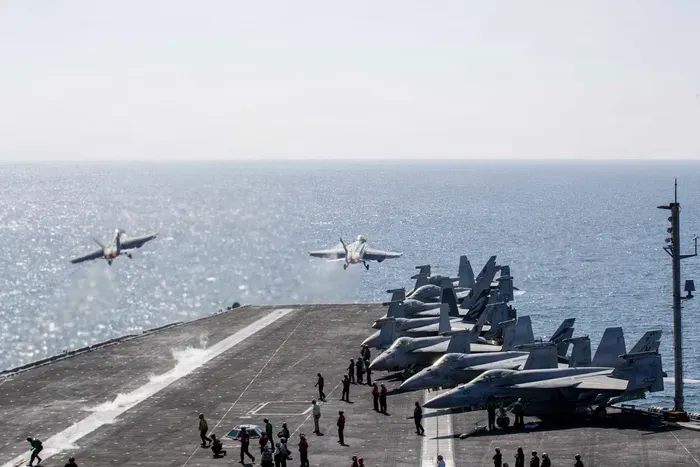
For now, the ships continue to move. The crews like Elias still scan the horizon, watching for the silhouette of a drone or the wake of a fast boat. They live in the gap between the "urging" of presidents and the reality of the sea.
The world watches the price of Brent Crude as if it were a heartbeat monitor. Every time a headline breaks about a seized ship or a drone strike, the line spikes. We are all passengers on those tankers, whether we realize it or not. Our lives are fueled by the stability of a two-mile-wide stretch of water that most people couldn't find on a map.
The silence in the Strait is not peace. It is a held breath. It is the sound of a world waiting to see if the words of a president in Paris can actually reach the hearts of the men holding the blades in the Gulf.
As the sun sets over the jagged cliffs of the Musandam Peninsula, casting long, dark shadows over the water, the steel giants continue their slow, rhythmic crawl. They carry the lifeblood of nations through a gauntlet of ghosts and grievances. Every successful passage is a miracle of restraint, a tiny victory of order over chaos that we take for granted until the moment the lights go out.
The sea remembers every ship it has taken. It waits to see if we have learned enough to keep the rest afloat.