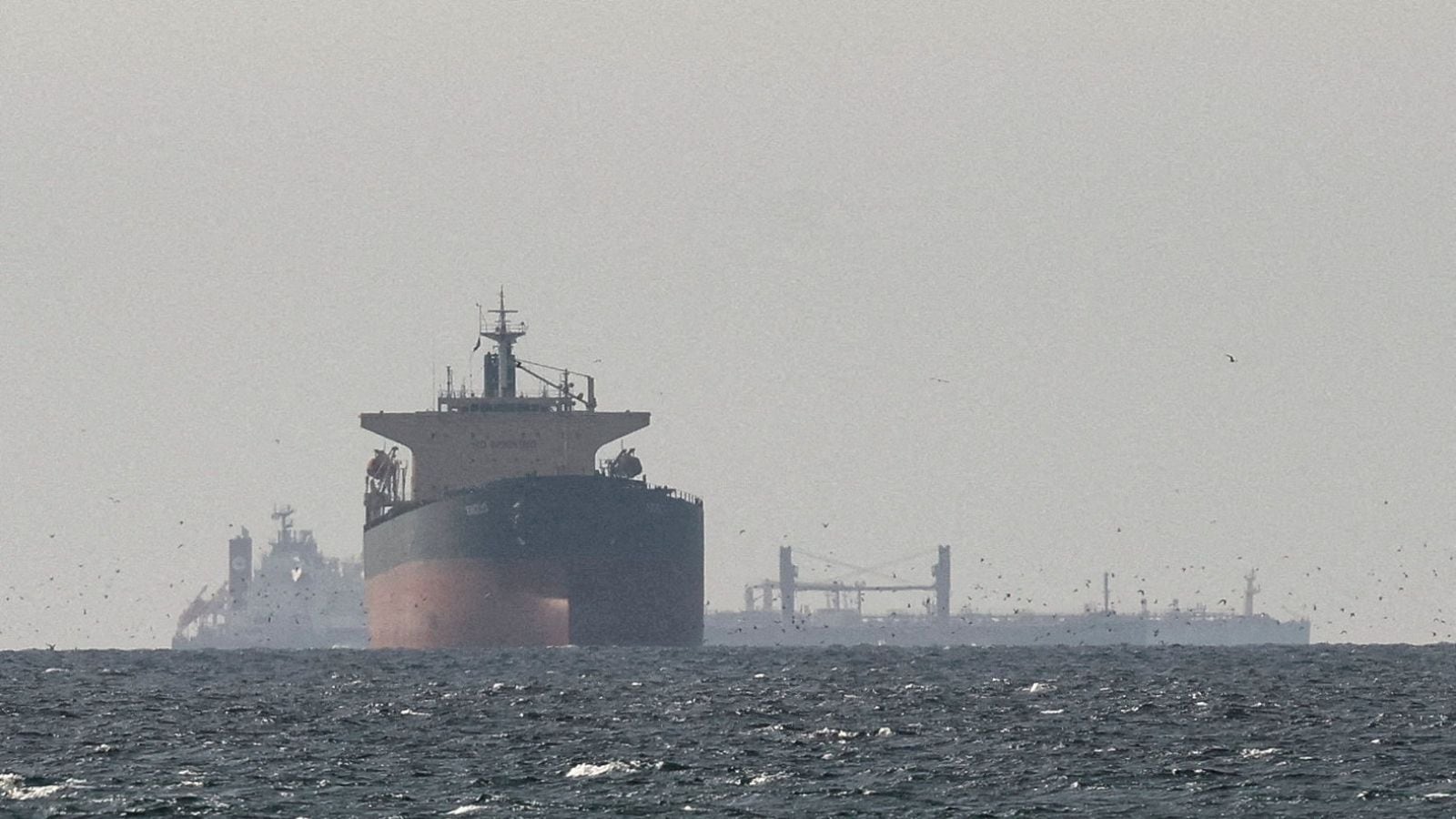
The air in the control room of an offshore oil platform in the Arabian Gulf doesn't smell like sea salt. It smells like recycled oxygen, expensive electronics, and the faint, metallic tang of anxiety. To the engineers staring at the flickering monitors, the blue expanse outside isn't just water. It is a highway. A fragile, crowded, twenty-mile-wide highway called the Strait of Hormuz.
One-fifth of the world’s petroleum liquid consumption passes through this single artery every day. If you are sitting in a car in London, or heating a home in Tokyo, or running a factory in Seoul, you are tethered to this specific patch of blue. But right now, that tether is fraying. If you enjoyed this post, you should look at: this related article.
The geopolitical math used to be simple: exert pressure on Iran, squeeze their economy, and force a new behavior. But Riyadh is sending a message to the Trump administration that the old math is broken. This isn't a game of checkers where you remove a piece from the board. It’s a game of Jenga. If you pull the Iranian brick too hard, the entire tower—including the Saudi economy—comes crashing down.
The Geography of a Nightmare
Think of the Strait of Hormuz as the neck of a bottle. Saudi Arabia, Kuwait, the UAE, and Iraq are all inside that bottle. Iran sits on the other side of the glass, holding the cork. For another angle on this story, refer to the recent update from The New York Times.
When Washington discusses a "blockade" or "maximum pressure" to stop Iranian exports, they see a strategic lever. Riyadh sees a suicide pact. The Saudi warning isn't born of sudden sympathy for their neighbors in Tehran; it is born of cold, hard physics. If the U.S. successfully chokes off Iran’s ability to sell its oil, Iran has a very limited, very dangerous set of responses. They don't have to win a war. They just have to make the water impassable.
Imagine a single "shadow" tanker—one of those rusted, aging vessels used to move sanctioned oil—hitting a mine or being seized in the narrowest part of the channel. The insurance rates for every other ship in the Gulf would triple instantly. Shipping companies would refuse to send their crews into a kinetic zone.
The flow stops.
Not just for Iran, but for the Kingdom. Saudi Arabia’s Vision 2030—the ambitious, multi-billion-dollar blueprint to move the country beyond oil—depends entirely on the steady, uninterrupted revenue of... oil. You cannot build a futuristic city in the desert if the money to pay the architects is trapped behind a wall of naval mines and burning tankers.
The Ghost of 2019
The Saudis remember what many in Washington have chosen to forget. In September 2019, a swarm of drones and missiles struck the Abqaiq and Khurais processing facilities. In a matter of minutes, half of Saudi Arabia’s oil production vanished.
The world’s "swing producer" was suddenly swinging in the wind.
That attack proved that the Kingdom’s infrastructure is a series of glass houses, and Iran has a lot of stones. The report circulating in diplomatic circles suggests that a total blockade on Iran would be the ultimate provocation, forcing Tehran to move from "gray zone" harassment to "red zone" disruption.
If Iran can't sell oil, they will ensure nobody else can either. This isn't a theory. It is a stated doctrine of the Islamic Revolutionary Guard Corps.
The irony is thick enough to choke on. A policy designed to protect American interests and stabilize the Middle East could, in one afternoon of escalation, send global oil prices into a vertical climb. We are talking about $150 or $200 a barrel. We are talking about a global recession triggered by a miscalculation in a twenty-mile stretch of water.
The Strategy of the Cornered
Humans do not make rational decisions when they are backed into a corner with no exit. Nations are no different.
The Trump administration's "Maximum Pressure 2.0" aims to drain the Iranian treasury to the point of collapse. But Riyadh is quietly pointing out that a collapsing Iran is far more dangerous than a sanctioned one. A regime with nothing to lose has no reason to respect the "lifeline" of its rivals.
Consider the hypothetical life of a merchant sailor on a VLCC (Very Large Crude Carrier). You are navigating a ship the size of an Empire State Building laid on its side. You know that somewhere beneath the waves, or tucked into the jagged cliffs of the Musandam Peninsula, are eyes watching your transit. You aren't a combatant. You’re a target.
When the Saudis warn that a blockade could backfire, they are thinking about that sailor. They are thinking about the tankers that will sit idle at the Ras Tanura terminal, unable to move because the "highway" is closed.
The Kingdom has spent decades positioning itself as the reliable bedrock of the global energy market. That reliability is their primary export. If they cannot guarantee safe passage through the Strait, their primary export becomes worthless.
Beyond the Barrel
This isn't just about the price at the pump. It’s about the credibility of alliances.
For years, the bargain was simple: the U.S. provides security, and the Gulf provides energy. But if the U.S. policy of "security" through aggression actually creates "insecurity" for the energy flow, the bargain is dead.
Saudi Arabia is moving toward a more pragmatic, "Middle Way" diplomacy. They have restored ties with Iran. They are talking to Beijing. They are joining BRICS. They are no longer interested in being the front line for someone else’s ideological crusade if that crusade ends with their own ports in flames.
The report highlights a terrifyingly fragile reality. We live in a world of high-speed fiber optics and AI-driven markets, but it all still rests on the hull of a ship moving through a narrow channel at fifteen knots.
The tension in the Gulf is a reminder that you can't punish your enemy by poisoning the well you both drink from. The water in the Strait is deep, but the margin for error is incredibly thin.
The warning from Riyadh isn't an act of defiance. It is an act of self-preservation. It is a plea for the "dealmaker" in the White House to realize that some deals have a hidden cost that no one can afford to pay.
In the end, the oil must flow. Not because it’s good for the planet, and not because it’s a moral imperative, but because the alternative is a darkness that reaches far beyond the desert. If the throat of the world is squeezed, everyone stops breathing at the same time.
The monitors in the control room continue to flicker. The ships continue to move, tiny dots on a digital map, each one a heartbeat of the global economy. For now, the highway remains open. But as the rhetoric heats up and the pressure mounts, the engineers keep one eye on the pressure gauges and the other on the horizon, waiting to see if the next wave brings a cargo or a catastrophe.
It is a strange thing to realize that the stability of your world depends on the restraint of people who have every reason to be desperate. That is the gamble being played out in the Gulf. It is a high-stakes poker game where the chips are the very engines of civilization, and the house doesn't always win.
The silence in the Strait is never truly quiet. It is the sound of a held breath.



