The ground beneath north-central Venezuela did not merely shake on Wednesday evening; it ruptured with a tectonic violence unseen in the region for over a century. Two massive strike-slip earthquakes, measuring 7.2 and 7.5 in magnitude, struck the state of Yaracuy just 39 seconds apart. The back-to-back double blow rippled across the country, turning high-rise apartment complexes into vertical graveyards and paralyzing critical infrastructure from the coastal hubs of La Guaira to the capital city of Caracas.
While initial state dispatches confirmed 188 fatalities and roughly 1,500 injuries, the actual human toll is almost certain to be orders of magnitude higher. Thousands of families are currently searching for more than 40,000 people officially reported missing. Predictive models from the U.S. Geological Survey paint an even grimmer reality, estimating a 42 percent probability that final fatalities will surpass 10,000 deaths. The unfolding catastrophe is not just a story of sudden natural disaster, but a systemic exposure of decades of structural vulnerability, urban overcrowding, and a severely degraded public safety grid.
The Thirty Nine Second Doublet
To understand why the destruction is so widespread, one must look at the specific physics of the event. The disaster began at 6:04 PM local time along the San Sebastián fault system, a major tectonic boundary where the Caribbean and South American plates grind past each other.
The first event was a magnitude 7.2 foreshock centered near San Felipe, Yaracuy, at a depth of roughly 20 kilometers. Before residents could even comprehend the initial shaking, the second, more powerful magnitude 7.5 mainshock struck directly east of the first at a shallow depth of just 10 kilometers. Because the second rupture occurred closer to the surface and carried significantly more energy, it amplified the seismic waves already moving through the earth.
This rapid sequencing left no time for evacuation. June 24 is a national holiday in Venezuela, marking the Battle of Carabobo, meaning millions of citizens were inside their homes celebrating with family rather than spread out in commercial or office districts. High-rise structures that survived the initial 7.2 wave were structurally compromised in seconds, leaving them utterly defenseless when the 7.5 shock wave arrived moments later.
The shaking was intense enough to force the evacuation of buildings in Manaus, Brazil, over 1,000 miles away, and triggered temporary tsunami warnings across the Caribbean.
The Collapse of Altamira and Southeastern Caracas
In Caracas, the geological violence manifested in spectacular, terrifying structural failures. The upscale eastern municipalities of Chacao and Baruta, long considered the architectural crown jewels of the capital, bore the brunt of the structural destruction.
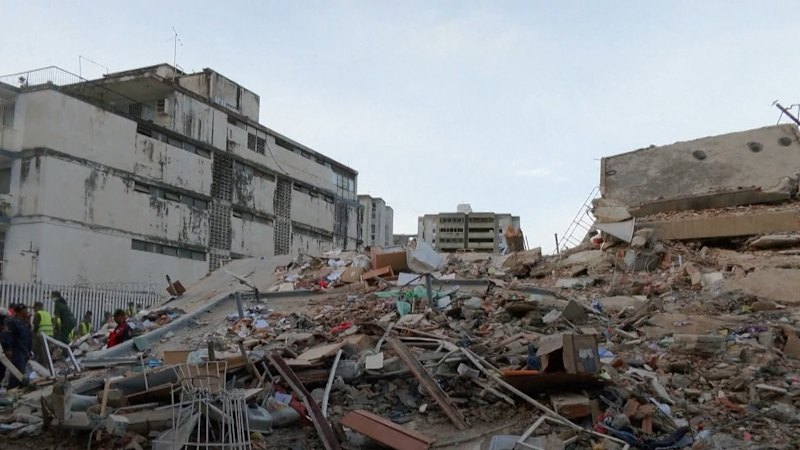
In the Altamira neighborhood, a 22-story residential tower collapsed completely into a mountain of pulverized concrete and twisted steel. Eyewitnesses described a massive cloud of dust and smoke that instantly blinded survivors attempting to flee down shattered stairwells. In southeastern Caracas, entire clusters of multi-story apartment buildings suffered total structural failure. Buildings that managed to remain upright had their ground-level columns sheared completely through, leaving them tilting precariously over debris-strewn avenues.
Interior Minister Diosdado Cabello confirmed that rescue teams are facing an alarming situation. The immediate suspension of the Caracas Metro and a government-ordered shutdown of the city's main gas lines prevented secondary infernos, but it also plunged the capital into a logistical standstill. Emergency vehicles are forced to navigate roads blocked by toppled electrical poles and heavy masonry, while thousands of residents remain on the streets, clutching pets and children, terrified to return to standing structures as aftershocks continue to rattle the valley.
Disaster at the Coast
The situation is arguably worse on the other side of the Avila mountain range in the coastal state of La Guaira. Designated an official disaster zone by Acting President Delcy Rodríguez, La Guaira saw more than 100 buildings collapse within minutes of the mainshock.
Crucially, the disaster has severed Venezuela's primary umbilical cord to the outside world. Simón Bolívar International Airport, located in Maiquetía, sustained severe structural damage to its terminals and runways. All commercial and humanitarian flights have been canceled indefinitely, preventing standard airborne relief missions from landing directly outside the capital.
Hospitals across north-central Venezuela are overwhelmed, functioning on intermittent backup generators with severely depleted stockpiles of trauma medication, surgical sheets, and clean water. The National Headquarters of the Venezuelan Red Cross reported critical damage to its own infrastructure, hobbling local medical response teams at the exact moment their services are most desperately needed.
The Geometry of Rescue
International aid is beginning a frantic, logistically complex mobilization. Because the main airport is closed, rescue missions must rely on alternative staging grounds and maritime routes.
The United States has offered full assistance, with Secretary of State Marco Rubio announcing the immediate deployment of search and rescue teams alongside medical resources. Regional neighbors are moving rapidly; Brazil is dispatching a KC-390 military transport aircraft filled with 36 urban search rescue specialists, risk assessment teams, and nine tons of emergency equipment. A secondary Brazilian flight is scheduled to bring a mobile field hospital and solar-powered water purifiers. The Colombian Red Cross has mobilized its own disaster response units, preparing to move across the land border into western Venezuela.
Yet, the window for pulling survivors from the rubble is closing fast. Urban search and rescue operations are inherently tethered to the "golden 48 hours," after which the survival rate for trapped individuals drops exponentially.
The ultimate lesson of Yaracuy is an old, brutal one. Earthquakes do not kill people; weak infrastructure does. Until the deep, systemic deficits in regional building code enforcement, emergency grid redundancy, and public medical infrastructure are addressed, the cities of northern Venezuela remain acutely vulnerable to the inevitable movements of the fault lines beneath their feet.