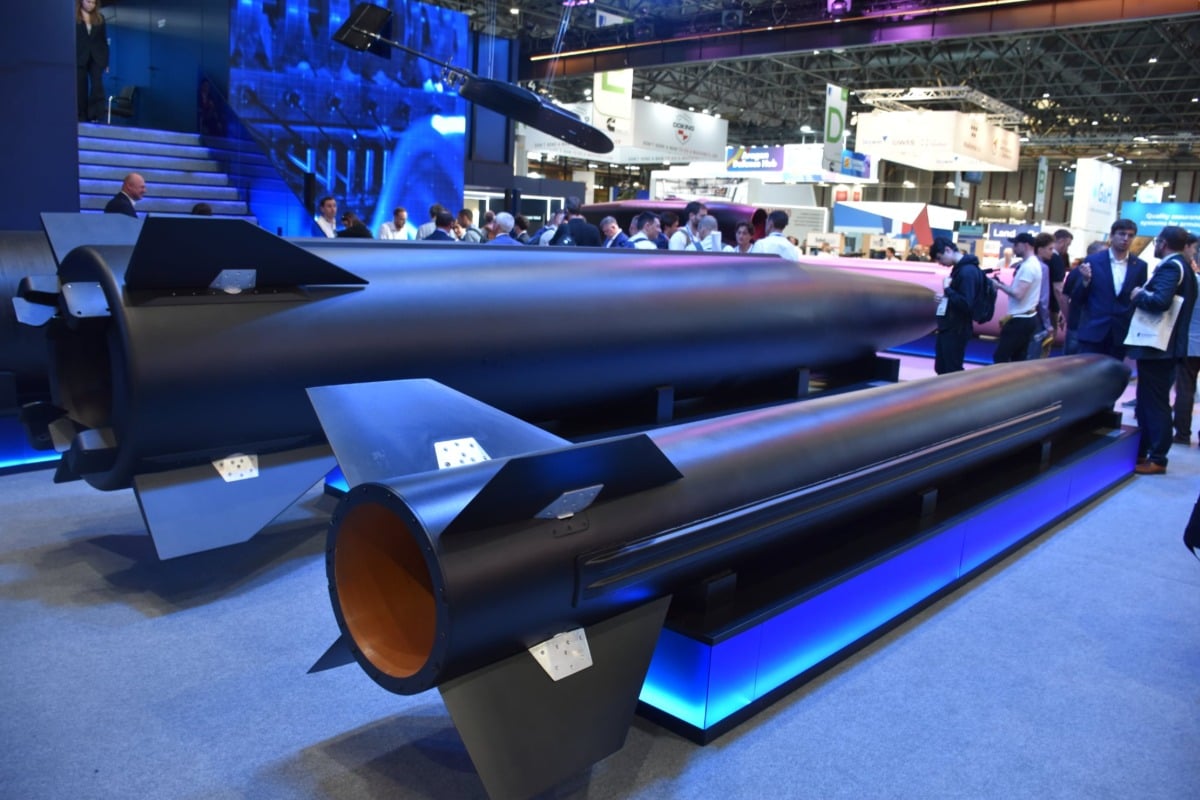
Kyiv is finalizing a weapon that changes every calculation in the Kremlin. For months, international observers tracked Ukraine’s drone strikes on Russian oil refineries, but a far more potent threat has quietly moved from the testing grounds to the assembly lines. The 1KR1 Sapsan, a domestically produced short-range ballistic missile system also known as the Hrim-2, is entering active operational deployment. With a strike range now pushing past 500 kilometers and potentially reaching up to 700 kilometers in its optimized domestic configuration, this platform places Moscow directly within the crosshairs of Ukrainian commanders. Kyiv no longer needs to beg Western capitals for permission to strike deep inside Russian territory. They built their own solution.
The strategic equation shifted the moment President Volodymyr Zelenskyy confirmed the successful combat testing and serial production of an indigenous ballistic system. For three years, Washington and Berlin tightly rationed long-range weapons like ATACMS and Taurus missiles, paralyzed by the fear of cross-border escalation. By funding and reviving a dormant Soviet-era aerospace legacy, Ukraine bypassed the diplomatic red tape entirely. This is not a slow-moving, easily jammed propeller drone. It is a solid-propellant ballistic missile that drops from the upper atmosphere at speeds exceeding Mach 5, leaving air defense systems like the S-400 with mere seconds to react.
The Saudi Funding and the Soviet Ghost
The story of the Sapsan does not begin in the current conflict. It begins in the skeletal remains of the Soviet defense apparatus. Following the collapse of the Soviet Union, Ukraine inherited the Yuzhnoye Design Office (KB Pivdenne) and the Pivdenmash manufacturing plant in Dnipro. These facilities once built the world’s most terrifying intercontinental ballistic missiles, including the SS-18 Satan. Yet, for decades, independent Ukraine lacked the capital to maintain these aerospace giants, leaving advanced missile designs gathering dust on secure servers.
Money arrived from an unexpected quarter. In 2016, Saudi Arabia sought a tactical ballistic missile to counter regional threats and signed a 40-million-dollar research and development contract with Ukraine. The kingdom funded the initial prototypes of the export variant, dubbed Hrim-2, which was artificially limited to a 280-kilometer range to comply with international export controls. When Russian tanks crossed the border in 2022, the Ukrainian government quietly seized the asset. They took the Saudi-funded blueprints, stripped away the export restrictions, and retooled the system for national survival.
Retooling an aerospace supply chain under constant bombardment is an extraordinary engineering feat. Russian intelligence understood the danger of the Sapsan early on. Throughout 2024 and 2025, the Russian Ministry of Defence repeatedly claimed to have destroyed manufacturing workshops in Dnipro and Kharkiv using Khinzhal hypersonic missiles. They failed to halt the project. Ukrainian authorities decentralized the entire production network, scattering component manufacturing into underground bunkers, subterranean concrete vaults, and masked civilian industrial sites spread across western Ukraine.
Engineering Death at Mach 5
To understand why the Sapsan terrifies Russian military planners, one must look at the physics of ballistic flight. A standard long-range attack drone takes hours to trundle toward a target, buzzing loudly enough to be picked up by basic acoustic sensors. A ballistic missile climbs into a steep parabolic arc, cutting through the thin air of the upper stratosphere before screaming downward toward its target.
The Sapsan utilizes a advanced single-stage solid-propellant motor. Solid fuel is stable, requiring none of the volatile, time-consuming fueling procedures associated with older liquid-fueled systems like the Scud. A Sapsan launcher can sit hidden in a dense forest for weeks, elevate its twin launch canisters, fire, and drive away within five minutes. This capability renders counter-battery radar useless. By the time Russian reconnaissance drones spot the launch flash, the ten-wheeled heavy transporter-erector-launcher is already kilometers away, melting back into civilian traffic.
The payload is equally devastating. The Sapsan carries a 480-kilogram warhead, more than double the explosive mass of an American-supplied MGM-140 ATACMS. The warhead can be configured as a single massive high-explosive fragmentation charge to punch through hardened underground command bunkers, or filled with cluster submunitions to wipe out entire military airfields. When combined with an inertial navigation system augmented by jam-resistant satellite tracking, the missile achieves a circular error probable of under 50 meters. Moscow's air defenses face a structural crisis.
The Moscow Dilemma and Western Friction
The true target of this weapon is not merely military infrastructure; it is the political willpower of the Russian elite. For years, the civilian population of Moscow experienced the war as a distant television spectacle, occasionally interrupted by minor drone debris scratching a skyscraper in the business district. The Sapsan destroys that illusion of safety.
A missile launched from the safety of Ukraine’s northern Chernihiv region requires less than six minutes to strike the center of the Russian capital. This reality creates immense strategic leverage for Kyiv, but it also sparks quiet panic in Western diplomatic circles. Behind closed doors, officials in the White House express deep anxiety that a massive ballistic strike on Moscow could prompt a catastrophic response from the Kremlin. Ukraine’s leadership remains unmoved by these warnings. They argue that Western hesitation forced their hand.
The geopolitical consequences are immediate. By achieving self-sufficiency in ballistic missile production, Ukraine breaks the monopoly that Western donors held over its military strategy. Kyiv can now target the logistical spine of the Russian war machine: the assembly plants in Izhevsk, the ammunition depots in Voronezh, and the command centers controlling the occupation forces. The Sapsan gives Ukraine the one thing the West consistently denied it: a true strategic deterrent.
The production numbers are accelerating. Reports indicate that a significant multi-billion-euro defense package provided by European partners, specifically earmarked for domestic manufacturing, has allowed Ukrainian factories to scale up output. The goal is no longer to build a few showcase weapons for propaganda purposes. The objective is regular, sustained mass production.
Air defense networks across western Russia are scrambling to adapt. Moving battery units from the front lines to protect Moscow weakens the protection over critical supply hubs, while leaving the capital vulnerable invites a political disaster for the Russian leadership. Ukraine has successfully forced its adversary into an impossible choices. The weapon is ready, the launchers are moving, and the maps in the war rooms of Kyiv have a new, definitive target circle.