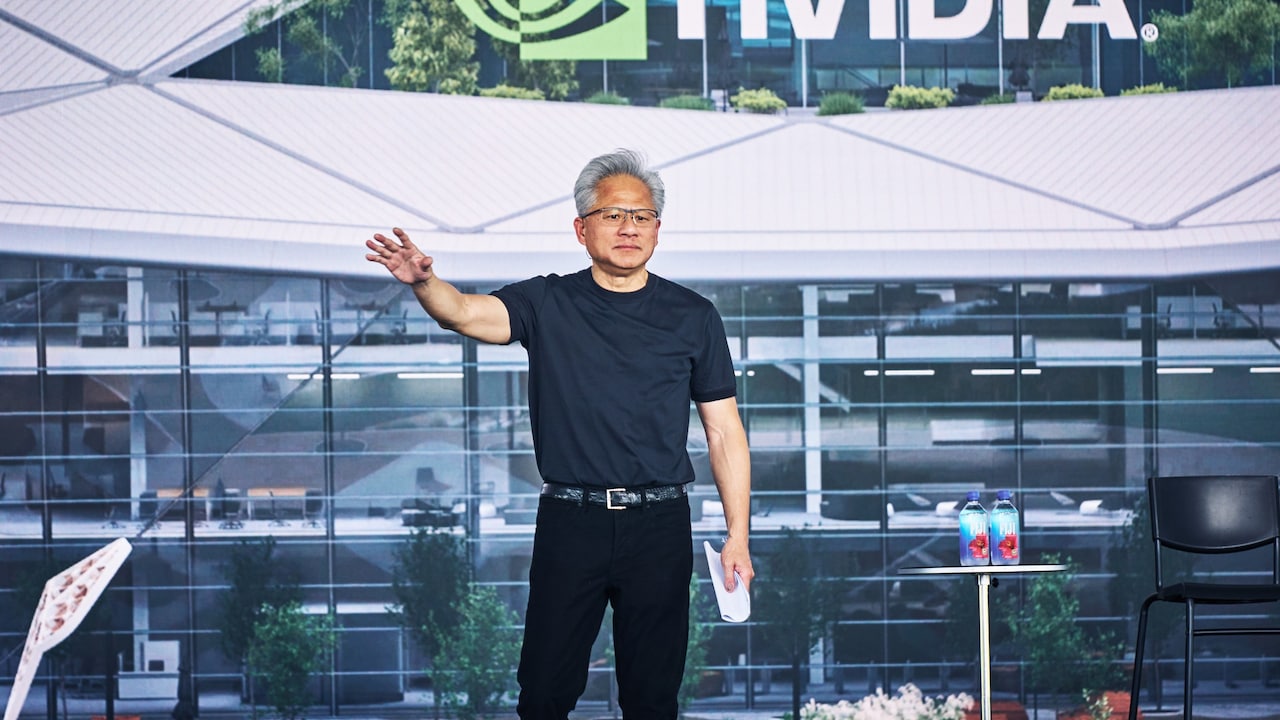
Tech executives want you to change how you live so their software can keep growing. During a June 2026 factory expansion event in Sherman, Texas, Nvidia chief executive Jensen Huang argued that society needs to establish entirely new social norms to accommodate the widespread deployment of artificial intelligence. His message was unmistakable. Rather than modifying the technology to fit human comfort, humanity must alter its habits to fit the technology. This strategy shifts the burden of adaptation onto the public, protecting a five-trillion-dollar market valuation while treating the displacement of human labor and massive energy consumption as mere speed bumps.
The corporate playbook here is ancient. When automobiles first arrived on American streets, they killed pedestrians at horrifying rates. The automotive industry did not slow down production. Instead, it lobbied to criminalize walking in the middle of the street, inventing the crime of jaywalking and forcing pedestrians onto sidewalks. Huang used this exact historical example to justify the disruption caused by automated systems. He recalled playing in the streets as a child and noted that when cars arrived, that norm had to end.
The analogy is telling. It acknowledges that human safety and public space were sacrificed to clear a path for corporate machinery.
The Trillion Dollar Shield Against Backlash
The call for new behavioral standards arrives at a moment of deep economic anxiety. Public opposition to sprawling data centers is mounting, driven by concerns over strained electrical grids and sudden workplace layoffs. By telling the public to simply go engage with the software, tech leaders attempt to reframe systemic economic threats as personal failures of adaptation.
The financial stakes explain the urgency of this public relations campaign. Nvidia sits atop a historic concentration of wealth, heavily supported by infrastructure spending from firms like OpenAI and Anthropic. If public resistance slows the construction of power plants or forces aggressive labor protections, that financial tower shakes.
Nvidia Market Capitalization (2026): ~$5,000,000,000,000
Estimated Milestone for OpenAI/Anthropic Public Value: $1,000,000,000,000 each
To preserve this valuation, the industry must convince workers that learning to prompt a chatbot is an equalizer. Executives argue that the ability to generate a website or analyze a document without writing code closes the technological divide. This perspective assumes that a worker replaced by an automated system can simply become the manager of that system, ignoring the reality that one manager requires far fewer hours of paid labor than a team of creators.
The Regulatory Capture Game
Behind the scenes, a quiet battle over government intervention is playing out in Washington and Silicon Valley. While some tech figures have called for sweeping federal agencies to oversee algorithmic safety, others view these demands as a calculated move to lock out competition.
When a dominant corporation asks for stricter rules, it often hopes the compliance costs will crush smaller startups that cannot afford legal teams. This dynamic represents a classic corporate strategy.
- Incumbents use complex rules to build a moat around their market share.
- Startups get starved of capital because they cannot meet compliance standards.
- The Public receives an illusion of safety while choices disappear.
The debate has even touched unusual proposals, including ideas mused about by political figures to have the federal government take equity stakes in leading automation firms to distribute windfalls to citizens. Industry leaders reject this approach. They argue that public investment already exists through retirement portfolios and stock ownership, and that corporate profits yield taxes that fund infrastructure. Yet, this argument glosses over the reality that stock ownership is heavily concentrated among the wealthiest households, leaving the average displaced worker with little cushion when an algorithm takes over their duties.
The Grid Crisis Nobody Wants to Face
The most immediate barrier to the corporate vision is physical, not social. The massive computational arrays required to train and run these models are colliding with the limits of the American energy grid.
Building a digital infrastructure requires massive amounts of copper, steel, and, above all, electricity. The United States is starting from a structural disadvantage, possessing an aging power grid that was never designed for the continuous, high-density load of modern data centers.
To bypass this bottleneck, some technology firms are planning to build private power plants directly adjacent to their server farms. While this secures their operational needs, it isolates vast amounts of energy generation from the public grid, potentially driving up utility costs for surrounding communities. The industry is racing to develop hardware that minimizes this drain, such as advanced data-transmission lasers designed to cut chip-to-chip power consumption by half. Even with these efficiency gains, the net demand for electricity continues to outpace new clean energy production.
Adapting to the Digital Sidewalk
If society is forced to build the modern equivalent of sidewalks for automation, the changes will look far different than concrete curbs. The new boundaries are already taking shape in employment contracts, intellectual property laws, and daily workplace expectations.
Workers face a stark choice. They can resist the integration of automated tools and risk being replaced by cheaper, algorithmic alternatives, or they can become supervisors of the software, accelerating the optimization of their own fields. The path forward requires looking past the optimistic rhetoric of corporate leaders and understanding that technology is never neutral. It reshapes the landscape to benefit the entities that control the infrastructure. Humanity is not just adopting a tool; it is reorganizing its communities, its legal systems, and its daily routines around the requirements of the silicon chip.