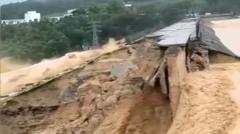
The failure of the Liulan Reservoir dam wall in Hengzhou, Guangxi, on July 6, 2026, exposes a critical vulnerability in infrastructure design: the miscalculation of compounding meteorological variables. When Typhoon Maysak decelerated from a wind-dominant tropical system into a slow-moving, precipitation-heavy low-pressure cell, it transformed into a highly efficient mechanism for extreme water delivery. By dropping historic volumes of moisture over saturated catchments, the storm triggered a classic failure cascade across southern China. Standard disaster reporting views these incidents as isolated, tragic anomalies. A rigorous engineering and economic analysis reveals them as predictable outcomes of infrastructure age exceeding historical climate baselines.
Evaluating the structural breach requires an understanding of how hydraulic forces interact with aging earthen and concrete masonry structures. Built in 1960, the Liulan Reservoir manages a maximum volumetric capacity of 95.52 million cubic meters. The engineering failure sequence under extreme precipitation operates across three distinct mechanical phases.
The Three Phases of Reservoir Overtopping
- Catchment Saturation and Inflow Surges: As a tropical storm moves inland and weakens, its convective bands drop continuous precipitation over a geographic basin. If preceding storms have already driven the soil moisture content to 100% field capacity, the entire volume of subsequent rainfall converts immediately into surface runoff. Inflow rates outpace designed spillway discharge capacities.
- Hydrostatic Pressure Escalation: As the volumetric level within the reservoir approaches and surpasses the maximum pool elevation, the hydrostatic pressure exerted on the upstream face of the dam increases exponentially. For every meter of water level increase, the horizontal force per unit length grows proportionally to the square of the depth.
- Erosive Overtopping and Structural Breach: When water breaches the crest of an earthen or composite dam wall, it shifts from static containment to dynamic kinetic energy. As fluid spills over the downstream face, the shear stress of the rushing water detaches soil and aggregate particles. This process initializes headward erosion, slicing a notch into the dam wall that widens rapidly under the force of the escaping reservoir pool, culminating in a total structural blowout.
Structural Depreciation vs. Hydrological Shifts
The collapse of a 66-year-old asset highlights the systemic risk of compounding design-life degradation. Dams constructed in the mid-20th century were engineered using empirical hydrological models that assumed weather patterns would remain stationary over time. This baseline assumption is no longer valid. The structural integrity of these containment systems is continuously eroded by a dual-variable problem.
[Historical Baseline Engineering Assumptions]
                      │
                      ▼
 ┌──────────────────────────────────────────┐
 │ Static Meteorological Variable Models    │
 └────────────────────┬─────────────────────┘
                      │  Intersects with
                      ▼
 ┌──────────────────────────────────────────┐
 │ Mechanical Depreciation (60+ Year Asset) │
 └────────────────────┬─────────────────────┘
                      │  Yields
                      ▼
 ┌──────────────────────────────────────────┐
 │ Catastrophic Systemic Failure Potential  │
 └──────────────────────────────────────────┘
The first variable is internal mechanical depreciation. Over six decades, infrastructure suffers from internal erosion (piping), concrete carbonation, alkali-silica reactions, and spillway gate degradation. Without capital-intensive rehabilitation, the nominal load-bearing capacity of the barrier trends downward.
The second variable is the shifting intensity of regional weather. The atmospheric moisture-holding capacity increases by roughly 7% for every 1°C of warming, a thermodynamic principle governed by the Clausius-Clapeyron relation. Consequently, convective storm systems now routinely drop rainfall volumes that exceed the 100-year or 500-year flood thresholds used in original engineering blueprints. When a degraded asset with a reduced safety margin meets an upgraded storm system delivering unprecedented volume, the mathematical result is structural failure.
Downstream Micro-Economic Shocks
The immediate physical consequence of a reservoir breach is a high-velocity flood wave that propagates downstream, disrupting local economic engines. In the Nanning and Guigang municipal corridors, the impact surfaces across specific operational vectors.
Industrial and Construction Inundation
Flash flooding converts active construction zones and industrial sites into immediate liabilities. When floodwaters submerge active projects, the economic damage extends far beyond ruined materials. Mud and debris siltation ruins foundational work, fouls heavy machinery, and requires extensive environmental remediation before operations can resume. This causes long-term project delays, triggers contractual penalty clauses, and inflates commercial insurance premiums across the sector.
Logistics Bottlenecks and Civil Disruption
Urban centers like Nanning face systemic logistics failures when street-level flooding submerges commuter and transport vehicles. As water levels rise to submerge municipal roadways, the transport of goods, components, and labor grinds to a halt. The halting of cross-border railway infrastructure in Guangxi cuts off critical trade links, severing manufacturing supply chains between southern China and Southeast Asian markets.
The Agricultural Capital Drain
The geography surrounding major river basins contains prime agricultural assets. When a dam breaches, the resulting surge strips topsoil, drowns standing crops, and destroys rural storage infrastructure. The economic blow is two-fold: an immediate loss of current-season yield and a long-term capital drain as farmers reinvest to restore soil health and rebuild damaged equipment.
The Compound Threat Horizon
Managing infrastructure risks requires examining upcoming weather patterns on a broader horizon. Even as regional emergency teams deploy assets to stabilize breaches across Guangxi, the arrival of Super Typhoon Bavi in the Pacific introduces a distinct risk factor: the compound hazard sequence.
When a geography experiences a secondary extreme weather event within days of an initial disaster, the risk profile does not simply double; it multiplies. The first storm, Maysak, has already fully saturated the regional drainage basins, filled surviving reservoirs to capacity, and disrupted localized emergency supply networks. Under these conditions, the defensive capability of the regional landscape is zeroed out.
If Super Typhoon Bavi dumps high-volume precipitation onto this primed landscape, even minor storms can trigger major flooding. Spillways already running at maximum capacity will have no buffering volume left to capture new inflows. Emergency management teams are forced into a difficult optimization problem: they must preemptively discharge water from vulnerable dams to prevent catastrophic failure, even if those tactical releases worsen downstream urban flooding.
Systemic Risk Management Strategies
Confronting this changing infrastructure landscape requires shifting away from reactive crisis response toward predictive asset hardening. Municipal planning departments and infrastructure funds must deploy systematic, data-driven frameworks to mitigate risks before failure occurs.
First, engineering teams must implement continuous, real-time telemetry across aging water management networks. Relying on periodic physical inspections introduces dangerous information gaps. Deploying IoT-connected piezometers, tilt sensors, and automated water-level gauges allows engineers to monitor internal pore pressure and structural shifting as it happens. This real-time data feeds predictive algorithms that can spot a potential piping failure or structural compromise hours before a physical breach occurs, giving downstream populations critical evacuation lead time.
Second, the baseline metrics used to calculate spillway capacity require a complete overhaul. Regulatory bodies must retire historical weather datasets in favor of dynamic climate models that incorporate changing atmospheric moisture trends. Spillway structures on high-consequence dams must be widened, reinforced, or outfitted with auxiliary fuse plug spillways to handle extreme precipitation events.
Finally, economic planners must decouple critical supply chains from single points of failure. When key transport nodes or industrial clusters depend on a single aging protection barrier, the entire economic ecosystem is at risk. Building structural redundancy into regional transport networks, establishing secondary logistics pathways, and mandating localized flood defenses for industrial assets are essential strategies to ensure business continuity when upstream containment fails.
Emergency Management Drone Briefing
This video provides a field-level look at the immediate rescue response and drone operations deployed to navigate the severe flooding caused by Typhoon Maysak across the region.