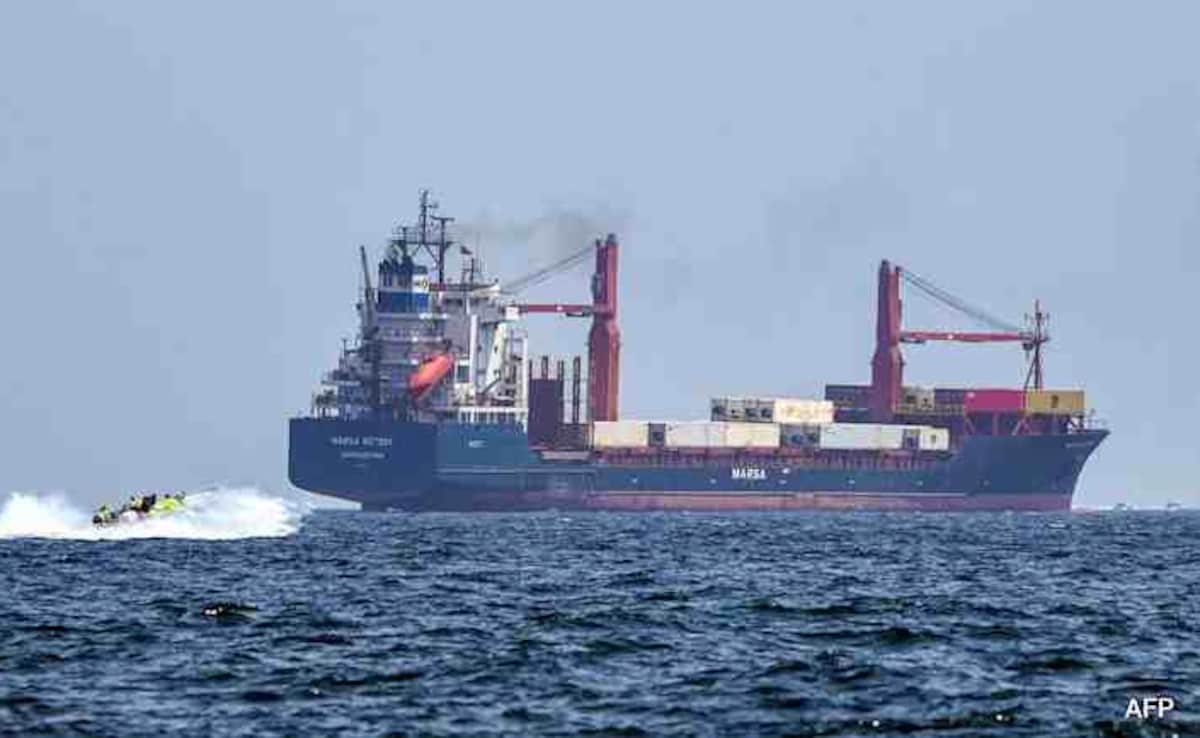
The headlines are screaming about 1,900 ships "stranded" and 20 vessels under fire. They want you to believe the global economy is one drone strike away from a total cardiac arrest. They want you to panic.
Most analysts see a choke point. I see a massive, expensive game of chicken where the biggest loser isn't the consumer—it's the credibility of traditional naval power. If you found value in this article, you might want to read: this related article.
The narrative being pushed by Navy chiefs and defense contractors is built on a fundamental misunderstanding of modern logistics. They are counting hulls. They are tallying historical "attacks." What they aren't telling you is that the maritime industry has already priced in this chaos, and the "stranding" of 1,900 ships is less a catastrophe and more a high-stakes tactical pause that benefits the largest players in the room.
The Mathematical Illusion of the Stranded Fleet
When a Navy official says 1,900 ships are stranded, your brain pictures a parking lot of rusting iron. That is not what is happening. For another perspective on this story, refer to the recent coverage from MarketWatch.
The reality is a shift in Operating Expenses (OpEx) versus Risk Premiums. A ship isn't "stranded" if its owners are currently negotiating a 300% increase in freight rates because of the "crisis." For the major carriers, a bottleneck in the Strait of Hormuz is the best thing to happen to their balance sheets since the post-pandemic surge.
Let’s look at the actual physics of the strait. It’s roughly 21 miles wide at its narrowest point. The shipping lanes are only two miles wide in each direction, separated by a two-mile buffer. Yes, it’s tight. But it’s not a wall.
The "stranding" is largely a voluntary halt by companies waiting for insurance rates to stabilize. By framing it as a military crisis rather than a commercial insurance negotiation, the media provides cover for carriers to jack up prices. We’ve seen this play out in the Red Sea, and we’re seeing it here. The "crisis" is a pricing mechanism.
Why 20 Attacks Mean Almost Nothing to Global Trade
Twenty ships attacked sounds like a war zone. In a vacuum, it is. But let's look at the scale.
Around 80,000 ships transit through these types of high-risk corridors annually. A 0.025% hit rate is a tragedy for the crew involved, but it is a statistical rounding error for global trade. If you managed a factory and your "failure rate" was 0.025%, you’d get a bonus.
We have been conditioned to view maritime security through the lens of WWII-era convoy protection. We think in terms of "sinking" versus "floating." Modern asymmetric warfare—using $2,000 drones to harass $200 million tankers—isn't trying to sink the fleet. It's trying to sink the reputation of the Navy's ability to provide a "global commons."
The real disruption isn't the physical damage; it's the data. When an attack happens, the Automatic Identification System (AIS) data goes haywire. Algorithms used by commodity traders trigger "buy" signals on oil futures. The volatility is the product. The 20 ships are just the marketing budget.
The Navy Chief’s Conflict of Interest
Why is the Navy Chief sounding the alarm so loudly? Because a quiet Hormuz means a smaller budget.
There is a long-standing "lazy consensus" that only a massive, carrier-group-led presence can keep these waters open. I’ve watched defense budgets balloon every time a speedboat gets too close to a destroyer.
The Navy’s problem is that their $13 billion carriers are effectively being held hostage by cheap, land-based missiles and swarm tactics. By emphasizing the "1,900 stranded ships," they are justifying the continued investment in legacy hardware that is increasingly irrelevant in narrow-water skirmishes.
They are solving a 21st-century problem with a 20th-century mindset. The solution to Hormuz isn't more destroyers; it's the radical decentralization of energy and the total automation of the "ghost fleet."
The Counter-Intuitive Truth: We Need the Bottleneck
Here is the take that will get me banned from the boardroom: The global supply chain is too efficient for its own good.
For decades, "Just-in-Time" manufacturing has relied on the assumption that the oceans are a free, frictionless conveyor belt. They aren't. They are a geopolitical chessboard.
The Hormuz "crisis" acts as a necessary stress test. It forces companies to:
- Diversify Sourcing: If you can’t get your components through the strait, you start looking at Mexico, Eastern Europe, or domestic options.
- Increase Inventory Buffers: The death of "Just-in-Time" is a good thing for long-term stability.
- Invest in Alternative Routes: Whether it’s pipelines across the Arabian Peninsula or the "Middle Corridor" rail lines, the Hormuz threat is the primary driver of infrastructure innovation.
Without these periodic shocks, the global economy becomes a brittle, over-optimized mess. We need the threat of the blockade to prevent us from becoming entirely dependent on a single, vulnerable geographic point.
Stop Asking if the Strait is Open
The question isn't "Is the Strait of Hormuz safe?" The question is "Why does your business model collapse if it isn't?"
If your margins are so thin that a 10% increase in shipping costs or a two-week delay ruins your year, you don't have a shipping problem—you have a math problem.
The "People Also Ask" sections of the internet are obsessed with "When will Hormuz be safe?" and "Will oil hit $150?" These are the wrong questions. You should be asking how to build a business that thrives on the volatility of these choke points.
The Strategy for the New Era
I’ve seen companies spend millions on "logistics consultants" who just tell them to buy more insurance. That’s a coward’s move.
If you want to win in this environment, you stop looking at the Navy's map. You start looking at the Insurance-to-Value (ITV) ratios. You look at the "dark fleet"—the thousands of tankers operating outside Western sanctions and insurance circles. They aren't "stranded." They are moving oil right now, under the radar, while the "1,900 ships" sit and wait for a press release.
The maritime "status quo" is a fiction maintained for the benefit of stakeholders who profit from fear. The vessels aren't stuck; they are waiting for the most profitable moment to move.
Stop waiting for the Navy to "solve" the Strait. They can’t. The ocean is too big, the drones are too cheap, and the political will is too thin. Instead, accept that the "global commons" is dead. We are entering an era of "Marital Law" on the high seas, where safety is a premium service, not a right.
If you’re still waiting for a return to 2019 levels of maritime stability, you’re not just a romantic; you’re a target. The bottleneck isn't in the water. It’s in your refusal to adapt to a world where the choke point is the permanent state of affairs.
Burn your "Just-in-Time" manual. Build a buffer. Or get comfortable watching your cargo rot while a Navy Chief uses your loss to ask for another billion dollars.
The ships aren't stranded. You are.