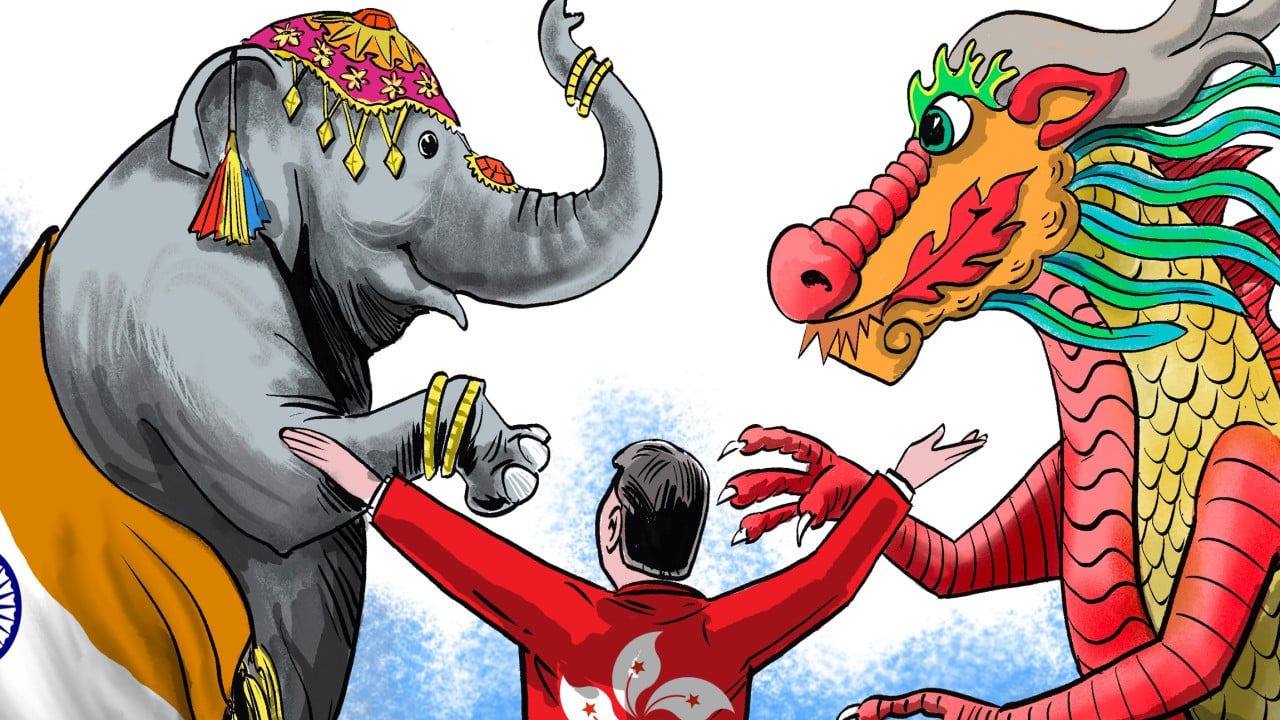
Hong Kong is currently a city searching for a new identity, and its survival as a global financial hub depends on whether it can bridge the widening chasm between Beijing and New Delhi. While the city's leadership focuses on internal integration with the Greater Bay Area, the real economic prize lies in positioning Hong Kong as the indispensable neutral ground for China-India trade. This isn't just about trade figures; it is about providing the legal, financial, and logistics infrastructure that two suspicious superpowers cannot build for themselves.
The math is simple, even if the politics are not. By 2030, the combined consumer markets of China and India will dictate the flow of global capital. Yet, the border between these two giants remains one of the most volatile stretches of land on earth. As New Delhi tightens its grip on Chinese FDI and Beijing looks for ways to bypass Western-controlled financial nodes, Hong Kong sits in a unique, if precarious, sweet spot. The city possesses the common law framework India trusts and the proximity to the mainland that China requires.
If the upcoming five-year policy cycles do not explicitly treat the India-China corridor as a foundational economic pillar, Hong Kong risks becoming a secondary regional port rather than a global arbiter of wealth.
The Trust Deficit as a Market Opportunity
Investigative looks into capital flows show a startling trend. Despite the "de-risking" rhetoric heard in New Delhi, Indian reliance on Chinese intermediate goods—electronics, active pharmaceutical ingredients, and solar components—has never been higher. However, the friction of doing business directly is becoming unbearable. Indian startups face immense scrutiny when taking Chinese venture capital, and Chinese firms are wary of the sudden regulatory shifts in the Indian market.
Hong Kong can act as a "clearing house" for this tension.
The city’s legal system remains its most potent weapon. When an Indian firm enters a contract with a mainland supplier, neither party truly wants to litigate in each other's home courts. By embedding Hong Kong arbitration clauses into these deals, the city provides a safety net that encourages higher trade volumes. This is not a hypothetical advantage; it is the reason why many of the largest cross-border mergers in the past decade were structured through offshore vehicles.
Beyond the Greater Bay Area Tunnel Vision
The prevailing narrative in the Legislative Council is that Hong Kong’s future is entirely tied to the Greater Bay Area (GBA). While the GBA provides a massive manufacturing hinterland, it is a supply-side play. For Hong Kong to maintain its premium, it needs a demand-side play. That demand is India.
India’s digital economy is exploding, but it is capital-hungry. Meanwhile, China has a surplus of capital and a saturated domestic market. The natural bridge should be Hong Kong, yet the current policy focus is disproportionately weighted toward north-bound integration. If the city fails to look West toward the subcontinent, it will find itself competing with Shenzhen and Guangzhou on their terms—a fight Hong Kong cannot win due to its higher cost base.
The city needs to establish dedicated India-desk initiatives within the Office for Attracting Strategic Enterprises (OASES). These shouldn't just be promotional offices; they need to be staffed by specialists who understand the specific tax treaties and repatriation hurdles that currently stymie China-India ventures.
The Fintech Neutral Zone
The most overlooked factor in this relationship is the plumbing of the financial system. Both China and India are leaders in digital payments, yet their systems are largely incompatible. India’s Unified Payments Interface (UPI) and China’s digital yuan (e-CNY) represent two different visions of the future of money.
Hong Kong is the only place on the planet where these two systems could theoretically be bridged. By developing a multi-CBDC (Central Bank Digital Currency) arrangement that includes the mBridge project, Hong Kong can lower the cost of remittances and trade settlement between the two nations. This removes the reliance on the SWIFT system and the US dollar, an objective that aligns perfectly with the long-term strategic goals of both Beijing and New Delhi.
Addressing the Geopolitical Elephant
It would be naive to ignore the border skirmishes in the Himalayas or the diplomatic frost. However, history shows that trade often thrives in the gaps between geopolitical grandstanding. During the Cold War, Hong Kong served as the window to China when the rest of the world was closed off. Today, it must perform a similar feat for India.
India is currently pursuing a "China Plus One" strategy, inviting global manufacturers to set up shop in Chennai or Gujarat. Many of these "Plus One" factories are actually being managed or supplied by Chinese firms. These entities need a neutral, sophisticated financial base to manage their treasury operations. Singapore has been the primary beneficiary of this trend lately, but Hong Kong’s deep liquidity and proximity to the Pearl River Delta give it a natural edge if—and only if—it can shed its reputation for being purely a mainland satellite.
The Talent War and Visa Friction
If Hong Kong wants to be a pillar of the India-China relationship, it has to be a place where Indians and Chinese want to meet. Currently, visa restrictions and a lack of cultural infrastructure for the Indian diaspora are significant hurdles.
The "Top Talent Pass Scheme" has seen a massive influx of mainland professionals, which is good for the city’s demographics but does little to diversify its economic utility. To truly capture the India opportunity, the city needs to aggressively recruit from the Indian Institutes of Technology (IITs) and the Indian Institutes of Management (IIMs).
Creating a seamless corridor for tech talent would allow Hong Kong to become the R&D lab for the next generation of Asian unicorns. Imagine a firm where the hardware is designed in Shenzhen, the software is written in Bengaluru, and the IPO is launched in Hong Kong. That is the only version of the future where Hong Kong remains a Tier-1 global city.
The Infrastructure of Connectivity
Air connectivity between Hong Kong and India's major metros—Mumbai, Delhi, and Bengaluru—remains below pre-pandemic levels. While Cathay Pacific is slowly rebuilding its network, the government needs to incentivize more direct flights and perhaps even "fast-track" business travel permits for Indian entrepreneurs.
Logistically, the Port of Hong Kong must also adapt. As manufacturing shifts toward South Asia, the flow of goods is no longer a one-way street from China to the West. It is becoming a complex web of intra-Asian trade. Hong Kong’s logistics firms need to invest heavily in the "India-Vietnam-China" triangle, providing the tracking and financing tools that small-to-medium enterprises need to navigate this maze.
Reforming the Five-Year Outlook
The upcoming policy addresses must move past the rhetoric of "stability" and toward the reality of "utility." To be useful to the world, Hong Kong must be useful to its neighbors.
The city’s financial regulators should look at creating a specialized "India-China" corridor fund, perhaps backed by the Hong Kong Investment Corporation. This fund could co-invest in joint ventures that utilize Hong Kong’s professional services to scale mainland technologies into the Indian market. It is a high-risk strategy, but it is far more productive than waiting for Western capital to return to its previous levels.
Western institutional investors are increasingly hesitant to put money into the region due to geopolitical tensions. This makes it even more imperative for Hong Kong to tap into the regional wealth of the Global South. The capital is there; the desire for growth is there. What is missing is the trusted intermediary.
Hong Kong has spent decades perfecting the art of being the "middleman." It is time to apply those skills to the most important bilateral relationship of the 21st century. If the city continues to focus solely on its northern neighbor while ignoring the giant to its west, it will have missed the greatest economic realignment of our time.
The window for this pivot is closing. Singapore is not waiting. Dubai is not waiting. Hong Kong must decide if it wants to be a quiet Chinese city or the loud, vibrant, indispensable capital of Asian trade.
Direct the Hong Kong Trade Development Council to host a permanent India-China Industrial Summit, moving it away from a yearly event to a constant, operational hub for deal-making.