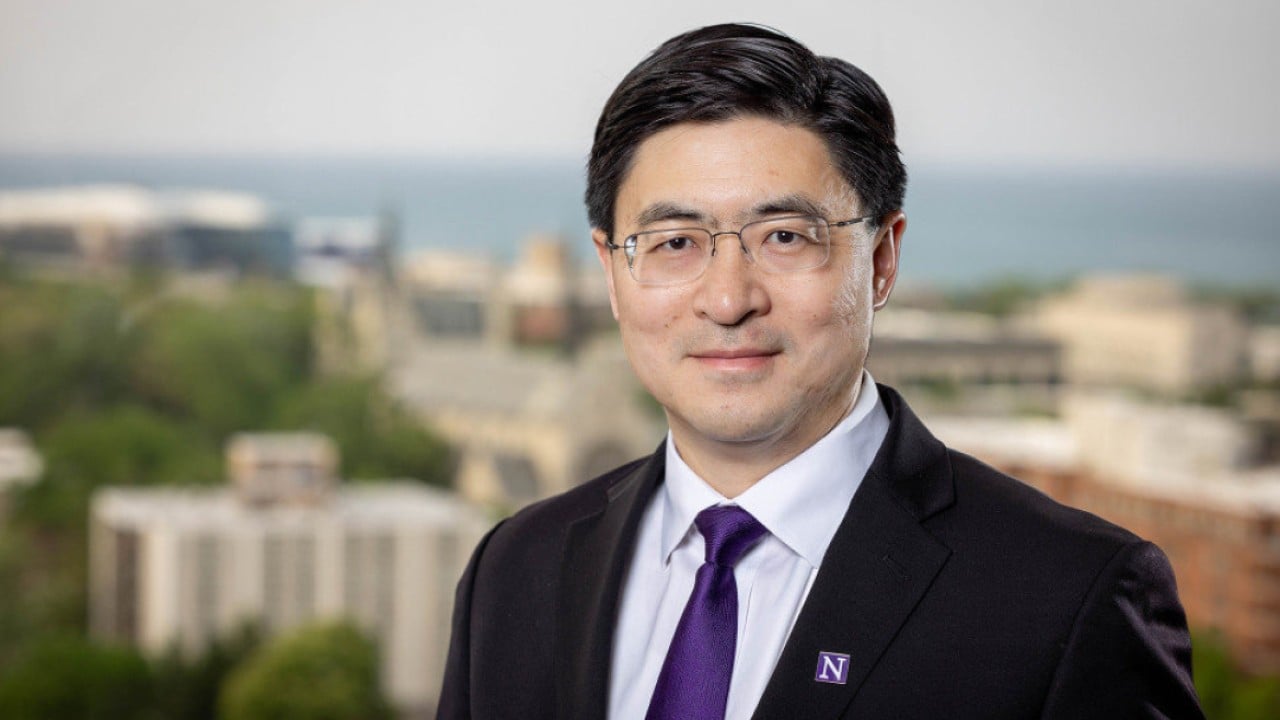
The air inside a Hong Kong examination hall in the late 1990s was heavy, almost suffocating. Thousands of students sat at uniform desks, their futures riding on the scratch of a pen against paper. In this pressure cooker, one name rose to the absolute top. Mung Chiang scored a perfect ten As on the Hong Kong Certificate of Education Examination. In a city that worships academic excellence, he was instantly propelled into a localized form of stardom. He was the "top scorer," a title that carries lifelong prestige in Asia.
Most people assumed his trajectory was set. A comfortable, highly lucrative career in finance or medicine in Hong Kong’s glittering skyscrapers seemed inevitable.
Instead, he packed a suitcase and boarded a flight across the Pacific.
Decades later, that same kid from the exam halls has just been named the next president of Northwestern University. It is an institution with an annual budget measured in billions, a fierce Big Ten athletic legacy, and a reputation as one of the world's premier research hubs. To understand how a young man from Hong Kong became the leader of an American academic empire, you have to look past the dry press releases. You have to look at the invisible stakes of modern global education.
The Weight of the Top Scorer Tag
In Western education, being a straight-A student is commendable. In Hong Kong, it is a cultural phenomenon. Top scorers are interviewed by television crews. Their faces appear on the front pages of newspapers. They are treated like oracle-like figures, asked to give advice to the next generation before they have even lived their own lives.
Imagine the immense psychological pressure of that moment.
When you win the academic lottery at age seventeen, the easiest thing to do is stay put. You stay where everyone knows your name. You accept the local accolades and walk the pre-paved path. But Chiang chose a different route. He chose anonymity. He arrived at Stanford University as just another face in a crowd of global overachievers.
The transition from a rigid, rote-memorization culture to the freewheeling, chaotic innovation of Silicon Valley is a shock to the system. It is a shift from answering questions correctly to figuring out which questions are even worth asking. Chiang didn't just adapt to this new environment; he mastered it. He flew through his undergraduate, master's, and doctoral degrees in electrical engineering at Stanford, transforming from a consumer of knowledge into a creator of it.
By the time he was done, he wasn’t just solving equations. He was rewriting how networks talk to each other.
Decoupling the Ivory Tower
There is a common complaint about academic researchers. We often view them as detached brilliant minds locked away in ivory towers, scribbling complex formulas on chalkboards that have zero relevance to the real world. For a long time, universities tolerated this divide.
But the world changed.
Chiang realized early on that brilliant theory without practical execution is just expensive daydreaming. His research focused on edge computing and optimization shifts in wireless networks. To put it simply: he figured out how to make the invisible digital grid that powers our smartphones and smart cities faster, more reliable, and less prone to crashing under heavy traffic.
Consider what happens when you try to stream a video in a crowded stadium. The network chokes. Chiang’s work helped create the mathematical frameworks that prevent that digital traffic jam.
He didn't just publish papers on the subject. He founded startups. He took his ideas out of the lab and thrust them into the brutal, unforgiving environment of the open market. He holds over twenty patents. This blend of deep-tech intellectual brilliance and raw commercial savvy caught the attention of Princeton University, where he became one of the youngest endowed professors in the institution's history.
He was proving that the modern university president can no longer just be a scholar. They have to be a CEO, a diplomat, and an entrepreneur all at once.
The Purdue Litmus Test
If Princeton was where Chiang refined his academic leadership, Purdue University was where he faced his true trial by fire. When he was appointed dean of Purdue's College of Engineering in 2017, he was stepping into the American heartland. Indiana is a long way from Hong Kong, and it is a long way from the elite coastal bubbles of Stanford and Princeton.
The stakes were massive. The American Midwest was undergoing a massive economic identity crisis, trying to transition from traditional manufacturing to a high-tech future.
Chiang saw the challenge not as a burden, but as a blank canvas.
He championed the rise of the "Silicon Heartland." He was instrumental in bringing massive semiconductor facilities to Indiana, bridging the gap between national security needs, corporate investment, and academic research. He understood a fundamental truth that many academic elites miss: a university must serve as an economic engine for the community surrounding it. Under his watch, enrollment surged, fundraising hit records, and Purdue became a national blueprint for how public universities can drive industrial rebirth.
When Purdue needed a new president to succeed the legendary Mitch Daniels, a former governor known for his fiscal discipline and political clout, they didn't look for a traditional politician. They looked to the engineer from Hong Kong. Chiang took the reins of Purdue in 2023, proving that his leadership style could scale to handle an entire university system.
The Audacity of the Northwestern Move
Then came the call from Evanston, Illinois.
Northwestern University is a different beast entirely. It is a private, elite institution nestled on the shores of Lake Michigan. It possesses a multi-billion-dollar endowment, a world-renowned journalism school, a top-tier business school, and a massive healthcare apparatus. It is also an institution navigating the turbulent waters of modern campus politics, shifting cultural dynamics, and the immense financial pressures of big-time collegiate sports.
To leave a successful, highly stable presidency at a massive public institution like Purdue for the complex, high-wire act of Northwestern is an act of immense professional audacity.
Why do it?
Because the landscape of global higher education is shifting beneath our feet. Universities are facing an existential crisis of faith from the public. People are questioning the value of a degree, the rising costs of tuition, and the ability of these massive institutions to foster true innovation rather than ideological conformity.
Northwestern didn't hire Mung Chiang to keep the seat warm. They hired him because he represents a bridge between distinct worlds. He connects the intense, competitive academic culture of Asia with the entrepreneurial spirit of Silicon Valley and the practical, grounded execution of the American Midwest.
He understands the anxieties of a parent worrying about tuition because he has lived the immigrant journey where education is the ultimate, non-negotiable ticket to a better life. He understands the frustrations of a researcher starved for funding because he spent years fighting for grants in the lab. He understands the demands of a corporate board because he has sat in the founder's chair.
Beyond the Numbers
When the news of his appointment flashed across the screens in Hong Kong, it sparked a quiet wave of pride. To the current generation of students cramming for exams in those same stuffy halls, Chiang’s face is a reminder that the path does not have to be linear. You can start in a highly rigid system, break out of it, and eventually lead one of the most prestigious intellectual institutions in the Western world.
The kid who once stared at an exam paper with the weight of a city's expectations on his shoulders now looks out over a vast campus on the edge of Chicago. The stakes are no longer just about his own report card. They are about steering thousands of young minds through an increasingly volatile world.
The pen has been replaced by the president's gavel, but the relentless drive to solve the problem remains exactly the same.