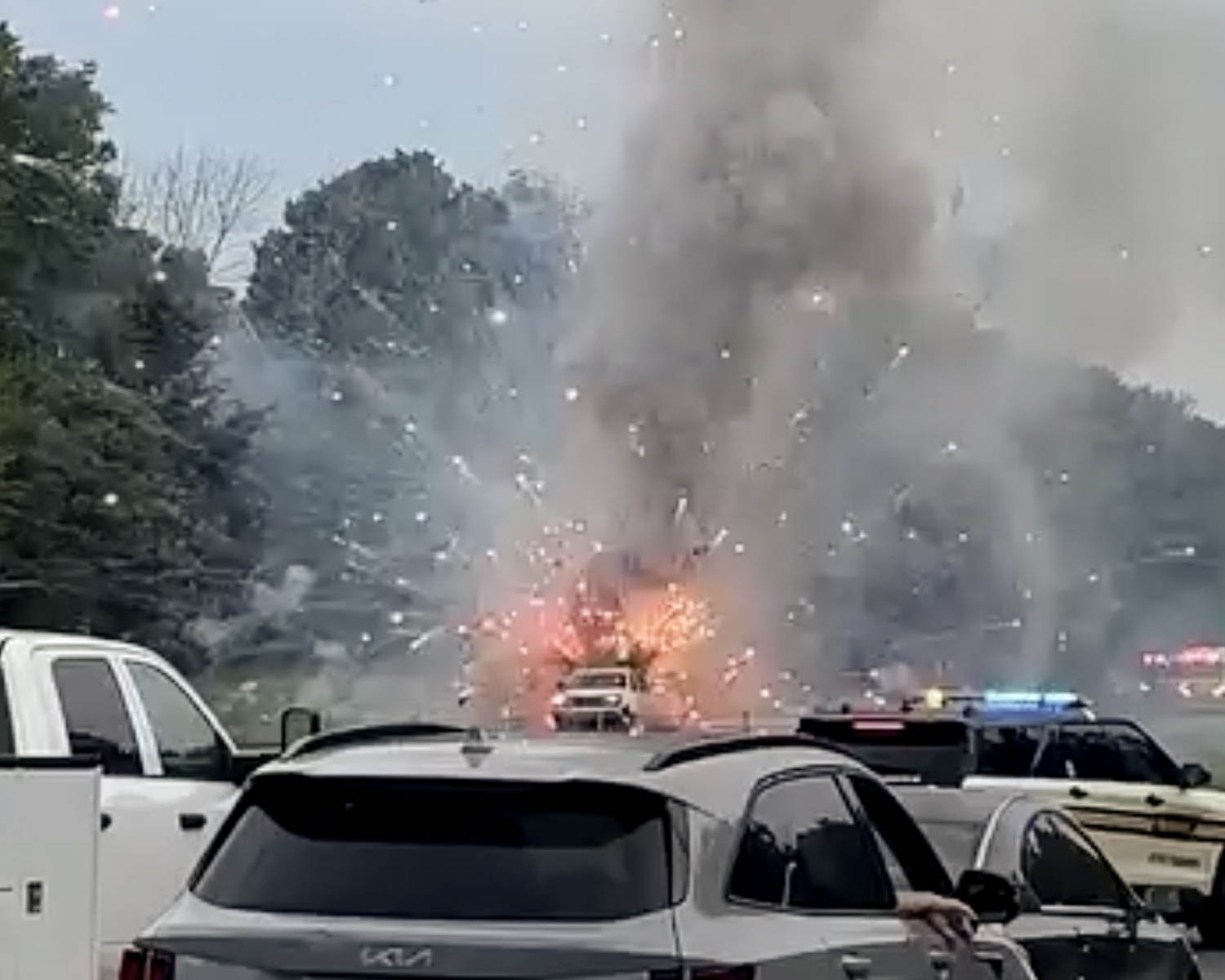
You have probably seen the video by now. A box truck parked on the side of Interstate 75 just north of Chattanooga, completely engulfed in flames. Instead of standard black smoke, the night sky is illuminated by a chaotic, multi-colored display of commercial fireworks shooting sideways across the lanes. Traffic is dead stopped. Mortars are exploding feet from emergency vehicles.
It looks like something out of an action movie. It's the kind of clip that dominates social media algorithms for 48 hours because it is visually spectacular. But if you talk to the emergency crews who actually have to stand in front of a burning trailer filled with class C explosives, they will tell you a completely different story.
When a fireworks transport ignites on a major transit artery like I-75 near Ooltewah, it turns a routine vehicle fire into an unpredictable tactical nightmare.
The Reality Behind The Chattanooga Interstate Fire
On Saturday night, June 6, 2026, the Tri-Community Volunteer Fire Department, alongside Chattanooga Fire and local law enforcement, rolled up to what was initially dispatched as a standard vehicle fire. What they found was a commercial box trailer transformed into a massive, uncontrolled launchpad.
The vehicle was carrying a full cargo load of consumer pyrotechnics. As the heat inside the enclosed space built up, it triggered a chain reaction. Instead of shooting straight up into the air like a choreographed 4th of July show, the projectiles fired horizontally. Mortars, rockets, and Roman candles shot directly across both the northbound and southbound lanes of the highway.
Firefighters couldn't just approach the truck with a hose line. Standard operating procedure for a vehicle fire involves attacking the engine block or cargo bay from a 45-degree angle to avoid bumper blowouts. When the cargo itself is shooting back at you, you have to back off.
"It involved fireworks that were going off in different directions, endangering drivers," the Chattanooga Fire Department noted during the incident response.
The danger to passing motorists forced state troopers and local police to immediately shut down the interstate in both directions. Think about the logistics of that for a second. You have a fire that requires thousands of gallons of water, but the traffic gridlock blocks your access routes. Tri-Community emergency vehicles had to resort to traveling northbound inside the closed southbound lanes just to shuttle water to the scene.
Miraculously, nobody was hurt. The driver got out in time, and the responding crews used the massive traffic backup as a natural safety buffer. The southbound lanes opened up fairly quickly once the initial cook-off subsided, but the northbound side remained closed well into Sunday while crews dealt with the warped, smoldering shell of the trailer.
Why Hauling Fireworks Is A Volatile Math Problem
People assume fireworks are inherently unstable, but modern commercial pyrotechnics are actually remarkably safe under normal transport conditions. They require a direct flame or extreme, sustained heat to ignite. The real issue isn't the stability of the black powder; it's the environment of an enclosed trailer when something else goes wrong.
Most highway fireworks fires start somewhere else on the vehicle. A frozen brake caliper, a blown tire that catches fire due to friction, or a faulty electrical line in the cargo hold are the usual culprits. Once a fire starts inside a sealed aluminum or fiberglass box truck, the ambient temperature skyrockets within minutes.
Consider the physics of a closed cargo container:
- Heat Trapping: The metal walls act like an oven, radiating heat back into the cardboard boxes of inventory.
- Auto-Ignition Thresholds: Consumer fireworks generally require temperatures around 300 to 500 degrees Fahrenheit to ignite. A typical vehicle engine fire easily exceeds 1,500 degrees.
- The Pressure Cooker Effect: In an open-air display, fireworks launch because they are placed inside a heavy mortar tube that directs the energy upward. Inside an enclosed trailer, hundreds of projectiles are firing simultaneously against metal walls, creating unpredictable ricochets and fragmentation.
When you pack thousands of pounds of class 1.4G explosives (the legal designation for consumer-grade fireworks) into a tight space, you aren't just hauling cargo. You are hauling a potential bomb.
The Logistics Nightmare Of A Roadway Detonation
When a standard semi-truck carrying groceries or electronics catches fire, the fire department's primary goal is containment and extinguishment. They get close, breach the trailer doors, and douse the interior.
With pyrotechnics, you cannot do that. Opening the door of a burning fireworks truck introduces a massive wave of oxygen into an already superheated environment. This can cause an immediate flashover or a backdraft explosion that can kill an entire crew.
Instead, firefighters have to establish a massive perimeter and essentially play defense. They protect the surrounding brush, look out for secondary fires started by stray sparks, and wait for the cargo to burn itself out. This is why highway closures for these specific incidents take hours. You cannot tow a vehicle while it is still popping off active ordnance.
The economic fallout of a shutdown like the one on I-75 is massive. That specific stretch of highway is a vital corridor linking Atlanta, Chattanooga, and Knoxville. When you freeze both sides of the interstate on a weekend night, you disrupt supply chains, delay hundreds of commercial shipping rigs, and force local towns like Ooltewah to absorb thousands of rerouted vehicles onto small, two-lane backroads that aren't built for heavy traffic.
What To Do If You Witness A Fireworks Transport Fire
If you are driving and see a truck ahead of you sparking, smoking, or actively shooting off pyrotechnics, your natural instinct might be to slow down and pull out your phone. Don't do that.
First, look for placards. Every commercial vehicle carrying hazardous materials is required by the Department of Transportation to display diamond-shaped hazmat signs. For fireworks, look for the orange diamond with the number 1.4 or 1.3.
Second, clear the area immediately. If you are behind the vehicle, pull over to the shoulder as far away as possible, or take the nearest exit. Do not try to pass a smoking fireworks truck. A single errant shell firing from the side of the trailer can easily smash through your windshield or ignite your own vehicle's fuel line.
Finally, let the professionals handle the aftermath. The cleanup process involves more than just towing the wreckage. Responding agencies have to meticulously sweep the roadway and ditches for unexploded ordnance that cooked off but didn't detonate. A single damp, half-burned mortar shell left in a ditch can easily explode later if a lawnmower hits it or if a curious pedestrian picks it up.
Keep your distance, let the highway patrol manage the gridlock, and remember that what looks like a great viral video is actually a high-stakes hazard for everyone on the road.