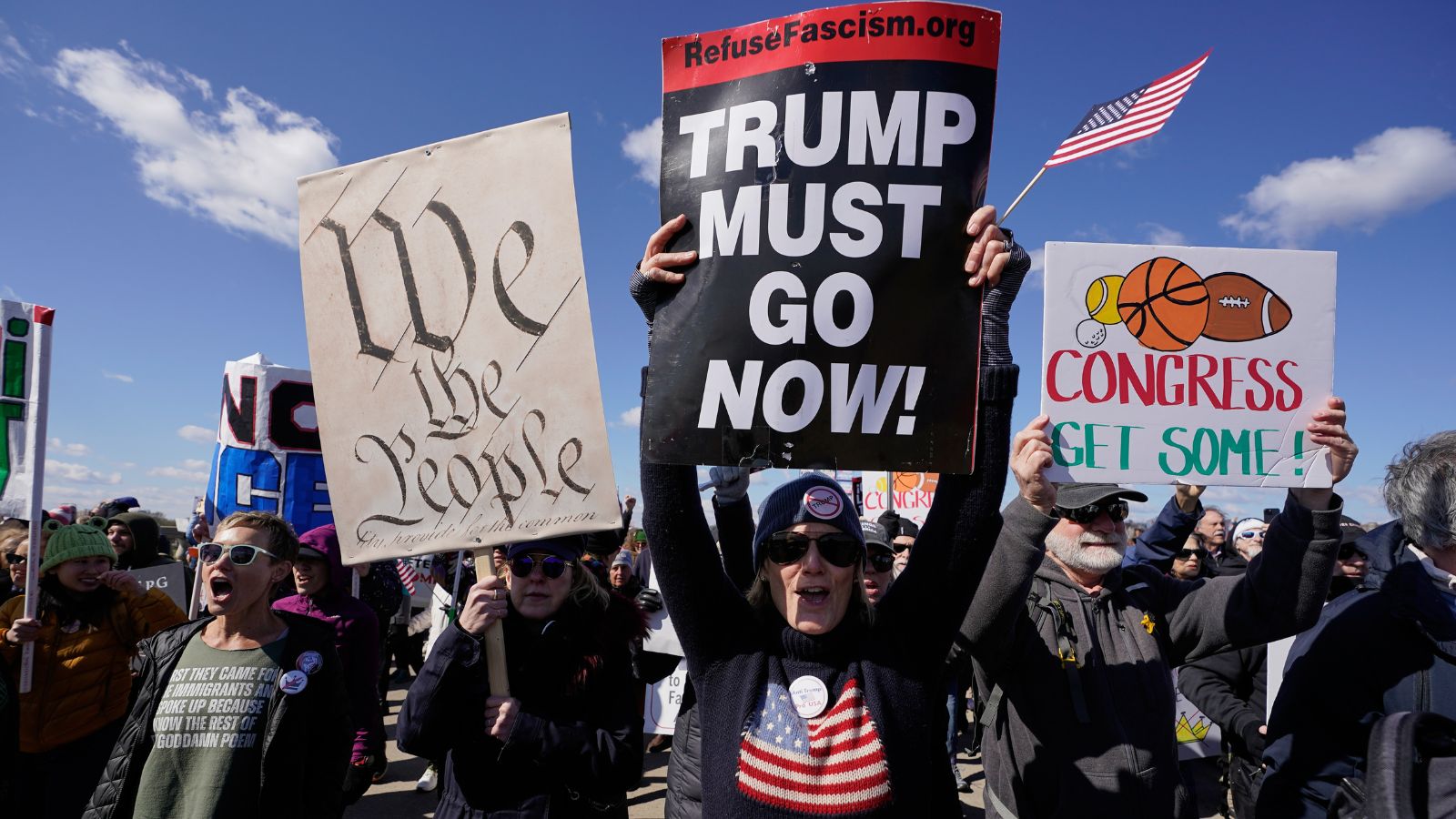
The projected mobilization of 9 million individuals across the American Midwest represents a logistical and socioeconomic anomaly that defies standard protest models. Traditional political demonstrations rely on urban density to minimize the "cost of participation"—the sum of travel time, lost wages, and physical risk. In the heartland, these costs are inherently higher due to geographic dispersion and the potential for economic reprisal in smaller, more tightly knit labor markets. To understand why such a massive demographic is willing to absorb these costs to protest a specific political figure, we must analyze the three structural pillars of this volatility: the collapse of regional institutional trust, the digital feedback loops of non-traditional media, and the "No Kings" doctrine—a fundamental shift from partisan disagreement to a rejection of perceived executive overreach.
The Mathematics of Mass Participation in Low-Density Areas
Regional protest dynamics are governed by a specific participation threshold equation. When the perceived threat to an individual's autonomy or economic future exceeds the sum of their logistical costs, participation occurs. In high-density urban centers like New York or Chicago, the cost $C$ is low, requiring only a moderate threat level $T$ to trigger action. In the heartland, the equation shifts:
$$P = \int (T - C) dt$$
Where $P$ represents the probability of participation. The "9 million" figure cited is not merely a headcount; it signifies a massive collective breach of this threshold across a diverse geographic area. The primary drivers increasing $T$ (threat perception) in this context are:
- Erosion of Local Autonomy: The perception that executive decisions are being made without regional consultation, specifically regarding land use, agricultural subsidies, and energy infrastructure.
- Economic Precarity: A realization that the "old guard" of political stability has been replaced by a system of extreme volatility, where a single tweet or executive order can disrupt multi-year supply chains.
- The Symbolic Rejection of Monarchal Governance: The "No Kings" sentiment is a direct ideological pushback against the centralization of power in the executive branch, moving beyond "Trump as a person" to "Trump as a systemic risk."
The Infrastructure of Decentralized Mobilization
The logistical feasibility of 9 million people protesting simultaneously in the heartland depends on two primary technological frameworks: encrypted coordination and decentralized logistics.
Information Asymmetry and Digital Picket Lines
The traditional gatekeepers of information—local news and major television networks—have been bypassed by decentralized networks. These platforms allow for the rapid dissemination of "trigger events," which are specific policy announcements or legal developments that serve as the final variable in the participation equation. Unlike urban protests, which often rely on a central organizing committee, heartland movements utilize a "mesh" structure. Small nodes of 10-50 people coordinate locally and then aggregate into larger regional events, reducing the risk of a single point of failure in leadership.The Logistics of the Heartland Protest
The geographic breadth of this movement creates a unique logistical bottleneck. For 9 million people to mobilize, there must be a massive reallocation of private transport resources. We are seeing a "peer-to-peer" logistics model where agricultural equipment, private transport fleets, and regional ride-sharing networks are repurposed for political ends. This creates a temporary but significant "black hole" in the local economy, as labor and transport are diverted from productive output to political participation.
The Cost Function of Political Risk
Participating in a protest of this magnitude involves two distinct types of risk: immediate physical risk and long-term socioeconomic risk.
Immediate Physical Risk
In decentralized heartland protests, the risk of escalation is heightened by the lack of clear buffers between opposing groups. Unlike urban environments with established riot-control protocols and defined protest zones, these events often occur in public squares or arterial roads where the police-to-protester ratio is significantly lower. This increases the "risk premium" for every individual involved.
Long-Term Socioeconomic Risk
In small-town economies, political anonymity is non-existent. Protesting against a dominant political figure in a region that may still lean heavily toward that figure carries the risk of social ostracization or job loss. The fact that 9 million individuals are willing to accept this risk suggests that the perceived long-term danger of the status quo—the "King" model of governance—far outweighs the immediate threat of local reprisal.
The Structural Failure of Traditional Political Forecasting
Most analysts failed to predict this level of mobilization because they relied on outdated metrics:
- Polling vs. Participation: Polling measures intent, which is cheap. Participation measures sacrifice, which is expensive. The current models do not account for the "tipping point" where a passive observer becomes an active participant.
- The Urban Bias: Political strategy often focuses on the 80% of the population in urban clusters. This ignores the disproportionate impact of heartland movements on essential supply chains (food, energy, logistics).
- The Misunderstanding of "Heartland Values": Traditional analysis assumes the Midwest is inherently conservative or pro-authority. The "No Kings" movement demonstrates a return to a more fundamental, libertarian-leaning skepticism of any centralized power, regardless of party affiliation.
The Feedback Loop of Executive Overreach
A critical mechanism driving this movement is the "action-reaction" cycle of executive power. Each attempt to consolidate power or bypass legislative norms acts as a catalyst for the next wave of mobilization. This creates a self-reinforcing loop:
- Executive Action: A policy is enacted via decree or unilateral order.
- Perceived Threat: Local populations view this as a violation of the "No Kings" principle.
- Mobilization: Participation costs are accepted, and protests occur.
- Counter-Action: The executive branch responds with more centralization to "maintain order," which feeds back into Step 1.
The danger of this loop is the eventual exhaustion of the system's "cushioning" mechanisms. When 9 million people are in a state of constant readiness to protest, the baseline level of societal tension remains high, making the system hyper-sensitive to even minor political shifts.
Technological Amplification of the "No Kings" Doctrine
The current unrest is also a byproduct of the "democratization of outrage." Modern communication tools allow for the near-instantaneous translation of a policy shift into a personal grievance. In the heartland, where community bonds are often stronger than in atomized urban environments, this grievance spreads laterally through existing social structures—churches, local clubs, and vocational networks.
This lateral spread is far more resilient than the top-down communication used by political parties. It means the "9 million" are not a monolith controlled by a single leader; they are a collection of thousands of autonomous groups acting on a shared set of principles. This makes the movement impossible to "decapitate" through the removal of a specific organizer or the shutdown of a single social media account.
Operational Vulnerabilities in Mass Mobilization
Despite the scale, this movement faces several critical vulnerabilities that will determine its ultimate impact:
- Fatigue and Resource Depletion: Mass mobilization is resource-intensive. Sustaining a 9-million-person movement requires a constant influx of capital, time, and emotional energy.
- Infiltration and Fragmentation: Large, decentralized movements are susceptible to external actors who may attempt to co-opt the "No Kings" message for more radical or divergent agendas.
- The Transition from Protest to Policy: Protesting is a negative-space activity; it defines what is not wanted. The difficulty lies in translating the "No Kings" sentiment into a positive policy framework that can be implemented within the existing legal system.
The Strategic Pivot: From Headcount to Economic Leverage
The true power of 9 million protesters in the heartland is not their presence on the street, but their control over the "physical layer" of the country. Unlike urban protests that disrupt retail and office work, heartland protests disrupt the literal movement of goods and the production of food.
We must monitor the shift from "symbolic protest" (holding signs) to "functional protest" (work stoppages or logistical blockades). If even 10% of this group moves from marching to halting production or transport, the economic impact will be measured in billions of dollars per day. This is the ultimate "No Kings" check on power: the ability of the governed to withdraw their participation from the fundamental systems that sustain the state.
The immediate priority for analysts is to track the "activation rate" of secondary and tertiary logistics nodes. If the protest movements begin to integrate with local transport unions or agricultural cooperatives, we are no longer looking at a political demonstration, but a structural realignment of regional power. The "No Kings" movement is effectively an audit of the executive branch's legitimacy, conducted by the people who manage the country's most vital infrastructure. Monitoring the intersection of this political fervor with critical supply chain chokepoints is the only way to forecast the true trajectory of this volatility.