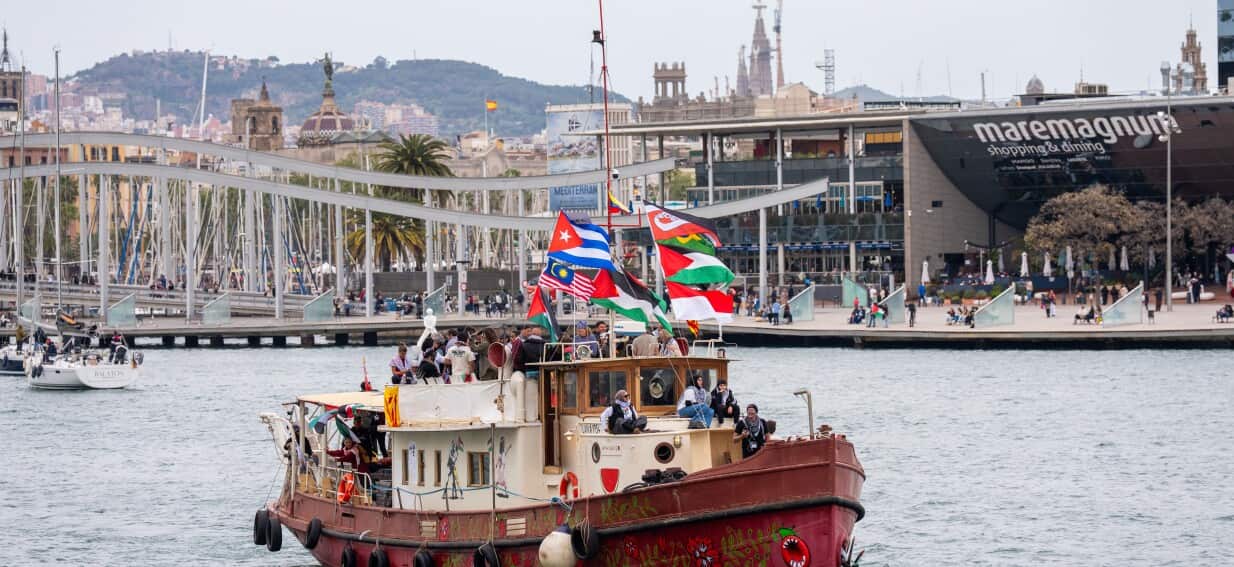
The headlines are predictable. They read like a logistics memo: Israel detains activists in international waters, processes them, and ships them off to Greece. The mainstream press treats this like a standard deportation procedure, a mere hand-off between two Mediterranean neighbors. They are missing the entire point. This isn't a logistical necessity; it’s a masterclass in geopolitical laundering.
By framing the transfer of activists to Greece as a humanitarian or administrative "solution," the media ignores the cold, hard mechanics of maritime sovereignty and the calculated optics of outsourced enforcement. We need to stop looking at where the boats are going and start looking at why Greece is the chosen pressure valve. Learn more on a related subject: this related article.
The Myth of the Neutral Port
Most analysts paint Greece as a neutral third party or a reluctant host. That’s a fundamental misunderstanding of the current power dynamics in the Eastern Mediterranean. Since the late 2010s, the strategic alignment between Jerusalem and Athens has shifted from "cool acquaintance" to "essential security partner."
When activists are sent to Greece, they aren't being sent to a neutral zone. They are being funneled into a specific legal and political environment designed to minimize the friction of their detention. Greece provides a "European" veneer to actions taken in international waters, effectively sanitizing the optics of the interception. If these activists were processed directly through Israeli military ports for extended periods, the legal outcry would be deafening. By offloading the "problem" to Greek soil, the narrative shifts from "military detention" to "immigration processing." More analysis by Associated Press explores related views on the subject.
International Waters and the Sovereignty Trap
The "international waters" label is frequently used as a shield by activists and a sword by state actors. Let’s be precise. Under the San Remo Manual on International Law Applicable to Armed Conflicts at Sea, the rules regarding blockades and the interception of merchant vessels are rigid—yet they are interpreted with extreme elasticity by those with the biggest guns.
The lazy consensus suggests that intercepting a vessel in international waters is a clear-cut violation of the law. It’s more complicated. If a state can argue that a vessel is intending to breach a legally established blockade, the interception—even in international waters—becomes a grey area that favors the interceptor.
The real scandal isn't just the interception; it’s the lack of a neutral adjudicator. When Israel transfers these individuals to Greece, they are effectively bypassing the need to justify the "international waters" seizure in a court that has any teeth. Greece, buried under its own migration crises and seeking to maintain its strategic energy alliance with Israel, has zero incentive to challenge the legality of how these people arrived on its docks.
Why Greece? Follow the Gas and the Gears
You don’t understand this story if you don't understand the EastMed pipeline and the shifting alliances of the Levant. Greece isn't doing this out of the goodness of its heart.
- Energy Security: The cooperation on subsea gas pipelines makes Athens a silent partner in Israeli maritime policy.
- Military Drills: The Hellenic Air Force and the IAF now train together with a frequency that would have been unthinkable twenty years ago.
- The Turkey Factor: Both nations share a common interest in containing regional rivals, making Greece the perfect "safe harbor" for Israeli diplomatic headaches.
This isn't about "taking" activists. It's about a quid pro quo that allows Israel to keep its hands clean of long-term detention while giving Greece a seat at the table of regional power brokers.
The Activist Miscalculation
I’ve watched organizations burn through millions of dollars in donor money on these flotillas. They operate on a 1970s playbook in a 2020s tech-surveillance world. They believe that being intercepted creates a "PR nightmare" for the state.
They are wrong.
In the modern attention economy, a maritime interception is a 24-hour news cycle blip. By the time the activists hit the pier in Piraeus or Thessaloniki, the world has moved on. The "transfer to Greece" is the final nail in the coffin of the protest's effectiveness. It diffuses the tension. It turns a high-stakes maritime confrontation into a mundane deportation case handled by Greek bureaucrats.
If you want to disrupt a blockade, you don't do it by sailing into a trap that has a pre-arranged exit ramp in a friendly neighboring country. You are literally following the script written by the security apparatus you claim to oppose.
The Logistics of Displacement
Imagine a scenario where the destination wasn't Greece. If the destination were Cyprus, the political heat would be different. If it were Turkey, it would be a declaration of war. Greece is the "Goldilocks" zone—just far enough to be international, just close enough to be manageable, and just "European" enough to silence the human rights lawyers for a crucial few days.
The processing is clinical.
- Interception: Occurs far enough out to avoid land-based witnesses.
- Transfer: Activists are moved to vessels or planes destined for Greek hubs.
- Legal Limbo: Greek authorities take over, moving the individuals through a system already clogged with thousands of migrants, ensuring the activists' specific message is drowned out by the sheer volume of "standard" immigration cases.
The Data the Media Ignores
Check the numbers on how many activists detained in these actions actually face a judge for the "illegal" nature of their voyage. It’s almost zero. Why? Because a trial requires a discovery phase. A trial requires the state to prove the legality of the interception in international waters.
Instead, the "Greece route" acts as a non-judicial deportation. It’s a loophole. You aren't being "arrested" in the traditional sense; you are being "removed" from a sensitive zone and placed in a third-party jurisdiction that has already agreed not to make a scene.
The High Cost of the "Safe Return"
We are told this is the safest way to handle these confrontations. "No one gets hurt, they just go to Greece." This "safety" is the ultimate tool of suppression. It makes the act of protest look like a choreographed dance.
The industry insider knows that the most effective way to kill a movement is to make it look routine. By standardizing the "Greece Transfer," the Israeli security establishment has turned a potential international incident into a scheduled flight.
The activists think they are challenging a blockade. In reality, they are providing the raw material for a demonstration of state cooperation. They are the unwilling actors in a play that proves Israel and Greece can manage the Mediterranean however they see fit, regardless of what the maritime charts say about where one country’s power ends and "international" space begins.
Stop asking when the activists will be released from Greece. Start asking why we’ve accepted a world where two nations can treat international waters like a private hallway between their homes. The "Greece Transfer" isn't a solution; it’s the blueprint for the permanent erasure of maritime dissent.
Next time a ship sets sail, don't look at the cargo. Look at the flight path of the deportation plane. That's where the real treaty is written.



