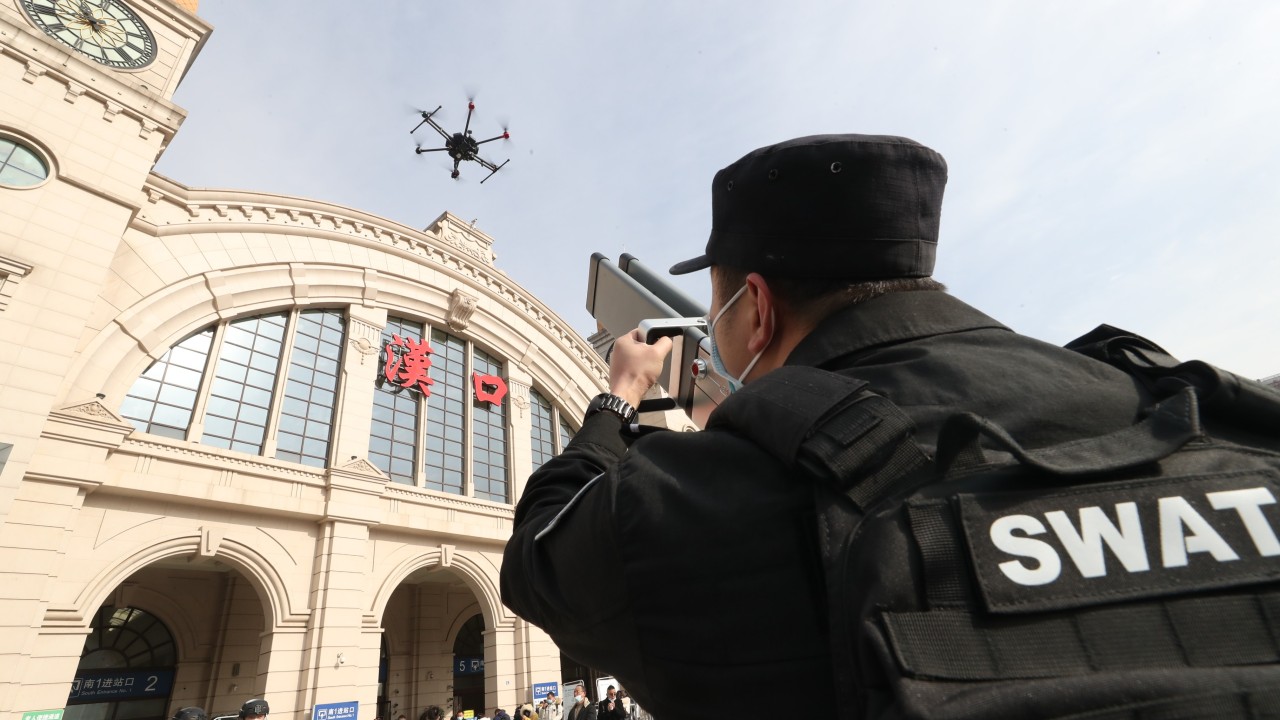
The paper trail of modern warfare is no longer found in traditional arms treaties but in the filing cabinets of patent offices. Data released in March 2026 by intellectual property specialists Mathys & Squire reveals a lopsided reality in the race to control the skies. China has secured a crushing lead in anti-drone innovation, accounting for 82 of the 126 global patent applications filed in the year ending March 2025. By comparison, the United States managed a meager 22, while South Korea followed with six.
This is not a statistical anomaly. It is the tactical result of a decade-long industrial pivot. While the West focused on high-cost, high-complexity interceptors designed to down multi-million dollar jets, China quietly weaponized the patent office to address the "cheap drone" problem that has redefined conflict from the Levant to the Dnieper. The numbers represent a 27% year-on-year surge in global filings, a frantic reaction to a world where a $500 hobbyist quadcopter can disabled a main battle tank.
The Paper Fortress
The sheer volume of Chinese filings points toward a strategy of intellectual saturation. In the realm of electronic warfare, quantity often possesses a quality of its own. By patenting hundreds of minor variations in jamming algorithms and signal interference patterns, Beijing is creating a legal and technological thicket that Western firms will struggle to navigate without infringing on existing IP.
Critics argue that Chinese patent data is historically inflated by state subsidies and "vanity filings" intended to meet government quotas. There is truth to this. In the domestic Chinese system, engineers often receive bonuses and career points for simply filing, regardless of whether the technology ever reaches a production line. However, dismissal of these figures as mere "paper tiger" posturing is a dangerous miscalculation. Even if only 20% of these patents represent viable, hardware-ready tech, that still places China’s innovation output on par with the combined efforts of the rest of the world.
The focus of these patents is tellingly pragmatic. Of the 126 global filings, 49 were dedicated to interference and jamming. This reflects a move away from "kinetic" solutions—shooting things with bullets or missiles—and toward the invisible disruption of the electromagnetic spectrum.
The Microwave and the Beam
While jamming remains the dominant category, the most significant movement is occurring in directed energy. Laser-related anti-drone patents jumped to 39 in the last year, and microwave systems rose to 24. These are the tools of "unlimited magazines." Unlike a traditional anti-air battery that is useless once its six missiles are fired, a laser or high-powered microwave (HPM) system can fire as long as there is diesel in the generator.
The US defense establishment is currently caught in a "cost-per-kill" crisis. Using a $2 million Patriot missile to down a drone that costs less than a used iPad is a mathematical path to bankruptcy. China's patent dominance in Directed Energy Weapons (DEW) suggests they are solving the math problem faster than the Pentagon. Systems like the Hurricane-3000 and the LW series are no longer prototypes; they are the physical manifestations of a patent strategy designed to make traditional air defense obsolete.
The European Vacuum
If the US is lagging, Europe is effectively absent from the conversation. Despite a string of high-profile drone incursions at major hubs like Brussels, Munich, and Oslo in late 2025, European filers are almost invisible in the Mathys & Squire report. This creates a strategic vulnerability where European critical infrastructure—airports, power plants, and ports—may soon find itself forced to purchase Chinese-patented technology to defend against drones, many of which are also manufactured in China.
This circular economy of threat and defense is the ultimate "closed loop." China currently controls over 70% of the global consumer drone market. By simultaneously dominating the patents required to stop those same drones, they have achieved a level of market verticality that Standard Oil would have envied.
Beyond the Battlefield
The move into anti-drone tech is not strictly a military affair. The commercial applications are ballooning. With the global drone market projected to hit $147 billion by 2036, the "protection" side of that industry is the new frontier for private security firms.
Current patent trends show a sharp rise in "target-capturing" and "net-launcher" technologies. These are designed for civilian environments where firing a laser or high-powered jammer might cause more collateral damage than the drone itself. An airport cannot simply jam all frequencies without grounded its own fleet. Prisons cannot fire 30mm cannons at a delivery drone dropping contraband into a yard. The innovation is moving toward precision—the ability to surgically "unplug" a single rogue aircraft while leaving the surrounding digital environment untouched.
The Reality of Secret Tech
There is one massive caveat to this data: the silence of the classified. The world’s most advanced counter-UAS (Unmanned Aerial System) technologies are likely hidden in "black" budgets and never see a patent office. Companies like Anduril Industries in the US or Saab in Sweden often rely on trade secrets and classified government contracts rather than public IP filings.
However, patents remain the best indicator of a nation's "industrial baseline." They show what is being prepared for the mass market and what will be available for export to the 150+ countries that don't have a classified aerospace program. China is clearly positioning itself as the global hardware store for the "Anti-Drone Age."
The West's response has been fragmented. While the US Department of Defense has earmarked $668 million for drone defense research in 2026, the translation from research to patented, exportable products remains slow. The paperwork race is being lost, and in the world of international trade and defense, the person who holds the patent usually holds the high ground.
Strategic autonomy in the 21st century is not just about having the best guns; it is about owning the blueprints for the tools that make the other side's guns stop working. Right now, the blueprints are being written in Mandarin.
Map out the supply chain for a domestic anti-drone system that bypasses these specific patent bottlenecks.