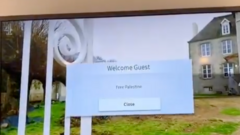
The plastic keycard chimes. A green light blinks, the lock clicks, and the heavy fire door swings open to reveal the familiar, comforting monotony of a budget hotel room.
It is a universal ritual. You drop your luggage on the luggage rack. You kick off your shoes. You collapse onto the tightly tucked bedsheets, feeling the ache of a long journey slowly drain from your posture. For a tourist arriving in north London after a grueling transatlantic flight from New York, this moment is supposed to be the ultimate reset. The world outside—with its chaotic airports, shifting time zones, and shouting streets—is finally locked away. If you liked this piece, you should check out: this related article.
Then, you press the power button on the remote control.
The television screen glows to life, cutting through the dim afternoon light of the room. But instead of the expected generic welcome message, the screen displays a stark, politically charged phrase: "Free Palestine." For another perspective on this event, refer to the latest coverage from AFAR.
Suddenly, the sanctuary of the hotel room evaporates. The outside world has not been locked out at all. It has bypassed the front desk, slipped through the walls, and intercepted the very technology meant to provide a temporary escape.
This was the exact reality for multiple guests, including orthodox Jewish travelers, checking into the Travelodge in Manor House, Finsbury Park. What was meant to be a predictable, sterile hospitality experience instantly transformed into an unsettling digital confrontation.
The Illusion of the Safe Space
Hotels sell sleep, but more than that, they sell neutrality. When we pay for a room, we are renting a temporary bubble of privacy. We expect the sheets to be clean, the water to be hot, and the environment to be completely indifferent to who we are, where we come from, or what we believe.
When you sit in a restaurant or walk down a public sidewalk, you accept the risk of bumping into the friction of the world. You might see a protest march, a provocative billboard, or a heated argument. That is the price of admission for existing in a modern society. But the hotel room occupies a different psychological category. It is a sanctuary.
Imagine, metaphorically speaking, walking into your home and finding that a stranger has rearranged your bookshelves to display a political manifesto. Even if you agree with the manifesto, the violation of your private space would cause a visceral jolt.
For the orthodox Jewish guests checking into the Manor House Travelodge, the shock was multi-layered. They had traveled across borders to a neighborhood known for its vibrant, diverse community, only to find that the geopolitical tremors of the Middle East had been hardwired into their television sets. The screen did not feel like a piece of standard hospitality equipment anymore. It felt like a broadcast targeted directly at them.
The psychological comfort of the room shattered in an instant. The question shifted from “Where should we go for dinner?” to “Are we safe here?”
The Ghosts in the Hospitality Machine
How does a corporate welcome screen turn into a political billboard?
To understand the breakdown, we have to look behind the drywall. Modern hotels no longer rely on simple coaxial cables plugged into the back of a TV set. Instead, they use complex, centralized Interactive Property Management Systems (IPMS).
When you check in at the front desk, the receptionist types your name into a computer. That computer talks to a server, which then talks to the smart TV in your assigned room. The server tells the TV to say, "Welcome, Smith Family," or to display the Wi-Fi password, or to showcase the hotel's breakfast hours.
It is a streamlined, automated system designed to make a massive corporate chain feel just a little bit personalized. But because it is centralized, it possesses a single point of failure.
If a rogue actor gains access to that central server—whether through a compromised employee password, an unprotected network port, or an external cyberattack—they do not just change one screen. They change every screen in the building.
Travelodge corporate headquarters quickly pivoted into damage control mode. They launched an urgent internal investigation, issued a formal apology, and scrambled technicians to scrub the unauthorized message from the system. They blamed a breach of their guest entertainment platform. They spoke in the defensive, sanitized language of corporate public relations, using words like "isolated incident" and "unauthorized access."
But public relations statements cannot retroactively patch the vulnerability that matters most: user trust.
When Neutrality Becomes a Luxury
The incident at Finsbury Park highlights an escalating trend in our hyper-connected world. Every screen is now a potential battlefield.
We used to worry about hackers stealing our credit card numbers or locking our laptops with ransomware. Now, the threat landscape has expanded into ideological vandalism. Hackers are increasingly targeting public infrastructure, smart billboards, and hospitality networks not for financial gain, but to hijack the attention of a captive audience.
For a budget hotel chain like Travelodge, this is an existential nightmare. The brand relies on being entirely unexceptional in the most reliable way possible. You book a room because you know exactly what you are going to get, whether you are in Edinburgh, Cardiff, or London.
The moment a brand becomes associated with unpredictable political messaging, the core promise of predictability breaks.
Consider the vulnerability of the traveler. You are in a foreign city. You do not know the local emergency numbers. You do not know the layout of the streets. You are entirely dependent on the hospitality provider to keep you secure. When the technology inside your room acts up, it sends a troubling signal: if the hotel cannot control its own televisions, what else have they lost control of? Are the digital room locks safe? Is the guest Wi-Fi network monitoring your passwords?
The glitch on the television screen becomes a proxy for a much larger, systemic anxiety.
The Lingering Echoes of the Screen
The televisions in Finsbury Park have long since been wiped clean. The corporate apology has been filed away in news archives. The travelers have moved on to their next destinations.
Yet, the incident leaves behind a quiet, uncomfortable truth about the spaces we inhabit.
We live in an era where true privacy is becoming an illusion. We surround ourselves with smart devices, connected appliances, and centralized networks designed to cater to our every comfort. We sacrifice a little bit of control for a lot of convenience. Most of the time, the trade-off works beautifully. The lights turn on when we speak, the room warms up before we arrive, and the TV greets us by name.
But every piece of connectivity is a window left unlocked.
The next time you walk into a hotel room, you will likely do what you have always done. You will drop your bags. You will kick off your shoes. You will reach for the remote control. But as the screen blinks to life, there will be a split second of hesitation. A tiny, quiet question hanging in the dark before the picture appears.
You will wonder exactly who is waiting to greet you on the other side of the glass.