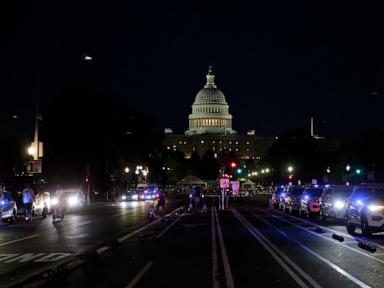
On a freezing Tuesday evening in January, a figure walked down New Jersey Avenue in Washington, D.C., carrying a standard, unassuming backpack. The air was heavy with the nervous energy of a capital on the brink. It was January 5, 2021. The city was quiet, but it was the silence that pulls tight right before a lightning strike.
The figure in the gray hooded sweatshirt and black gloves stopped at a park bench outside the Democratic National Committee headquarters. He sat down. To any passerby, he was just another cold commuter waiting for a bus or gathering his thoughts. But inside that backpack were tight coils of wire, powder, and metal. Two pipe bombs. Viable. Deadly.
After a few minutes of waiting, the backpack was placed. Later, a second device was tucked near the Republican National Committee headquarters.
Then, the figure vanished into the night.
For nearly four years, that person was the ultimate ghost of Capitol Hill. While the chaotic, high-definition violence of the next afternoon was broadcast across the globe in real-time, the dark silhouette who walked the streets the night before remained a phantom. The FBI put up posters. They offered a $500,000 reward. They enhanced grainy surveillance video, showing the suspect standing on tiptoe, looking around, checking his watch. Nothing worked. The case grew freezing cold.
But secrets have a way of decaying. By late 2025, the digital crumbs left behind in the snow finally caught up with a thirty-year-old man from Woodbridge, Virginia named Brian J. Cole Jr.
Federal authorities arrested Cole at his home, bringing a staggering development to a saga many assumed would never be solved. When the FBI questioned him, prosecutors say he didn't stay silent. He confessed. He told them he believed the 2020 election had been tampered with. He said he felt bewildered by what he was reading on YouTube and Reddit. He explained that he didn't like either political party, that he wasn't even a "political person," but that he felt someone needed to speak up. Over ninety minutes, he reportedly walked agents through the meticulous construction of the bombs.
The tragedy of the modern political fringe is often found in this exact blend of extreme isolation and digital radicalization. It is a lonely arithmetic.
To explain the psychological weight of this kind of isolation, consider a deep-sea diver whose lifeline to the surface gets twisted. The air keeps coming, but it is thin, stale, and increasingly toxic. They lose their sense of up and down. They begin to see shadows in the dark that aren't there. For young men sitting alone in suburban bedrooms, swallowed whole by algorithmic rabbit holes, the internet becomes that twisted lifeline. They believe they are saving the world, unaware they are building an echo chamber out of gunpowder and pipe casings.
His lawyers would later present documentation of autism spectrum disorder and obsessive-compulsive disorder. They used it to explain a bizarre, frantic behavioral pattern: Cole had factory-reset his cell phone more than 900 times between December 2020 and the day of his arrest. Nine hundred times. A compulsive, exhausting loop of trying to erase the digital ghost following him through his life.
But while the case against Cole finally materialized, the political landscape around him shifted completely.
When President Donald Trump returned to the White House, he issued sweeping, historic mass pardons for the Jan. 6 rioters. Over 1,500 people who had breached the Capitol, clashed with police, or disrupted the electoral count saw their legal slates wiped entirely clean. It was a blanket absolution that reshaped the American legal reality. The rioters went home. The cases were dismissed.
Brian Cole Jr., sitting in a jail cell, assumed he would be part of that mass exodus. His legal team argued vehemently that his alleged actions were "inextricably and demonstrably tethered" to the events of January 6. They argued he was part of the same historical event, driven by the same political fever dream.
But the law is an instrument of precise language, not broad strokes.
U.S. District Judge Amir Ali delivered a devastating blow to that defense. In a crisp, unyielding ruling, the judge pointed out a cold mathematical truth: when the mass pardons were signed on Inauguration Day, law enforcement hadn't even identified Cole yet. He wasn't charged until months after the proclamation. The pardon explicitly applied only to those who had already been convicted or faced pending indictments.
Because Cole was a ghost for so long, he missed the window for mercy. He was too late to be saved by the very movement he allegedly tried to spark.
Outside the courthouse, the human toll of this legal reality became painfully clear. Cole’s mother, Delicia Cole, stood before reporters, her voice heavy with the crushing weight of a parent watching her child slip beneath the waves of the federal justice system. She called the decision heartbreaking, stating it felt like the court had simply adopted the government's position without a second thought.
It is easy to look at political violence through the lens of macro-politics, to view it as a battle between parties, ideologies, and branches of government. But standing on the courthouse steps, it is always reduced to families left picking up the pieces of shattered lives.
Now, a hard date has been hammered into the federal docket. Judge Ali scheduled a two-week jury trial to begin on February 16.
The stakes for the Virginia man could not be higher. The federal government is not treating this as a standard protest case. A grand jury indicted Cole on four severe counts, including interstate transportation of explosives, malicious intent to use explosives, an act of terrorism while armed, and attempting to use weapons of mass destruction.
If convicted, the penalties are measured not in months, but in decades. Life options evaporate. The future shrinks to the size of a concrete cell.
There is a profound, tragic irony to how the timeline has played out. The crowds that smashed through the Capitol doors have largely been forgiven by executive decree, their actions re-contextualized by their political allies. But the man accused of walking the dark streets the night before, planting the most lethal instruments of that entire week, finds himself entirely alone. No political movement is marching for him. No executive orders are rushing to shield him.
Come February, twelve ordinary citizens will sit in a jury box in Washington, D.C. They will look at the surveillance footage of the masked figure in the gray hoodie sitting on the park bench. They will look at the thirty-year-old man sitting at the defense table. And they will decide what happens to the phantom who stayed in the dark for too long, only to wake up and find the rest of the world had moved on without him.