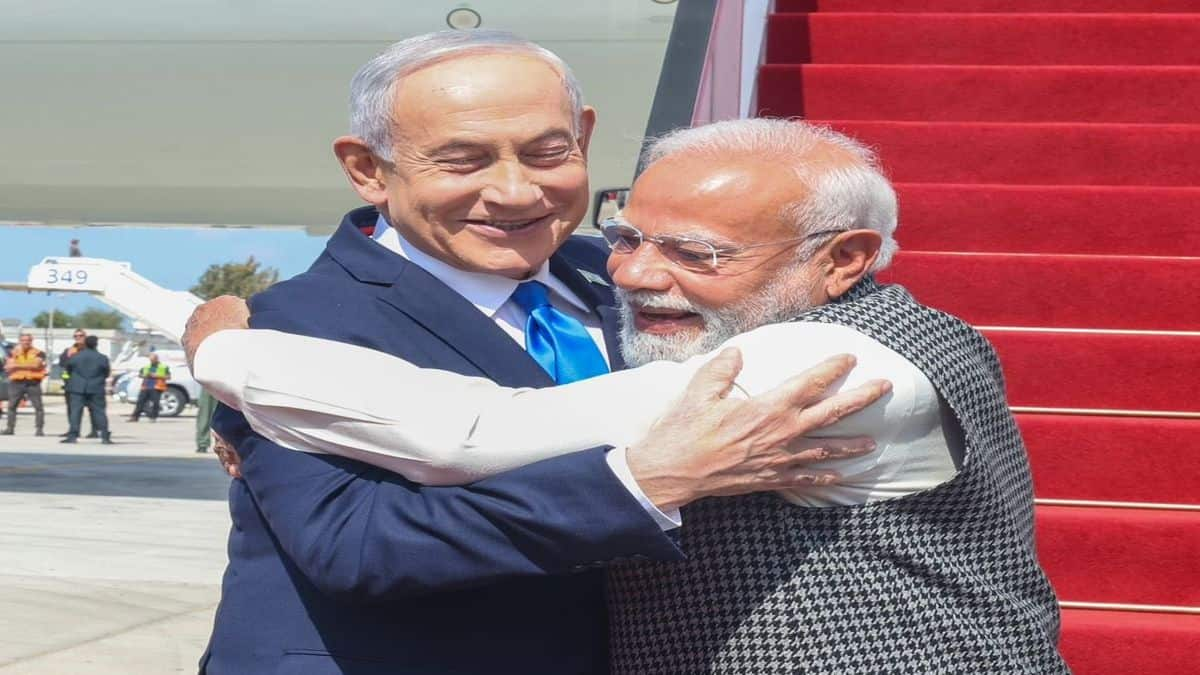
The visit of a head of state to Yad Vashem is not a perfunctory act of historical acknowledgement; it is a calculated engagement with the foundational ethics of the modern international order. For a leader like Narendra Modi, the first Indian Prime Minister to visit Israel, the pilgrimage to the World Holocaust Remembrance Center functions as a high-stakes signal of shared democratic values and a rejection of the ideologies that lead to industrial-scale genocide. To understand the significance of this site, one must deconstruct its role through three distinct lenses: its architectural narrative, its function as a repository of legal and historical evidence, and its status as a prerequisite for bilateral strategic depth.
The Structural Engineering of Remembrance
Yad Vashem is situated on the Mount of Remembrance (Har HaZikaron) in Jerusalem. Its physical layout is designed to impose a psychological progression on the visitor, moving from the collapse of civilization to the re-establishment of sovereignty. This is achieved through a specific architectural mechanism:
- The Linear Compression Model: The Holocaust History Museum, designed by Moshe Safdie, is a 180-meter long prismatic triangular structure that cuts through the mountain. The narrowing and widening of the walkway, combined with the play of natural light from a skylight overhead, creates a physical sensation of claustrophobia and release. This mirrors the historical narrowing of Jewish life under the Nuremberg Laws, leading to the "Final Solution."
- The Evidence-Based Archive: Unlike many memorials that rely on abstract art, Yad Vashem operates as a rigorous historical institution. It houses the world's largest collection of Holocaust-related information, containing over 210 million pages of documentation and 500,000 photographs.
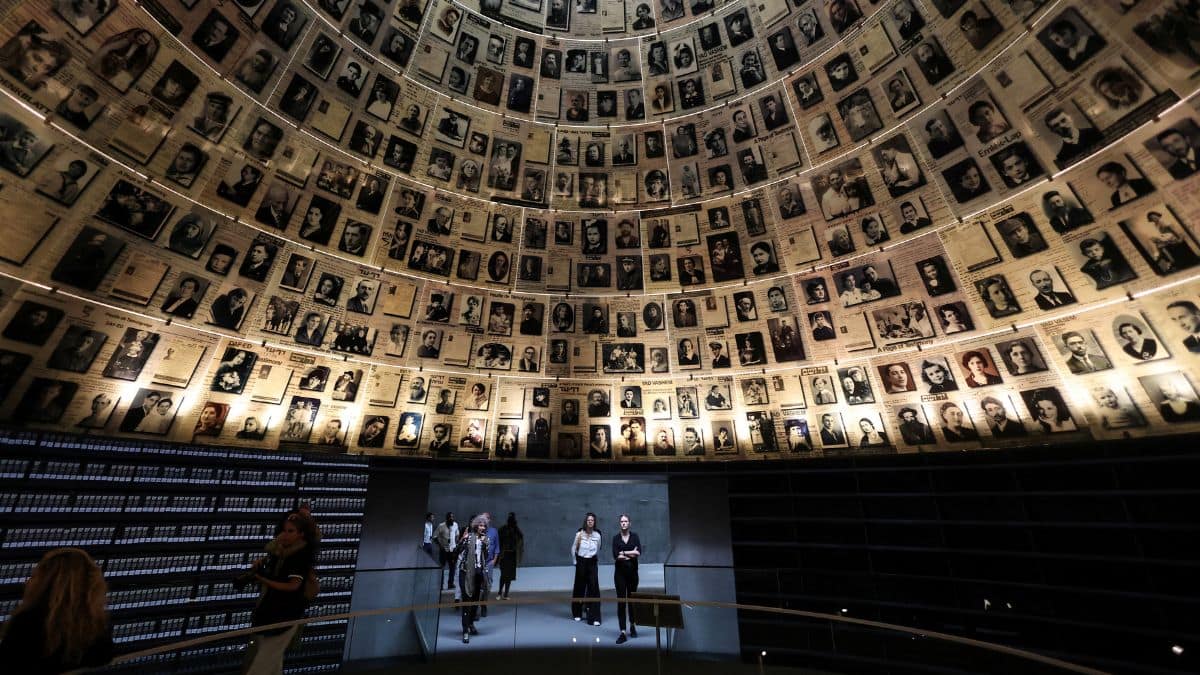
- The Names Database: A central pillar of the institution is the Hall of Names, which aims to restore the individual identity of the six million victims. This is a direct counter-strategy to the Nazi "process of dehumanization," which replaced names with numbers. To date, approximately 4.8 million victims have been identified and memorialized within these archives.
The Diplomatic Protocol of the Visit
In the context of international relations, a visit to Yad Vashem serves as a "moral vetting" process. For India, a country that historically maintained a cold-to-lukewarm stance toward Israel for decades due to Cold War alignments and domestic sensitivities, this visit marked a definitive pivot.
The protocol involves several mandatory stages, each carrying a specific symbolic weight:
- The Hall of Remembrance: A stark, tent-like structure with a floor inscribed with the names of 22 Nazi murder sites. The lighting of the Eternal Flame and the laying of a wreath constitute a formal state recognition of the tragedy.
- The Children’s Memorial: A hollowed-out underground cavern where the names of 1.5 million murdered children are read aloud in a continuous cycle. This site focuses on the "demographic theft" committed during the Holocaust, emphasizing the loss of future generations.
- The Avenue of the Righteous Among the Nations: This section honors non-Jews who risked their lives to save Jews. For visiting dignitaries, this area highlights the possibility of individual moral agency even within a failing state structure—a concept highly relevant to modern governance and human rights.
The Geopolitical Utility of Shared Trauma
The alignment between India and Israel is often framed through the lens of defense and technology, yet the cultural-historical alignment provides the necessary "soft power" glue. The visit to Yad Vashem bridges the gap between the two nations by establishing a common ground in the struggle against existential threats.
The "Strategic Remembrance" framework suggests that nations use historical memorials to:
- Legitimize Statehood: By acknowledging the Holocaust, a visiting leader acknowledges the historical necessity for the State of Israel as a refuge, thereby legitimizing its right to exist and defend itself.
- Universalize the Particular: While the Holocaust was a specific Jewish tragedy, its memorialization serves as a universal warning against radicalization and hate speech. This resonates with India’s own history of partition and its ongoing fight against cross-border terrorism.
- Establish Moral Equivalence: By participating in the remembrance, the visiting leader signals that their own nation adheres to a rules-based international order that views genocide as the ultimate violation of state sovereignty and human dignity.
Quantitative Impact of the Institution
Yad Vashem’s influence extends beyond the physical site in Jerusalem through its International School for Holocaust Studies. This is where the institution converts historical data into educational policy.
- Global Outreach: The school hosts over 300,000 students and 1,000 educators annually from across the globe.
- Legislative Influence: The documentation provided by Yad Vashem has been instrumental in shaping the legal definitions of "Crimes Against Humanity" used in international tribunals.
- Research Output: The institution publishes dozens of new research volumes each year, ensuring that the "Mechanism of Genocide" is understood from a sociological and psychological perspective, not just a historical one.
The "Righteous Among the Nations" project is particularly significant for its rigorous verification process. To be named "Righteous," an individual must meet four criteria: active involvement in saving one or more Jews; a risk to their own life, liberty, or safety; the absence of a financial motive; and the existence of testimony from the survivors or primary documentation. This level of factual rigor prevents the memorial from becoming a tool for political hagiography.
The Strategic Value of the Yad Vashem Visit for India-Israel Ties
The transition from "discreet cooperation" to "public partnership" between India and Israel required a high-profile symbolic act. The Yad Vashem visit provided this. It signaled to the global community that the India-Israel relationship had moved beyond transactional arms deals into a values-based alliance.
The relationship can be analyzed through a Bilateral Maturity Matrix:
- Level 1 (Transactional): Security cooperation and basic trade.
- Level 2 (Institutional): Joint ventures in agriculture, water tech, and space.
- Level 3 (Values-Based): Shared democratic identity and historical acknowledgement.
By visiting the memorial, the Indian leadership skipped the intermediary stages and moved directly to Level 3. This created the political capital necessary to sign major strategic partnerships without the traditional domestic backlash that characterized previous administrations.
The Limitation of Symbolic Memory
While the visit is a powerful diplomatic tool, it faces a structural limitation: the "Decay of Living Memory." As the generation of survivors passes away, the institution must transition from a site of witness to a site of archival authority. This requires an increasingly sophisticated digital strategy to combat Holocaust denial and distortion, which have been amplified by algorithmic social media structures.
The challenge for Yad Vashem—and by extension, the leaders who visit it—is to ensure that the "Never Again" mantra does not devolve into a cliché. This requires connecting the historical data of the 1940s to contemporary early-warning systems for mass atrocities.
The strategic play for any modern state visiting Yad Vashem is to integrate the lessons of institutional failure—specifically how the German civil service, legal system, and military were co-opted—into their own domestic governance training. The memorial serves as a stress test for the integrity of a nation’s democratic institutions. To visit the site is to accept a benchmark for one's own leadership: the commitment to prevent the incremental erosion of civil liberties that precedes systemic collapse. For the India-Israel partnership, this shared commitment forms the most durable pillar of their long-term strategic alignment.