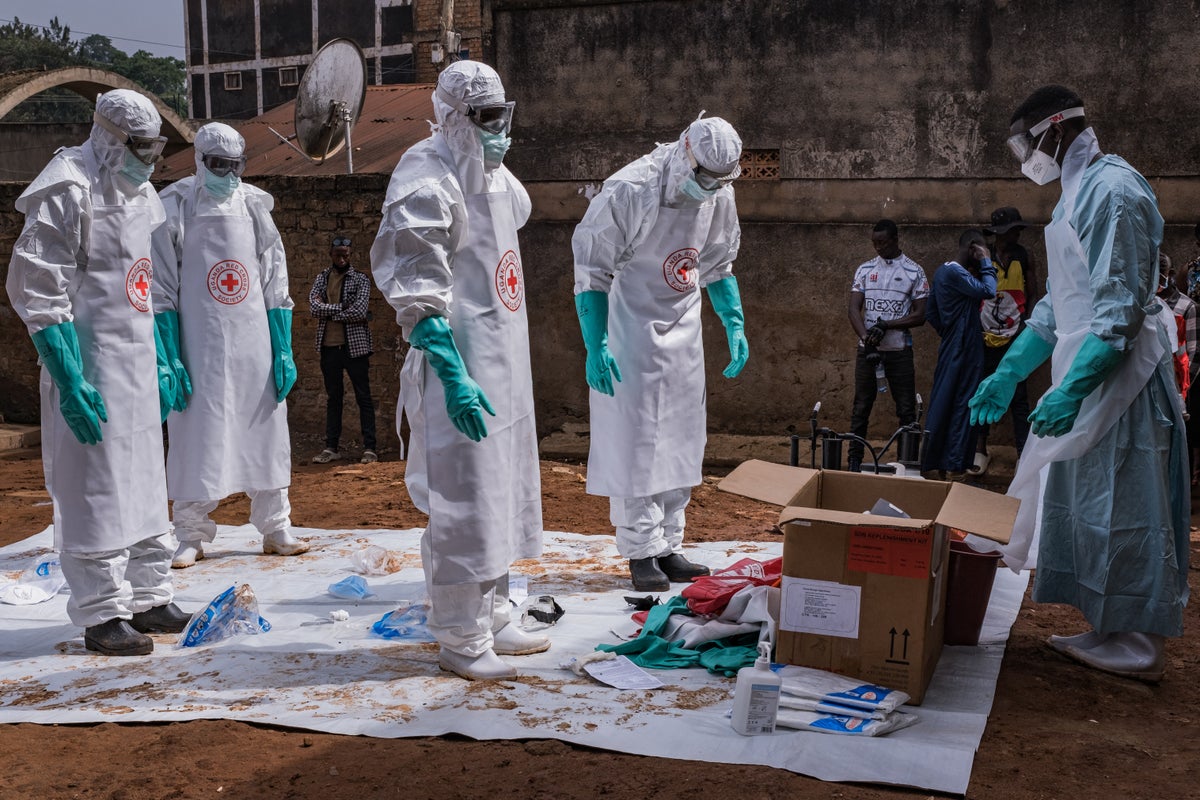
The decision to implement a unilateral border closure during a highly lethal infectious disease outbreak represents a high-stakes trade-off between immediate epidemiological containment and long-term systemic stability. When Uganda halts cross-border movement with the Democratic Republic of the Congo (DRC) during an escalating Ebola Virus Disease (EVD) surge, the action is rarely a simple health measure. Instead, it is an architectural shift in regional logistics, economics, and security. Standard reporting treats these closures as absolute barriers that stop a pathogen at a geographic line. Data and historical precedents demonstrate that physical border closures often transform a centralized, measurable public health crisis into a decentralized, unmonitored clandestine migration crisis.
Evaluating the efficacy of a border shutdown requires analyzing the intersection of viral dynamics, economic dependency vectors, and enforcement capacity.
The Three Vectors of Pathogen Spillover
Epidemiological risk across international boundaries is driven by three distinct structural vectors.
- The Formal Trade Vector: Regulated commercial traffic moving through official Points of Entry (POEs). This vector is highly visible, easily subject to screening protocols (such as thermography and symptom questionnaires), and highly responsive to state mandates.
- The Informal/Clandestine Vector: Unregulated, porous crossings—often referred to as "panya roads" in East Africa—used by local populations for daily sustenance, familial connections, and small-scale smuggling. This vector lacks any public health infrastructure.
- The Institutional Evacuation and Refugee Vector: Mass population displacements caused by concurrent crises, such as armed conflict or civil unrest, which force sudden, high-density migrations across borders without regard for administrative status.
When a government closes official POEs, it does not eliminate the regional push and pull factors that drive human mobility. Instead, it shifts traffic from the Formal Trade Vector directly into the Informal/Clandestine Vector. The immediate consequence is a total loss of epidemiological visibility. At an official POE, public health authorities can isolate suspected cases, trace contacts, and maintain a line of defense. Once movement is forced into unmonitored pathways, the basic reproduction number ($R_0$) of the pathogen within the vulnerable domestic population becomes impossible to calculate accurately.
The Econometrics of Border Porosity
The ongoing economic survival of border communities creates a direct counter-incentive to compliance with health decrees. The frontier between western Uganda and eastern DRC is not merely a political boundary; it is an integrated economic zone. Agricultural goods, minerals, and consumer commodities move continuously to sustain local markets.
To understand why absolute closures fail, one must analyze the economic cost function of compliance for an individual trader. If the financial penalty of staying home is starvation or business collapse, the trader will choose the risk of fines or arrest to cross illegally. The cost of evasion is frequently lower than the cost of compliance.
This economic reality introduces a predictable decay function in border enforcement efficiency.
[Formal Border Closure]
       │
       ▼
[Shutdown of Official POEs]
       │
       ▼
[Surge in Informal Crossings via Panya Roads]
       │
       ▼
[Total Loss of Epidemiological Screening & Contact Tracing]
As official routes close, demand for illicit transport rises. This demand incentivizes the creation of new bypass routes and can corrupt low-wage border enforcement personnel. Consequently, a policy designed to seal a nation off from infection instead drives the pathogen deep underground, accelerating community transmission in remote areas where healthcare infrastructure is least capable of managing a surge.
Operational Bottlenecks in Surveillance Architecture
A robust public health response relies on early detection and rapid isolation. A border closure disrupts the supply chains necessary to maintain this very architecture. The deployment of Personal Protective Equipment (PPE), viral transport media, diagnostic reagents, and specialized personnel requires open, highly functional transit corridors.
When a border is declared closed, bureaucratic friction increases exponentially. Humanitarian aid organizations, clinical teams, and cross-border task forces face severe logistical delays. Visas are delayed, cargo flights require exceptional clearances, and overland transport grinds to a halt at military checkpoints.
The second limitation is the degradation of cross-border data sharing. Managing a filovirus outbreak requires real-time intelligence on contact networks. If a confirmed Ebola patient in the DRC has contacts who reside in or traveled to Uganda, health workers must pass that data across the border within hours to initiate monitoring. Border closures often strain diplomatic relations and reduce institutional cooperation, causing communication channels between ministries of health to narrow precisely when they need to expand.
Pathogen Specifics and the Fallacy of Symptom Screening
The biological characteristics of the specific Ebola virus strain dictate the utility of border-based interventions. For instance, the Sudan ebolavirus and the Zaire ebolavirus present distinct challenges in clinical presentation and countermeasure availability.
Ebola virus disease has an incubation period ranging from 2 to 21 days. A person can cross an international border while fully infected but completely asymptomatic. Thermal cameras and visual inspections at POEs are structurally incapable of detecting a incubating virus. Therefore, even an open, heavily monitored border with 100% screening compliance will still experience leakages of incubating cases.
Furthermore, if the outbreak involves a strain like the Sudan ebolavirus, for which there are fewer widely deployed vaccines or therapeutics compared to the Zaire strain, the reliance on blunt containment strategies like border closures tends to increase out of political necessity rather than scientific utility. The lack of medical countermeasures creates a policy vacuum that leaders frequently fill with visible, militarized actions—such as deploying troops to border posts—to signal control to domestic populations, despite the low marginal utility of these actions in stopping viral replication.
Displacement and the Security Amplification Loop
Eastern DRC is characterized by long-term security instability, driven by various armed groups and displaced populations. This reality complicates the execution of any public health mandate. When an Ebola surge overlaps with an active conflict zone, the population’s primary driver shifts from disease avoidance to immediate physical survival.
Forcing a border closure during a security crisis creates a dangerous amplification loop. Refugees fleeing violence will not stop at a closed border; they will bypass it through rough terrain, carrying the virus with them into new areas.
Military enforcement of health cordons often breeds deep community distrust. In the history of filovirus eradication, community engagement is the single most critical variable determining success. When public health interventions are delivered via bayonets and barriers, local populations become defensive. They hide symptoms, secrete deceased relatives away for traditional burials (a primary driver of Ebola transmission), and avoid clinical centers entirely. The medical crisis then mutates into a security crisis, extending the duration of the outbreak.
Strategic Alternatives to Total Closure
Rather than enforcing an economically and socially unsustainable shutdown, advanced health intelligence networks favor a policy of managed porosity. This framework acknowledges that movement cannot be stopped entirely and focuses instead on funneling that movement through controlled channels optimized for public health surveillance.
- Continuous Risk Stratification: Classifying POEs by traffic volume and epidemiological proximity to known clusters, allocating scarce diagnostic and isolation assets to high-risk nodes.
- Incentivized Screening Protocol: Keeping official crossings open but conditioning entry on rapid diagnostic testing, vaccination (when available), or verified health declarations. This lowers the incentive for individuals to use illegal routes.
- Community-Led Transborder Surveillance: Empowering local leadership, elders, and traders on both sides of the border to monitor arrivals, report unusual clusters of illness, and manage safe isolation spaces before national authorities can intervene.
This approach preserves economic stability, retains vital visibility over human movement patterns, and ensures that the infrastructure required to deploy international aid remains operational.
The Operational Reality
The decision to seal a border during a filovirus surge is often an admission of systemic vulnerability elsewhere in the state's public health apparatus. It is a blunt instrument used when granular tracing, localized isolation capabilities, and community-level trust are insufficient to manage the threat.
The immediate tactical requirement for regional ministries of health is to pivot from a posture of total exclusion to one of targeted containment. Resources deployed to police vast, un-policable geographic borders must be reallocated to reinforcing local clinics, scaling up mobile laboratory capacities in border districts, and establishing clear, non-punitive isolation protocols at major transit hubs. True containment is achieved not by building walls that pathogens routinely bypass, but by establishing highly responsive, localized surveillance grids that neutralize the virus wherever it surfaces.