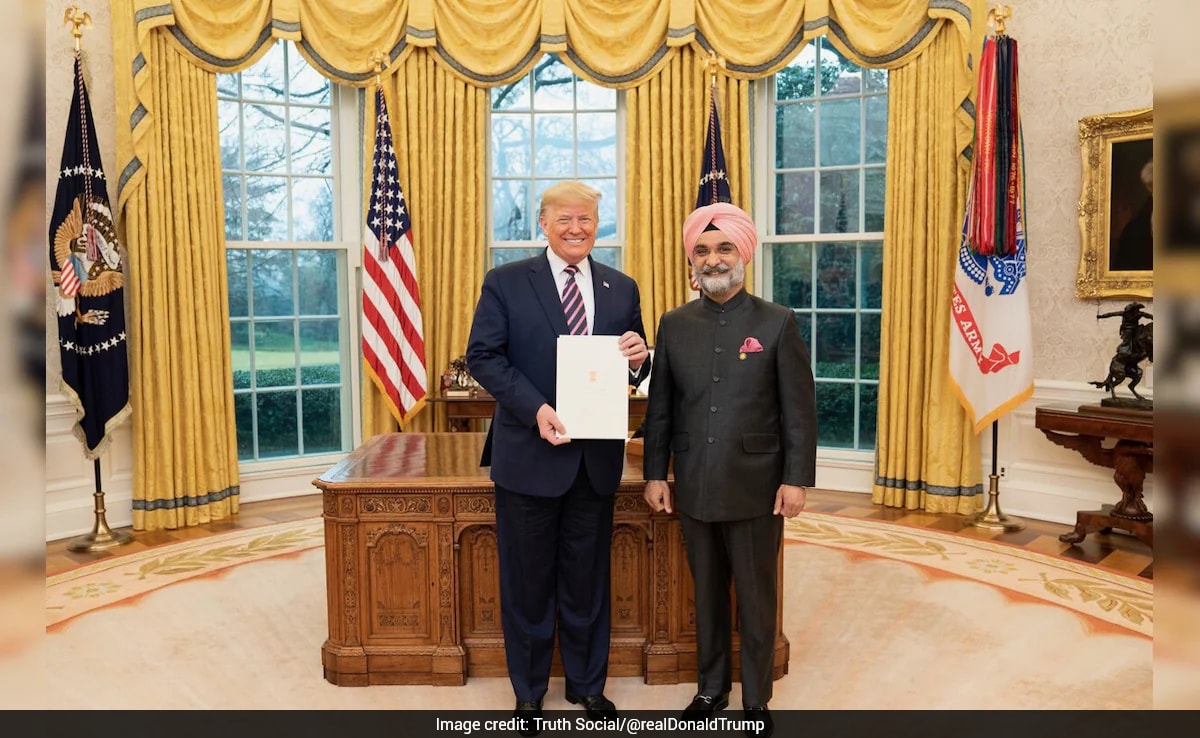
Donald Trump praising Taranjit Singh Sandhu is not the diplomatic victory lap the mainstream media wants you to believe it is.
The breathless reporting surrounding Sandhu’s potential role as Lieutenant Governor of Delhi, bolstered by Trump’s endorsement of his "commitment to US-India ties," misses the structural reality of how power actually moves between Washington and New Delhi. We are witnessing the "Personalization Fallacy"—the dangerous idea that individual rapport and career-diplomat charisma can override the cold, hard friction of national interest.
If you think a former ambassador moving into a domestic administrative role in Delhi is a "bridge" to the White House, you are fundamentally misreading the board.
The Myth of the Great Connector
The consensus view suggests that Sandhu’s tenure in D.C. makes him a unique asset for managing the US-India relationship from within India’s capital. This is bureaucratic romanticism.
Diplomacy is not a social club. It is a series of transactional maneuvers governed by domestic pressures. Sandhu’s supposed "clout" in Washington is a depreciating asset. In the high-velocity world of U.S. foreign policy, an "old friend" who is no longer in the room is just a contact in a digital Rolodex.
Trump’s praise is classic political theater. He values loyalty and visible success. By highlighting Sandhu, Trump isn't signaling a strategic shift; he is performing a brand exercise. He is signaling to the Indian diaspora—a massive economic and voting bloc—that he "gets" India. It is a retail political move masquerading as a grand geopolitical endorsement.
Delhi is Not a Diplomatic Outpost
The Lieutenant Governor of Delhi is a role defined by local friction, not international grandstanding. The position is historically a flashpoint for internal power struggles between the central government and the local administration.
To suggest that this role is a platform for enhancing US-India ties is a fundamental misunderstanding of the job description. The LG deals with land, police, and public order in a crowded, complex megacity. They do not negotiate trade deals or defense transfers.
When we focus on Sandhu’s "international profile," we ignore the administrative grind required for Delhi. High-level diplomacy is about "big picture" platitudes. Governance is about the sewage system, the police force, and the crushing weight of urban bureaucracy. Transitioning from the Mayflower Hotel to the Raj Niwas isn't a promotion in the global order; it’s a pivot into a localized knife-fight.
The Economic Friction No One Mentions
Trump’s "America First" and Modi’s "Atmanirbhar Bharat" (Self-Reliant India) are two sides of the same protectionist coin. No amount of "commitment" from a single individual can bridge the gap when both nations are doubling down on industrial policy and trade barriers.
Consider the following points of friction that a "friendly" LG cannot fix:
- Data Localization: India’s push for data sovereignty remains a thorn for US tech giants.
- Trade Deficits: Trump remains obsessed with the trade imbalance, and India is often in his crosshairs.
- H-1B Visas: Domestic labor politics in the US will always trump "special relationships" when the election cycle hits.
I have watched policy experts spend decades trying to "solve" US-India relations through personality. It fails every time. In 2018, the hype was all about the "2+2 Dialogue." In 2020, it was "Howdy Modi." Each time, the champagne stayed on ice while trade negotiators continued to bicker over poultry imports and medical device pricing.
The Shadow of the Deep State
There is a naive assumption that Sandhu represents a seamless transition of influence. In reality, his appointment would be a test of how much the Indian Ministry of External Affairs (MEA) is willing to let "Washington-style" thinking penetrate domestic governance.
The Indian bureaucracy is famously insular. Bringing in a "celebrity diplomat" disrupts the internal hierarchy. It creates a vacuum where local officials might view the LG not as an administrator, but as a political appointee with an external agenda. This breeds resentment, not efficiency.
The "People Also Ask" Fallacy
People ask: "Will Sandhu’s appointment improve US investment in Delhi?"
The answer is a blunt no.
Global capital does not flow based on who holds a ceremonial or administrative post in a city-state. It flows based on regulatory clarity, infrastructure reliability, and tax predictability. If a US firm wants to build a data center in Noida or Gurgaon, they aren't calling the LG of Delhi because he once had dinner with Mike Pompeo. They are looking at the power grid and the local labor laws.
The premise of the question is flawed because it assumes diplomacy is a top-down gift. It isn't. It’s a bottom-up grind.
The Professional Risks of Optimism
The contrarian truth is that this appointment is more about domestic Indian politics than international relations. It is about the BJP placing a trusted, high-profile loyalist in a position to check the power of local opposition.
Sandhu is the "prestige pick." He provides a veneer of global sophistication to a role that is often viewed as a partisan cudgel.
If you are betting on this move to accelerate the "Indo-Pacific Strategy," you are overvaluing optics. The real work of the US-India relationship happens in the quiet rooms of the NSC and the Ministry of Commerce, far away from the ceremonial functions of a Lieutenant Governor.
Stop Looking for Heroes
We are addicted to the narrative of the "Great Man" of history. We want to believe that one person’s presence can tilt the scales of global power.
It’s a lie.
The US-India relationship is a massive, sluggish tanker. It moves three degrees every decade, driven by Chinese aggression and tech interdependence. It does not turn on a dime because Donald Trump sent a nice tweet about a retired ambassador.
The "commitment" Trump speaks of is a relic of the past. The future is a cold, competitive landscape where friendship is a footnote to national security. Sandhu in Delhi is a local story with a global PR spin.
Treat it as such.
Stop expecting the LG’s office to be a branch of the State Department. It’s an office of urban management. If Sandhu wants to succeed, he needs to forget the Potomac and start obsessing over the Yamuna.
The era of personality-driven diplomacy is dead. Interests are the only thing left on the table.