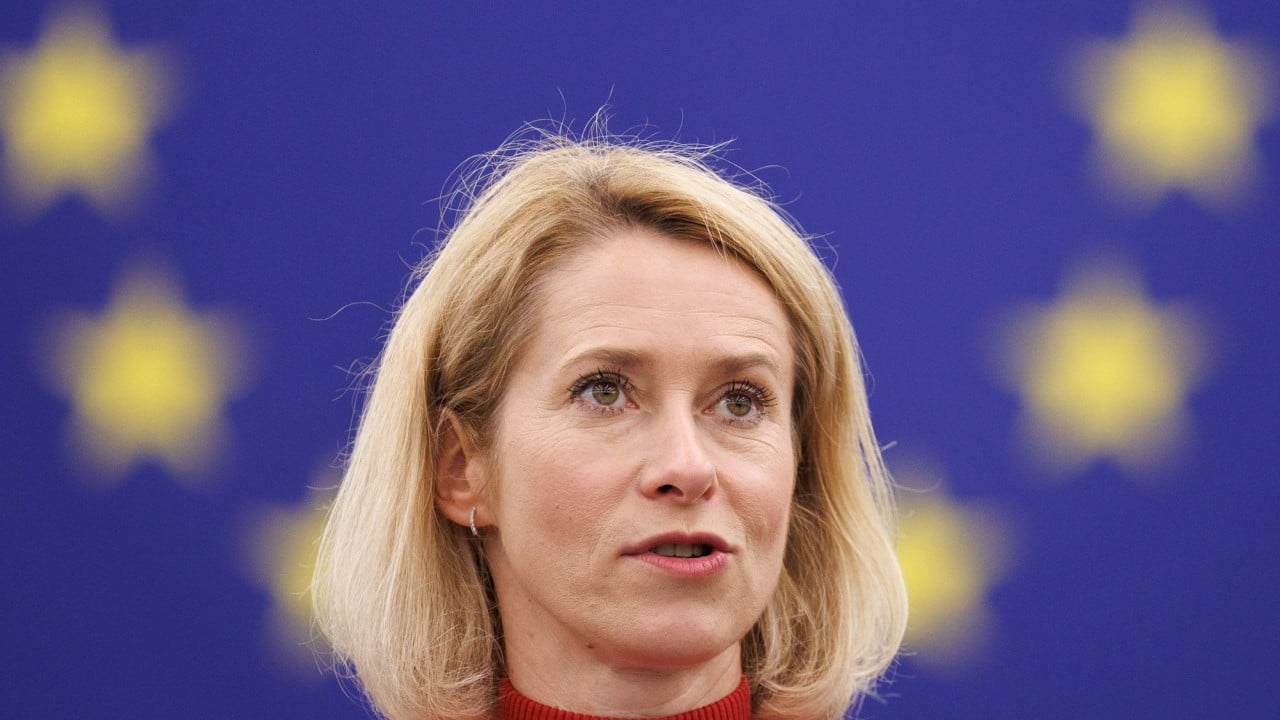
The decision by Israeli Foreign Minister Gideon Sa'ar to sever all contact with the European Union’s High Representative for Foreign Affairs and Security Policy, Kaja Kallas, represents a calculated exercise in diplomatic leverage rather than a spontaneous emotional reaction. The freeze was triggered by leaked reports of closed-door remarks made by Kallas during a diplomatic visit to Mexico, where she reportedly compared Israel’s governance of the West Bank and Gaza to apartheid-era South Africa. By implementing an outright boycott of the EU's top diplomat, Jerusalem is utilizing a specific, asymmetric counter-strategy designed to exploit the internal structural fragmentation of European foreign policy.
To analyze this breakdown objectively, the situation must be evaluated through a rigorous structural framework. The friction is not merely a dispute over rhetoric; it is a clash between the institutional architecture of the European External Action Service (EEAS) and the sovereign strategic imperatives of the Israeli state.
The Institutional Vulnerability of European Foreign Policy
The fundamental flaw in European external diplomacy lies in the governance structure of the EEAS. The High Representative is legally bound by EU treaties to represent the consensus of all 27 member states. However, on matters concerning the Middle East, this consensus does not exist. The EU's member states are sharply divided into three distinct ideological blocs:
- The Pro-Israel Minimalists: Led by Germany, Austria, and various Central European states, this bloc treats Israel's security and sovereignty as a core historical obligation and strictly rejects analogies to South Africa’s racist regime.
- The Non-Aligned Centrists: States that support official EU positions on a two-state solution but seek to maintain stable commercial and diplomatic ties with both Jerusalem and Arab partners.
- The Pro-Palestinian Critics: Nations like Ireland and Spain, which have actively pushed for trade sanctions and formal recognition of Palestinian statehood.
When Kallas introduced the "apartheid" comparison in Mexico, she violated the strict boundary condition of her mandate. By articulating a position aligned exclusively with the third bloc, she exposed a critical vulnerability: the lack of structural enforcement mechanism within the EU to discipline its own foreign policy chief. A national foreign minister who breaks ranks can be summarily dismissed or reprimanded by their prime minister; the High Representative, conversely, operates in an institutional grey zone where individual member states cannot easily enforce compliance without triggering a broader constitutional crisis in Brussels.
The Three Pillars of the Israeli Diplomatic Counter-Strategy
Israel’s immediate cessation of contact with Kallas is a systematic play designed to maximize the political costs of her statements. This strategy rests on three distinct operational pillars.
1. Cost Escalation via Functional Bypassing
By cutting off the High Representative, Israel does not stop communicating with Europe; rather, it shifts its diplomatic capital toward bilateral channels. Israel bypasses the centralized apparatus of the EEAS and engages directly with friendly capitals like Berlin, Prague, and Budapest. This functionally marginalizes Kallas, reducing her capacity to act as an effective mediator or to advance European initiatives—such as proposed trade sanctions or structural reviews of the EU-Israel Association Agreement—in the Middle East.
2. The Precedent of Successive Boycotts
This is not an isolated tactical maneuver. Israel pursued an identical containment strategy against Kallas’s predecessor, Josep Borrell, who faced a prolonged Israeli boycott following sharp criticisms of Israeli settlement expansion and military conduct. By establishing a repeatable pattern of non-cooperation with High Representatives who cross specific rhetorical thresholds, Jerusalem creates an ongoing disincentive for future occupants of the office. The message to the European diplomatic corps is institutionalized: adopting adversarial rhetoric carries the predictable cost of immediate, complete operational exclusion from the theater of conflict.
3. Exploitation of Internal European Backlash
The Israeli boycott acts as a catalyst that accelerates internal European criticism of Kallas's leadership. Prominent European figures, including Armin Laschet, the chair of the German Bundestag’s foreign affairs committee, have publicly warned that ill-judged remarks by the High Representative risk undermining European foreign policy and driving a return to unilateral national approaches. By holding a firm line, Israel forces the pro-Israel and centrist blocs within the EU to internalize the cost of Kallas's rhetoric, pressuring them to reassert control over the EEAS to protect their own strategic interests in the region.
The Limits and Strategic Risks of the Freeze
While the boycott effectively paralyzes centralized EU diplomacy in the short term, the strategy operates under definitive structural limitations.
The first risk is the potential for institutional alienation. While bilateral relationships with specific European capitals remain strong, a total freeze with the High Representative removes Israel's voice from the formal rooms where the EEAS drafts policy briefs, coordinates aid allocations, and structures multilateral statements. This creates a feedback loop where the central bureaucratic apparatus of the EU becomes increasingly monocultural, lacking any direct input or counter-arguments from Israeli diplomats.
The second limitation is the risk of unifying an otherwise fractured European consensus. If the pro-Israel or centrist blocs in Europe perceive the total boycott of an EU institution as an existential affront to European sovereignty, their willingness to defend Israel against harsher multilateral measures—such as trade restrictions or formal censures—could erode.
The Strategic Projection
The diplomatic freeze will persist until Kallas issues a formal clarification or retraction, a concession that she is structurally unlikely to make given her need to maintain credibility among the more critical factions of the EU. Consequently, centralized EU-Israel diplomacy will enter a prolonged state of paralysis.
The strategic play for Jerusalem is to double down on bilateralism, shifting all critical intelligence sharing, economic coordination, and security dialogues to individual European capitals that possess veto power over collective EU actions. This will effectively neutralize the EEAS’s capacity to execute punitive measures against Israel, rendering the centralized European foreign policy apparatus a spectator rather than a functional actor in the evolving geopolitical alignment of the Middle East.


