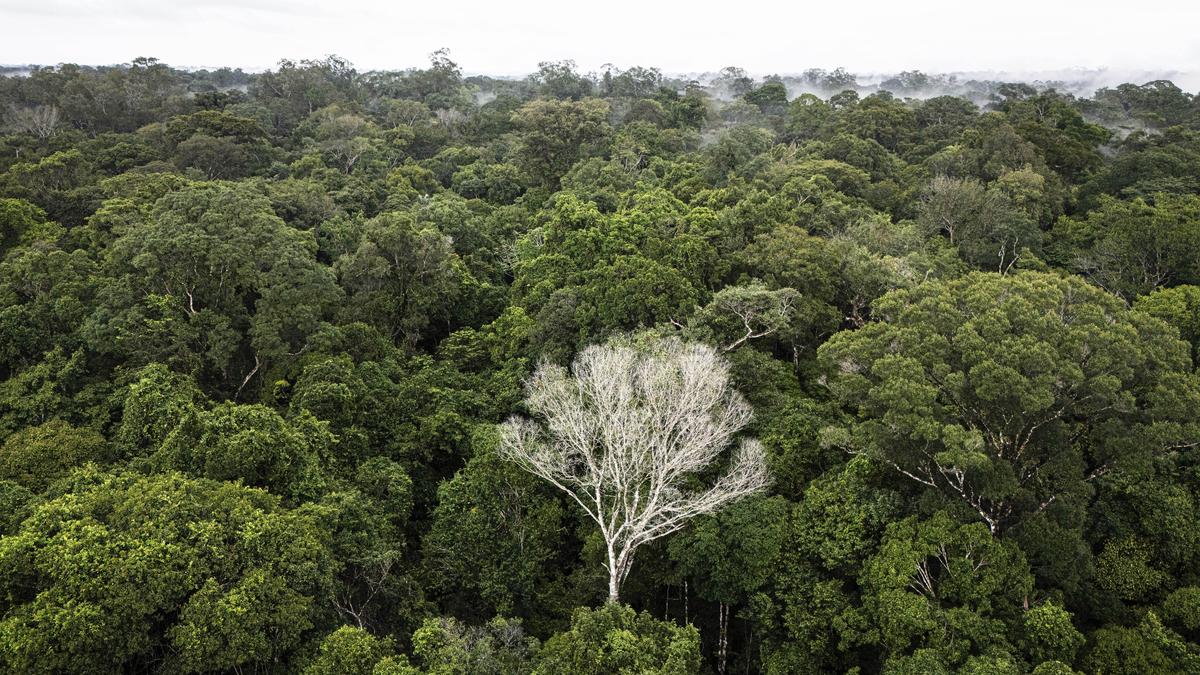
Recent data suggesting a slight reprieve for the world’s tropical forests provides a dangerous comfort. While high-profile researchers point to a dip in tree cover loss compared to previous record-breaking years, the underlying machinery of destruction remains largely intact. We are witnessing a statistical cooling rather than a structural shift in how humanity treats its most vital carbon sinks. The reality on the ground is far more nuanced, driven by volatile political cycles and shifting commodity markets rather than a sudden global awakening to environmental preservation.
The dip is real, but it is deceptive. If a house burns down one year and the garage burns the next, the rate of fire has technically slowed, but the property is still a smoldering ruin.
The Political Seesaw in the Amazon Basin
Brazil serves as the primary driver for these global statistics. Under the current administration, there has been a documented surge in enforcement actions. Satellite monitoring is more aggressive, and the environmental police have seen their budgets restored. This direct intervention has slashed deforestation rates in the Brazilian Amazon, proving that state power remains the most effective tool for conservation when wielded with intent.
However, this progress is inherently brittle. It relies heavily on the survival of a specific political mandate. History shows us that these gains can be wiped out in a single election cycle. When leadership shifts to favor short-term agricultural expansion, the chainsaws return almost overnight. Furthermore, as the Amazon sees increased protection, the pressure does not disappear; it simply migrates.
Neighboring regions like the Cerrado, a vast tropical savanna, are currently being sacrificed to protect the more famous rainforest. The Cerrado lacks the same level of legal protection and international "celebrity" status as the Amazon, making it an easy target for soy and cattle interests looking for a path of least resistance. We are not stopping deforestation; we are rearranging its geography.
The Southeast Asian Pivot
In Southeast Asia, particularly Indonesia and Malaysia, the narrative is different but equally complex. For decades, the palm oil industry was the undisputed villain of the region’s forests. Recently, industry-led commitments and government-enforced moratoriums have yielded significant results. Tree loss in these nations has hit historical lows.
The concern here is market saturation and the price of oil. When the price of palm oil is high, the incentive to clear land often outweighs the threat of government fines or the risk of losing "green" certifications. The current "ease" in forest loss is partially a byproduct of economic cycles. If global demand for biofuels or processed foods spikes, the corporate appetite for new plantations will test the strength of these recent bans.
Moreover, we must look at the industrialization of the Congo Basin. While the Amazon and Southeast Asia dominate the headlines, the forests of Central Africa are facing a slow-motion crisis. Small-scale subsistence farming and the charcoal trade are the primary drivers there, fueled by extreme poverty and a lack of energy infrastructure. This is a harder problem to solve with a simple government decree or a corporate pledge. It requires a fundamental overhaul of how millions of people access fuel and food.
Supply Chain Shadows and Legal Loopsholes
The business community loves to talk about "zero-deforestation" commitments. These look excellent in annual reports and satisfy ESG-focused investors. Yet, the tracking of raw materials from a cleared patch of forest to a supermarket shelf remains riddled with blind spots.
Indirect suppliers are the biggest hole in the bucket. A major meat processor might buy cattle from a "clean" farm, but that farm may have "laundered" the animals from a secondary ranch located on illegally cleared land. This practice is widespread across South America. Without mandatory, farm-to-fork digital traceability that includes every middleman, corporate claims of being "forest-friendly" are largely unverifiable.
The Problem with Reforestation Math
There is also a growing obsession with planting trees as a remedy for cutting them down. This is a false equivalence. A centuries-old primary forest is a complex, biodiverse machine that regulates local weather and stores immense amounts of carbon in its soil. Replacing it with a monoculture plantation of eucalyptus or pine does not restore that balance.
Data often counts "tree cover," which can include these industrial plantations. This masks the loss of old-growth ecosystems. While the total green area might look stable on a low-resolution satellite map, the functional health of the forest is in steep decline. We are losing the lungs and replacing them with a plastic ventilator.
The Financing of Destruction
Money is the ultimate fuel for the bulldozers. Despite all the rhetoric coming out of global climate summits, the world’s largest banks continue to pour billions into sectors linked to deforestation. Agriculture, mining, and infrastructure projects in tropical zones are high-yield investments.
Current international law lacks a "financial crimes" framework for environmental destruction. Until a bank in London or New York is held legally and financially liable for the deforestation caused by the companies it finances, the incentives will never change. Voluntarily guidelines are a sieve. Only hard regulation—such as the European Union’s recent Deforestation Regulation (EUDR)—starts to move the needle by demanding proof that products entering the market did not come from recently cleared land.
The industry's reaction to the EUDR has been telling. Many companies and exporting nations have lobbied for delays, citing "technical difficulties" in mapping their supply chains. This resistance reveals exactly how much work remains to be done. If they don't know where their products come from, they cannot claim to be protecting forests.
Carbon Markets and the Credibility Gap
The rise of voluntary carbon markets was supposed to provide a financial lifeline for standing forests. The idea was simple: polluters pay forest owners to keep trees standing. In practice, the system has been plagued by overestimation and "phantom" credits.
Investigations into major carbon standard setters have revealed that many projects claimed to protect forests that were never actually under threat, or they failed to account for "leakage"—where loggers simply moved to the next plot over. When carbon credits are based on flawed math, they allow companies to continue emitting CO2 while providing no real benefit to the atmosphere. This erodes trust and diverts capital away from genuine conservation efforts that actually need the funding.
The Heat is Coming From Within
We can no longer view deforestation as a purely external threat driven by chainsaws and fire. Climate change itself is now a primary driver of forest loss. Rising global temperatures are drying out the humid interior of tropical forests, making them more susceptible to wildfires.
In the past, tropical rainforests were too damp to burn easily. Now, we see "megafires" in the Amazon and Indonesia that are started by humans but sustained by a changing climate. These forests are losing their ability to recover. A forest that burns once is more likely to burn again as the canopy thins and the forest floor dries out. We are approaching a "tipping point" where the forest stops producing its own rain and begins to transition into a dry savanna. This shift is self-perpetuating and indifferent to human policy.
The Required Shift in Strategy
If we are to move beyond these temporary, fragile dips in forest loss, the strategy must change.
First, land rights for Indigenous peoples must be secured. The data is clear: forests managed by Indigenous communities are the best-preserved on Earth. They are not treating the land as an extraction site, but as a home. Legal title to their ancestral lands is the most cost-effective conservation tool available.
Second, we must end the commodity "race to the bottom." As long as the global market demands the cheapest possible beef, soy, and gold, forests will be at risk. This requires a transition to regenerative agriculture that produces more on less land, combined with a total ban on products from recently cleared areas.
Third, financial transparency must be absolute. Every loan, every bond issuance, and every investment must be screened for deforestation risk. This is not a matter of corporate social responsibility; it is a matter of long-term economic stability. A world without tropical forests is a world with a collapsed global climate, and there is no profit on a dead planet.
The recent "easing" of forest loss is a heartbeat in a patient that is still in critical condition. It shows that intervention works, but it also highlights how much of our success is tied to the whims of political leaders and the fluctuations of the market. We cannot afford to celebrate a slower rate of destruction. The goal is not to kill the forest more slowly; it is to stop killing it altogether.
Stop looking at the year-over-year percentages and start looking at the total hectares remaining. The trend is still downward. The clock is still ticking. The trees we lose this year are gone for centuries, regardless of how much "easier" the loss felt compared to the year before.
Governments and corporations must move from reactive "firefighting" to proactive, permanent protection that survives the next election or the next market crash. Without that, these statistics are nothing more than a temporary lull in a long, losing battle.



