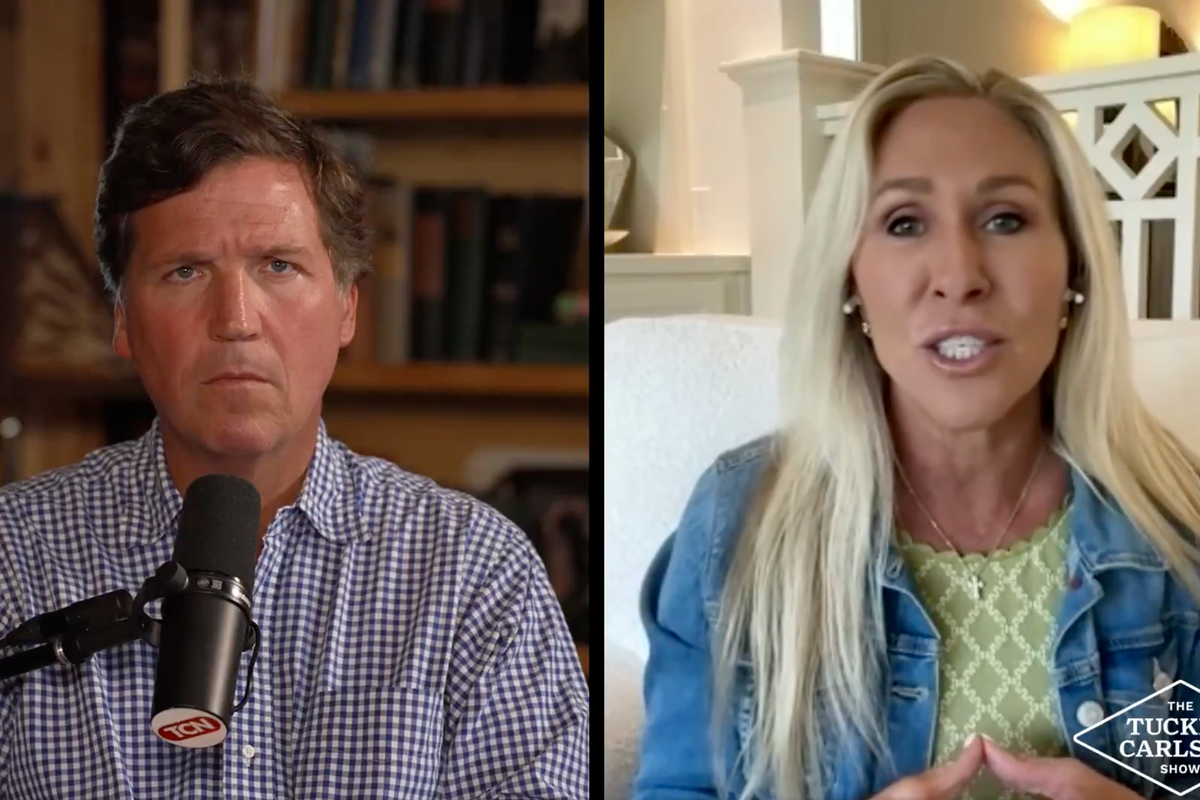
Marjorie Taylor Greene has officially broken ties with the Republican establishment, formalizing a political migration that completely alters the map of American populism. By alignment with media figure Tucker Carlson and a formal departure from the GOP apparatus, the former Georgia congresswoman has declared the party dead to its base. Her exit is not an isolated tantrum. It is the culmination of a months-long ideological civil war that pitted absolute isolationism against the practicalities of a second presidential administration, a split that became inevitable once the structural incentives of Washington clashed with pure movement politics.
The immediate catalyst for this rupture was not a singular vote, but a compounding series of grievances regarding domestic disclosures and foreign interventions. For years, the political apparatus operated under the assumption that the populist right could be disciplined by partisan loyalty. That assumption has shattered. When Greene stood alongside Carlson to proclaim an end to what they termed an establishment betrayal, they were not just launching a new media or political alliance. They were setting fire to the bridge that connected the populist base to the formal structures of the Republican National Committee.
To understand how the relationship deteriorated so completely, one must look closely at the months leading up to her resignation from Congress in January 2026. The alignment between the populist base and party leadership was always transactional. It depended entirely on the execution of a specific, disruptive agenda. When that execution faltered under the weight of legislative compromises and sudden geopolitical escalations, the transactional bond dissolved.
The Epstein Files and the Loss of Institutional Trust
The initial fractures appeared not over foreign policy, but over the handling of internal transparency, specifically the execution of the Epstein Files Transparency Act. Populist voters had long been promised a total, unvarnished disclosure of institutional corruption. When the administration hesitated, citing national security and the protection of ongoing investigative equities, the base did not see prudent governance. They saw a cover-up.
Greene chose to champion the immediate, unrestricted release of these records, forcing a direct confrontation with party leadership and the executive branch. The resulting fallout was swift and intensely personal. Accusations of betrayal were traded openly on social media and in committee hallways. The institutionalists within the party viewed the insistence on total disclosure as a reckless attack on the administration itself, while the populist wing viewed any delay as definitive proof that Washington alters anyone who stays within its orbit too long.
This dispute fundamentally changed the nature of the internal GOP debate. It shifted from a disagreement over policy details to an argument about fundamental honesty. Once a movement concludes that its own leadership is actively hiding information to protect systemic actors, cooperation becomes impossible. The friction grew from a quiet disagreement into an ideological chasm.
The Foreign Policy Breaking Point
If internal transparency created the crack, foreign policy widened it into an unbridgeable gulf. The escalation of military tensions in the Middle East, culminating in the strategic bombing of targets inside Iran, forced every faction on the right to choose between historical party orthodoxy and the strict non-interventionist doctrine that defined the early populist platform.
The establishment chose action, viewing the military maneuvers as an essential assertion of national power. Greene and her closest ideological allies saw it as a catastrophic return to global interventionism. They openly questioned how the expenditure of billions of dollars on foreign military campaigns benefited the working-class families of America's interior. The rhetoric grew increasingly severe, with Greene eventually characterizing certain foreign engagements in terms that completely alienated her from standard committee assignments and party funding structures.
GOP Ideological Fault Lines (2025-2026)

Establishment Position:
- Strategic foreign intervention to secure markets and partnerships.
- Managed transparency to preserve institutional authority.
- Legislative compromise to maintain basic governance.

Populist / Non-Interventionist Position:
- Strict isolationism and domestic resource retention.
- Immediate, total disclosure of institutional records.
- Total opposition to any spending bill containing foreign aid.
The split was accelerated by the realization that legislative majorities were not translating into the specific policy outcomes the populist base demanded. The passage of large spending packages that included foreign aid provisions, combined with a perceived failure to address rising domestic healthcare and housing costs, convinced the populist wing that the party structure itself was a barrier to change.
The Corporate Media Bypass
The decision to execute this split alongside Tucker Carlson highlights the shifting mechanics of political influence. Carlson, operating independently of legacy cable networks, has built a distribution network that bypasses the traditional gatekeepers of conservative thought. For an independent political figure, this infrastructure is far more valuable than the traditional backing of party donors or congressional leadership.
Traditional parties rely on control over funding and ballot access to maintain internal discipline. However, when an individual politician can speak directly to millions of motivated voters through independent digital channels, the party loses its leverage. Greene’s exit proves that for a specific brand of populist politician, institutional isolation is no longer a political death sentence. It is an opportunity to consolidate a more loyal, intense following.
This media ecosystem does not require the approval of a party chairman. It operates on engagement, ideological purity, and a constant critique of institutional failure. By anchoring her post-congressional career in this space, Greene has positioned herself outside the reach of primary challenges or leadership reprimands.
The Math of a Broken Coalition
The departure of high-profile populists creates an immediate mathematical problem for legislative governance. The party’s majority in the House of Representatives was already razor-thin. When a disciplined bloc of lawmakers decides that they no longer answer to the party whip, the capacity to pass routine legislation diminishes significantly.
This is not a temporary legislative hurdle. It is a structural paralysis. To pass funding bills, leadership is forced to look across the aisle for votes, a move that only confirms the populist accusation that both parties are fundamentally the same. Each compromise required to keep the government functioning further alienates the independent base, accelerating the cycle of defection.
- Fundraising shifts: Small-dollar donations are increasingly moving away from official party committees and toward independent populist figures.
- Primary vulnerabilities: Incumbent politicians who side with institutional leadership face severe challenges from candidates backed by independent media networks.
- Policy stagnation: The ideological distance between the party’s moderate wing and its populist defectors makes comprehensive domestic policy virtually impossible to draft.
The financial reality is shifting just as rapidly as the electoral one. For decades, major corporate donors held significant sway over policy outcomes. Today, the populist movement is funded by a decentralized network of small-dollar contributors who are completely uncoupled from the corporate interest groups that traditionally managed Washington politics.
The Myth of the Unifying Figure
For years, observers believed that the populist movement could be held together by individual personalities. This view misunderstood the nature of the movement. The populism that emerged over the last decade was driven by structural economic grievances and deep-seated institutional distrust, not merely by loyalty to a single leader.
When the actions of individual leaders conflicted with the core principles of non-intervention and transparency, the movement chose the principles over the personalities. The public disputes that preceded Greene’s exit demonstrated that the populist base is fully capable of turning on its former heroes if they are seen as compromising with the system. This development signals a new, more volatile phase of American politics where alliances are temporary and institutional loyalty is nonexistent.
The political independent is no longer a moderate seeking middle ground between two dominant parties. The new independent is an ideological hardliner who views both organizations as corrupt iterations of a singular establishment. This shift transforms the independent designation from a position of compromise into a weapon of total opposition.
Electoral Realities in the Deep South and Beyond
The true test of this movement will occur in the upcoming election cycles, where independent populists plan to challenge both traditional parties. In deeply conservative districts, the label of Republican is no longer a guarantee of victory. A candidate running on a pure independent populist platform can split the traditional vote, altering outcomes in regions that were once considered entirely predictable.
This strategy changes the nature of campaign messaging. Instead of debating traditional conservative principles like fiscal restraint or regulatory reform, the debate centers entirely on institutional capture and systemic corruption. The goal is not to win an argument within the existing system, but to convince the electorate that the system itself must be entirely replaced.
The long-term consequence of this fracture is a fragmented electorate where stable majorities are increasingly difficult to construct. The assumption that the American political system will always revert to a predictable two-party balance ignores the reality of the current ideological realignment. The bridge has been burned, and the political figures who have moved across it have no intention of returning.


