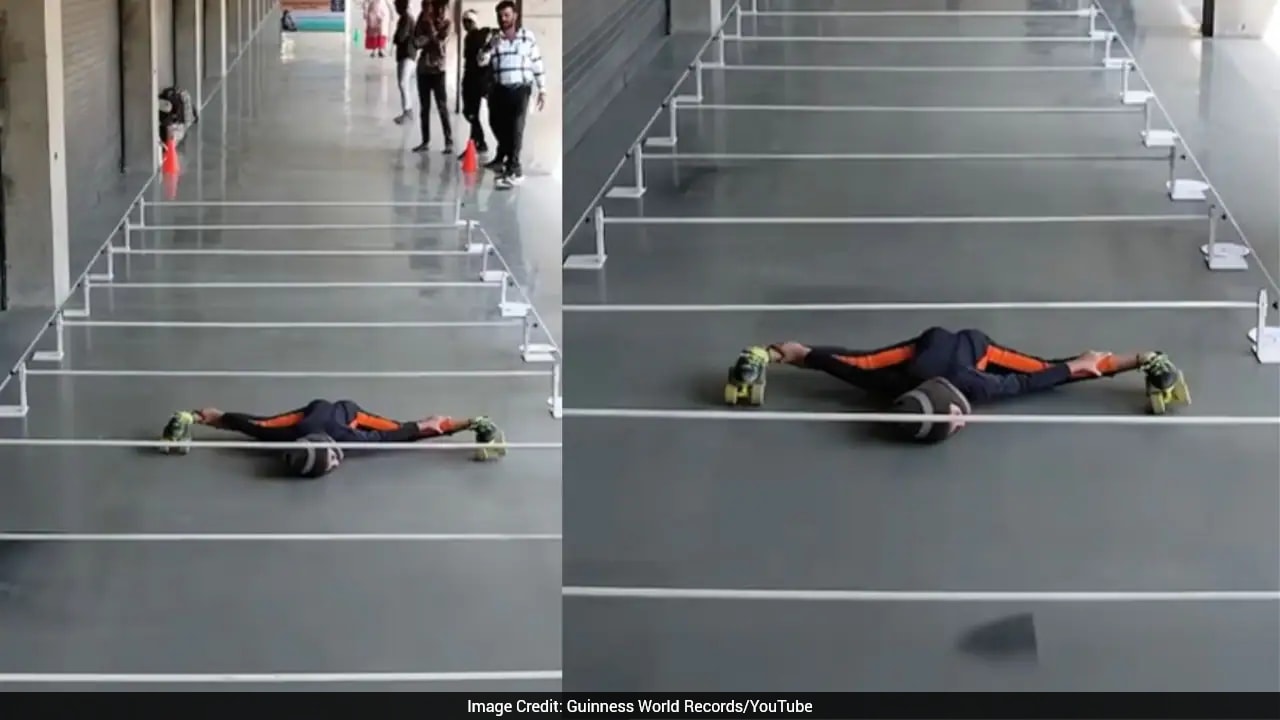
The human body is not designed to fold this way.
If you sit on the floor right now and try to spread your legs into a perfect split, your hip flexors will likely scream a warning by the time you reach a wide V. If you try to lean your chest forward until it touches the hardwood, your lower back will lock up. Now, imagine doing that while balancing on eight polyurethane wheels. Imagine doing it while traveling at fifteen miles per hour. Recently making waves lately: The Gravity of Ben Stokes and the Empty Room English Cricket Fears.
Now, imagine the ceiling above you is dropping. It is no longer a ceiling; it is a solid metal bar placed exactly 15.6 centimeters off the ground.
That is just over six inches. It is roughly the height of a standard smartphone stood on end. To pass underneath it, a human being must essentially become flat. The nose must scrape the floor. The spine must reverse its natural curve entirely, pressing the back of the head against the calves. The arms must stretch out like wings, skimming millimeters above the asphalt. More insights into this topic are explored by FOX Sports.
In Ahmedabad, India, an eight-year-old girl named Takshvi Vaghani looked at that bar. Most people see a gimmick when they look at limbo skating. They see a talent show trick, a colorful spectacle performed at festivals or on viral videos. But if you stand at the edge of the rink and listen to the sound of urethane bearings humming against the polished floor, you realize it is something else entirely. It is a high-stakes chess match between physics and human anatomy.
And the margin for error is zero.
The Geography of Friction
To understand what it takes to break a world record under a 16-centimeter bar, you have to understand the sheer hostility of the setup.
Limbo skating requires a skater to coast beneath an obstacle without any part of their body touching the bar or the ground, except for their skates. In Takshvi’s case, the distance wasn't just a single hurdle. It was a gauntlet stretching across twenty-five meters.
Think about that distance. Twenty-five meters is roughly the length of a standard swimming pool. For twenty-five meters, you cannot breathe. If you inhale, your chest expands by two to three centimeters. In a sport where your ribs are clearing a metal pipe by less than five millimeters, a deep breath is the difference between a clean run and a catastrophic crash.
The physics are brutal. When a skater enters the low-profile position, they lose all ability to generate forward momentum. They cannot pump their legs. They cannot sway their hips. Every ounce of speed must be generated before they drop into the split.
But if you go too fast, the friction of the wind catches your clothes, creating drag that lifts your torso just enough to clip the bar. If you go too slow, you stall halfway through the tunnel, trapped in a bone-shattering stretch, unable to move, while your muscles burn through their remaining glycogen stores.
It is a paradox of motion. You must be explosive to get there, and entirely motionless once you arrive.
The Room Where the Bones Bent
The air inside the sports complex in Ahmedabad smelled of rubber, sweat, and cheap floor wax. It is a familiar smell to anyone who has spent their youth chasing a clock or a tape measure. It is the smell of obsession.
Takshvi’s coach stood near the starting line, his eyes tracking the digital calipers used by the officials from the Guinness World Records. They treat these measurements with the solemnity of an autopsy. They use spirit levels to ensure the bar does not sag even a fraction of a millimeter in the center. A single millimeter of variance would invalidate months of skin-peeling labor.
Watching an eight-year-old prepare for a moment like this changes how you view childhood ambition. We like to think of sports as play, especially for children. We use words like foster and unleash in corporate brochures to describe youth development, but the reality on the concrete is far rawar. It is tedious. It is repetitive. It is a child practicing the exact same drop three hundred times a day until the skin over her inner thighs turns purple from bruising.
Consider what happens next: the skater takes a deep breath, centers her weight, and pushes off.
The acceleration phase lasts less than three seconds. Her skates click against the floor—a rapid, syncopated rhythm. Clack-clack-clack-clack.
Then, silence.
She drops.
To the untrained eye, it looks like a collapse. Her legs snap outward into a 180-degree line, her torso drops forward, and suddenly she is no longer a person standing; she is a human sled, a low-slung kinetic projectile sliding underneath the red-and-white striped bar.
What We Forget About Pain
There is a specific vulnerability in watching someone perform at the absolute limit of human capability. You find yourself holding your own breath, your own shoulders tightening in sympathy.
When Takshvi slid under the first section of the bar, her nose was so close to the ground that the dust kicked up by her front wheels swirled into her eyes. She couldn't blink. Blinking shifts the micro-muscles in the face, and at 15.6 centimeters, even a twitch of the cheekbone can snag the metal above.
We often celebrate the glory of the record—the certificate, the flashing cameras, the proud parents beaming in the background. We forget the quiet mornings that built it. We forget the times her skates slipped, sending her chin slamming directly into the hardwood. We forget the terrifying moments of hyper-extension where the ligaments feel less like rubber bands and more like guitar strings tuned so tight they are about to snap.
The real problem lies elsewhere, though. The physical pain is manageable; it can be iced away. The mental burden is what breaks most young athletes.
Imagine being eight years old and knowing that an entire room of adults is watching you to see if your spine will bend low enough to cheat a mathematical certainty. You are carrying the weight of expectation on a back that hasn't even finished growing.
The run lasted only a matter of seconds, but inside the slide, time dilates. Every meter feels like a mile when you are looking at the world sideways, your ear pressed so close to the floor you can hear the structural vibrations of the building itself.
The Final Millimeter
She cleared the final bar.
When her head emerged from the other side of the structure, she didn't immediately stand up. The human body, having been forced into an unnatural state of compression for so long, requires a moment to remember how to be upright again. She uncoiled slowly, like a watch spring relaxing.
The crowd didn't roar immediately. There was a pause—a collective intake of breath while everyone looked at the judges. Did a stray thread of her jersey touch? Did her back pocket graze the underside of the pipe?
Then, the nod. 15.6 centimeters. A new world benchmark.
The certificate was handed over, photographs were taken, and the dry facts were logged into a database to be distributed to news outlets across the globe. Eight-year-old girl sets record. It reads like a footnote. It reads like something simple.
But if you look closely at the floor where she slid, you can still see the faint, dark streaks left by the heat of her wheels. Those marks are the only real testament to what happened in Ahmedabad. They are the physical residue of a moment where a child looked at a space too small for a dog to crawl through, and decided she could fit her entire life inside it.
The cameras eventually stopped flashing, the officials packed their digital calipers into velvet-lined cases, and the gym began to cool down. Takshvi sat on the bench, pulling at the laces of her skates, her fingers small and slightly trembling from the adrenaline crash.
Outside, the Ahmedabad traffic hummed, completely indifferent to the fact that a few feet away, the earth’s relationship with flexibility had just been rewritten by someone who still has her baby teeth.