French rugby used to be a mess. For a decade, "French Flair" was just a polite way of saying the national team was talented but fundamentally broken. They were the team that could beat the All Blacks one week and lose to Italy the next while arguing in the locker room. Then came Fabien Galthie. He didn't just change the tactics; he changed the entire DNA of how France approaches the sport. He brought a level of cold, calculated intensity that the Federation hadn't seen in generations.
If you want to understand why France is now a global powerhouse, you have to look at the man's obsession with data and his ruthless selection policy. He stopped picking players based on reputation. He started picking them based on "red zone" efficiency and GPS tracking numbers. It was a culture shock for a nation that once valued a cigarette at halftime more than a sprint interval.
The Data Revolution Under The Glasses
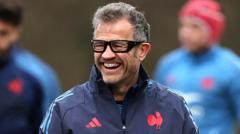
Galthie is often seen pacing the sidelines with those distinctive thick-rimmed sports goggles. They're a perfect metaphor for how he sees the game: with a clarity that borders on the neurotic. Before he took over in 2019, France played off instinct. Galthie replaced instinct with algorithms.
He partnered with tech companies to track every micro-movement on the pitch. We aren't just talking about how far a player runs. We're talking about the speed of the ball coming out of a ruck and the specific fatigue levels of his front row. He realized that modern Test rugby is won in the last twenty minutes. If your props can't hit a certain wattage in the 70th minute, they're gone.
This data-driven approach wasn't popular at first. French fans love a maverick. They love the fly-half who tries a chip-and-chase from his own try line. Galthie hated it. He demanded discipline. He implemented a "kick-pressure" game that felt more like South African pragmatism than Parisian art. But it worked. Winning has a way of silencing the critics who miss the "beautiful" losses of the past.
A Ruthless Culling Of The Old Guard
When Galthie stepped in, he looked at the roster and saw a group of aging stars who were comfortable with mediocrity. He didn't wait for them to retire. He pushed them out. He turned to the youth, specifically the back-to-back Under-20 World Championship winning sides.
Names like Antoine Dupont and Romain Ntamack weren't just "prospects" anymore; they became the pillars. By trusting kids in their early twenties to lead the national side, he built a squad that would grow together for an entire World Cup cycle. It was a massive gamble. Usually, international coaches crave experience. Galthie craved hunger.
- The Dupont Factor: He identified Antoine Dupont not just as a good scrum-half, but as the tactical centerpiece of a new era.
- Fitness Standards: He raised the mandatory fitness levels to a point where several established veterans simply couldn't keep up in training.
- The Shaun Edwards Hire: Bringing in an Englishman to run the defense was a stroke of genius. It broke the insular "French only" coaching tradition and added a layer of grit that was previously missing.
Shaun Edwards brought a "thou shalt not pass" mentality. Suddenly, France wasn't just scoring flashy tries; they were hitting people. Hard. The defense became a weapon of transition. They would bait teams into attacking, strip the ball, and use that famous pace to score on the counter. It was a hybrid of English toughness and French speed.
The Divisive Personality That Drives Success
You don't get to Galthie's level without making enemies. He’s been called arrogant, distant, and overly controlling. During the 2021 Six Nations, he broke COVID-19 protocols to watch his son play rugby, sparking a massive scandal that almost cost him his job. He didn't apologize with much conviction. He just kept winning.
He operates like a CEO rather than a traditional "player's coach." There's no hand-holding. If you're in the squad, you're there to perform a function. If you stop performing that function, the data shows it, and you're replaced by the next 21-year-old off the assembly line. This ruthlessness has created a high-pressure environment where no one feels safe. In the world of elite sports, that's exactly what you want. Complacency is the silent killer of French rugby history.
Building The Club Country Connection
One of the biggest hurdles in French rugby has always been the war between the national team and the Top 14 clubs. The clubs pay the massive salaries, and they historically hated letting their stars go for international duty. Galthie did the impossible: he negotiated a peace treaty.
He worked with the LNR (Ligue Nationale de Rugby) to ensure he had his players for longer preparation windows. He showed the club owners that a successful national team raises the value of the entire league. Because of this, France players now arrive at the Marcoussis training center fresh and tactically aligned, rather than exhausted from a heavy club schedule.
This structural change is arguably his greatest achievement. Without the time to drill his complex tactical systems, the data and the youth movement wouldn't have mattered. He bought himself the time to be brilliant.
Why The Mojo Is Back To Stay
France isn't just a flash in the pan. They've built a system that is sustainable. Even when they suffer injuries to key players like Ntamack, the "system" allows a replacement to step in without the wheels falling off. This is the hallmark of a great program.
Galthie proved that you can keep the soul of French rugby—the speed, the offloads, the flair—while wrapping it in a suit of armor made of modern sports science. They are no longer the team that plays for 60 minutes and collapses. They are the team that waits for you to tire, tracks your heart rate through your jersey, and then strikes when the numbers say you're vulnerable.
If you're looking to apply the Galthie method to your own leadership or sports coaching, stop looking at the highlights and start looking at the spreadsheets. Success isn't about the one "brilliant" play; it's about the thousand tiny efficiencies that lead up to it. Invest in youth early, set non-negotiable standards for physical output, and don't be afraid to be the most disliked person in the room if it means protecting the vision. France found their mojo because they finally decided that being organized was more important than being liked.
Check the current Top 14 standings and see how many of the leading try-scorers are under the age of 23. That’s the Galthie effect in real-time. Keep an eye on the defensive turnover stats in the next Six Nations. You’ll see a team that doesn't just play rugby; they solve it like a math problem.