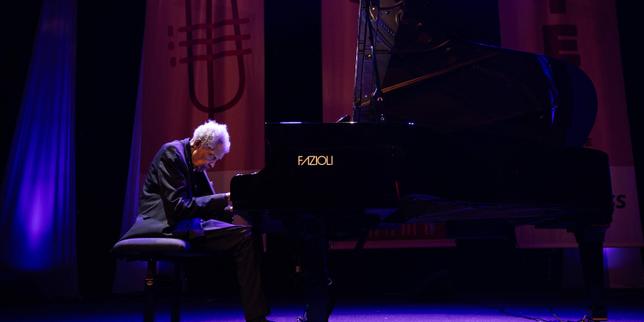
The death of legendary South African jazz pianist Abdullah Ibrahim at age 91 marks the end of an era for global music. Ibrahim passed away peacefully in Germany following a short illness, leaving behind a legacy that transformed Cape jazz into a universal language of resistance. While mainstream reporting frames his passing as the loss of a standard jazz icon, his true legacy lies in how he weaponized melody against an authoritarian regime. He did not just play music; he constructed the sonic architecture of a liberation movement.
To understand Ibrahim, born Adolph Johannes Brand in 1934, one must look beyond the standard obituary timeline. His life was defined by the intersection of forced migration, spiritual evolution, and a radical refusal to allow the state to dictate the boundaries of Black creative expression.
The Sound of District Six
Ibrahim grew up in the cultural crucible of Cape Town's District Six. The neighborhood was a chaotic, brilliant collision of identities. Christian hymns, traditional Khoisan melodies, Cape Malay vocal chants, and American swing records blended together in the streets.
This environment formed his early musical vocabulary. He was raised by his mother and grandmother, both deeply embedded in the African Methodist Episcopal Church. His grandmother played the church piano. His mother led the choir. The secular and the sacred were never separate entities in his mind; they were two sides of the same coin.
By 1959, he formed The Jazz Epistles alongside legends like trumpeter Hugh Masekela and saxophonist Kippie Moeketsi. They recorded the first full-length jazz album by a Black South African band. It was brilliant, fast-paced bebop with an unmistakable township cadence.
Then came the hammer.
Following the Sharpeville massacre of 1960, the apartheid regime intensified its crackdowns. The government banned gatherings, enforced strict segregation at public venues, and explicitly targeted jazz clubs. Jazz was dangerous because it forced integrated audiences into the same room. The state could not tolerate that kind of solidarity.
The Ellington Intervention and Forced Flight
By 1962, the pressure became unbearable. Ibrahim, then still performing under the moniker Dollar Brand, fled South Africa alongside his future wife, the vocalist Sathima Bea Benjamin. They landed in Switzerland, broke and politically unmoored.
A chance encounter in Zürich changed the trajectory of modern jazz history. Benjamin convinced Duke Ellington to come to a local club to hear Ibrahim play. Ellington was transfixed. He immediately arranged for a recording session in Paris, which became the album Duke Ellington Presents the Dollar Brand Trio.
Notable Early Collaborations (1960s-1970s)
===========================================
* Duke Ellington (Arranged breakout Paris sessions)
* John Coltrane (Avant-garde explorations in New York)
* Don Cherry & Ornette Coleman (Free jazz integration)
* Max Roach (Duo performances pushing rhythmic boundaries)
Ellington did not just offer charity; he recognized a kindred spirit who understood that big-band swing and African polyrhythms shared the same root system. This connection brought Ibrahim to New York, putting him at the center of the 1960s avant-garde jazz movement. He rubbed shoulders with John Coltrane and Ornette Coleman, yet his mind remained anchored to the struggles back home.
The Invention of a Liberation Anthem
In 1968, seeking spiritual grounding in an increasingly fractured world, he converted to Islam and took the name Abdullah Ibrahim. He briefly returned to South Africa in the 1970s, a move that resulted in his masterpiece.
In a single, spontaneous recording session in Cape Town in 1974, Ibrahim composed "Mannenberg." Named after a township where the regime dumped displaced families after bulldozing District Six, the track featured a distinct, rolling rhythm known as marabi. It was slow, mournful, yet impossibly defiant.
"Mannenberg" became the unofficial national anthem of the anti-apartheid movement.
The track was smuggled into townships, played through loudspeakers at political rallies, and blasted from underground radio stations. When Nelson Mandela was imprisoned on Robben Island, a tape of "Mannenberg" was smuggled into his cell. Mandela later remarked of Ibrahim, "Bach, Beethoven? We have better."
The power of the track lay in its subversion. The regime viewed township culture as primitive and easily managed. Ibrahim took the very sounds of those discarded spaces and turned them into a sophisticated, international symbol of resistance.
The Discipline of the Keys
What separated Ibrahim from his American contemporaries was his treatment of time and space. While American bebop prized rapid-fire velocity and complex chord substitutions, Ibrahim leaned into repetition and weight. His left hand anchored the bass line with the heavy, unyielding cadence of a church march, while his right hand spun delicate, folk-inflected melodies above the noise.
His later years showed no signs of creative deceleration. He spent decades studying koryu budo, an ancient Japanese martial arts tradition, under Grand Master Tonegawa. This discipline directly informed his solo piano performances, which became exercises in extreme minimalism and intense focus. Every note carried the weight of an entire history.
When Mandela was inaugurated as president in 1994, Ibrahim was invited back from exile to perform. It was a moment of profound vindication, but Ibrahim refused to treat it as a final victory lap. He understood that political liberation was only the first step.
He dedicated his remaining decades to educational initiatives like the Green Kalahari Project, trying to pass musical and agricultural literacy down to a younger generation of South Africans. He continued to perform into his nineties, surprising audiences as recently as March 2026 with an intimate, unannounced set at the Cape Town International Jazz Festival.
Ibrahim never viewed his work through the lens of mere entertainment. For him, the piano was an instrument of historical preservation. When the apartheid government tried to erase the identity of South Africa's majority population, Ibrahim recorded the erasure, archived the pain, and broadcasted the survival of his people to the global stage. His passing removes a monumental pillar from the jazz world, but the rhythmic architecture he built remains completely indestructible.