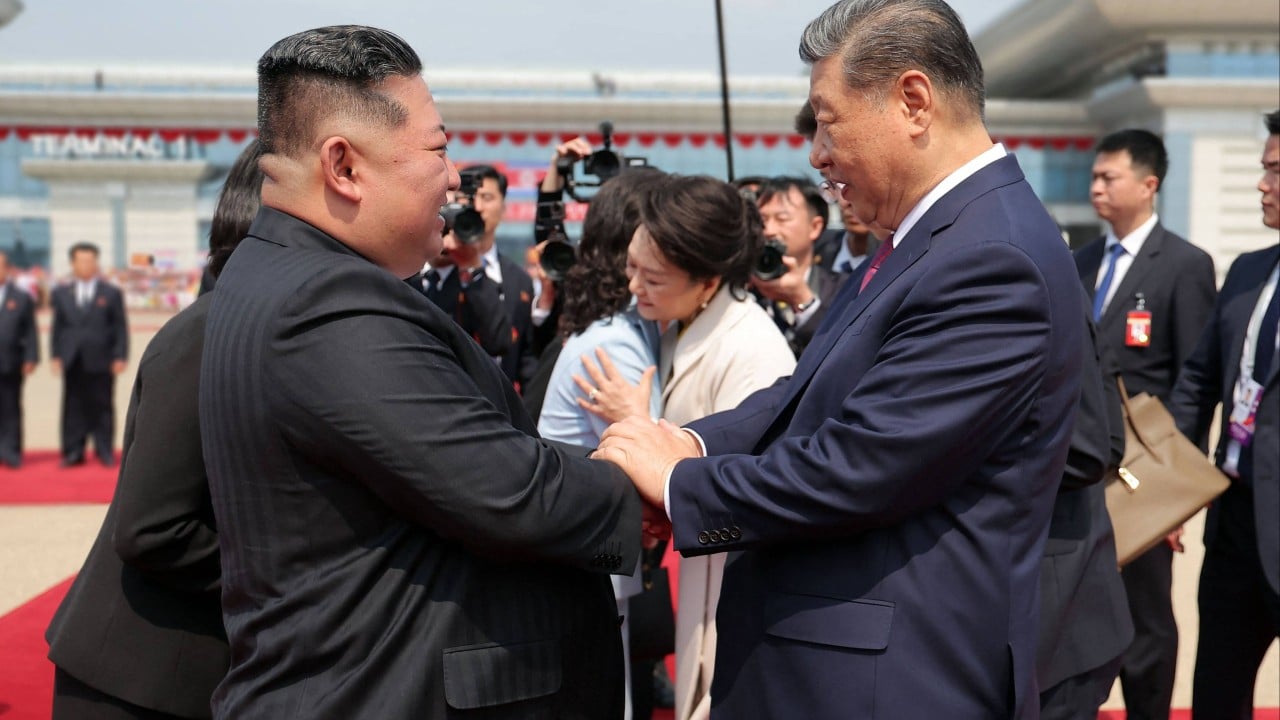
Western analysts are collectively losing their minds over Xi Jinping’s sudden trek to Pyongyang. The talking heads look at the grand receptions, the absolute silence on denuclearization, and the mutual defense posturing, and they immediately roll out the standard, predictable script. They tell you Beijing is desperate to leash a rogue Kim Jong Un who has spent the last two years cozying up to Vladimir Putin. They tell you China is terrified of losing its proxy to Russia or triggering a massive Washington-Tokyo-Seoul military axis.
They are fundamentally misreading the board.
The mainstream consensus treats North Korea like a misbehaving child and China like an anxious parent trying to keep the house from burning down. This entire framework is dead wrong. I have spent years tracking East Asian defense procurement and tracking the quiet flows of dual-use hardware through the Yalu River. Let me tell you how this actually works: Beijing isn’t panicking about Russia, nor is it trying to play nice with Washington.
What we witnessed in Pyongyang wasn't an emergency intervention. It was a cold, calculated consolidation of a high-tech manufacturing and intelligence ecosystem designed to bypass Western containment permanently.
The Myth of the Anti-Western Bloc
Open any major foreign policy publication and you will see the same lazy acronym thrown around: "CRINK" (China, Russia, Iran, North Korea). The conventional wisdom insists these nations are forming a tight, NATO-like ideological alliance to upend the global order.
This is an illusion. The relationships between these states are fiercely transactional, bordering on paranoid. China is a global economic superpower deeply integrated into global trade supply chains; North Korea is a highly militarized garrison state operating on the fringes of the global economy. They do not share a vision for a "new global architecture." They share a border and a list of enemies.
The idea that Xi Jinping went to Pyongyang because he was "irritated" by Kim Jong Un sending troops to assist Russia in Ukraine misses the structural reality. Beijing doesn’t operate on emotion. For China, North Korea’s deeper ties with Moscow aren't a threat; they are an asset. Every single artillery shell or missile technology transfer moving between Pyongyang and Moscow acts as a stress test for Western defense logistics. It drains Western stockpiles while keeping Beijing's hands completely clean.
Xi's silence on the nuclear issue during the summit isn't a "tacit acceptance" or a sign of weakness. It is a calculated deployment of strategic ambiguity. By completely dropping the word "denuclearization" from the official state readouts, Beijing effectively told Washington that the old diplomatic playbook is dead. The U.S. can no longer rely on China to act as the world’s unpaid security guard on the Korean Peninsula.
The Real Play: Industrial Symbiosis and Technology Monitoring
The lazy consensus ignores the actual mechanics of what Xi brought with him to Pyongyang: a delegation packed with defense, law enforcement, and technology officials. The mainstream media looks at a state visit and sees political theater. If you want to know what is actually happening, look at the industrial supply chain.
North Korea has spent the last several years rapidly modernizing its military apparatus, recently unveiling plans for massive naval destroyers and highly advanced missile tracking systems. Where do you think the core foundational technology for those systems originates? It isn't coming from thin air, and Russia cannot provide it all while choked by its own wartime constraints.
Consider the real nature of this renewed bilateral "blueprint":
- Intelligence Co-optation: By expanding military and law enforcement exchanges, Beijing isn't just offering support. It is inserting its own eyes and ears directly into the North Korean military command structure. This allows China to monitor exactly what technological secrets and telemetry data are flowing back from Russian battlefields into Pyongyang.
- The Yellow Sea Buffer: A highly capable, conventional North Korean military acts as a permanent shield for China's industrial heartland. If Pyongyang can field credible air defense systems and naval assets, it forces the U.S. Seventh Fleet to spread its surveillance and deterrent capabilities thin, directly relieving pressure on the Taiwan Strait.
- The Dual-Use Pipeline: While the West focuses entirely on nuclear warheads, the real strategic shift is in dual-use tech—machine tools, semiconductor components, and advanced metallurgy. China can outsource high-risk, heavily sanctioned manufacturing processes to North Korean facilities, utilizing a highly disciplined labor force that operates entirely outside Western regulatory reach.
Dismantling the Deceptive Questions
Go through the standard "People Also Ask" entries regarding East Asian security, and the structural blindness of the current discourse becomes glaringly obvious.
Is China losing its leverage over North Korea to Russia?
This question assumes leverage is a zero-sum game. It isn't. Kim Jong Un utilizing Russian energy and financial inflows doesn't make him less dependent on China; it makes him a more resilient buffer state for China. A bankrupt, starving North Korea is a liability for Beijing. A self-sustaining, aggressively armed North Korea that funds itself through arms sales to Moscow is a massive net win for Chinese strategic depth. Beijing hasn't lost leverage; it has successfully outsourced the financial maintenance of its neighbor to the Kremlin.
Will North Korea's nuclear expansion force a US-led regional response?
The premise here is that Washington isn't already fully committed to militarizing the region. Tokyo is already shedding its post-WWII pacifist constraints, and Seoul is consistently pushing for deeper integration with U.S. nuclear planning. Xi knows this pivot is happening regardless of what Kim Jong Un does. Trying to force North Korea to denuclearize to placate the West is a sucker’s game that Beijing abandoned years ago. Instead, China is using North Korea’s growing nuclear leverage as a counterweight to Japan’s military resurgence.
The Cost of the Strategy
No strategy is without its downside, and pretending this is a flawless victory for Beijing is equally naive. The risk of this hyper-pragmatic approach isn't that North Korea goes rogue; it's the lack of fine-tuned control.
By integrating military communications and tech pipelines, Beijing is permanently tethering its own security apparatus to a regime that thrives on brinkmanship. The 1961 mutual defense treaty, renewed through 2041, means that if North Korea miscalculates and triggers a kinetic conflict in the region, China is legally and strategically dragged into a confrontation it does not want.
Furthermore, this overt shift from "mediator" to "partner" completely destroys any lingering illusions in European capitals that China can act as a neutral broker in global security. It cements a bifurcated security architecture that will accelerate economic decoupling, making technology supply chains even more fragmented and expensive to maintain.
Stop Misreading the Board
The West needs to stop treating the Pyongyang summit like an episode of diplomatic panic. Xi Jinping did not go to North Korea to beg Kim to behave. He went to lock down a vital cog in China's broader regional denial strategy.
The old world—where Washington and Beijing could sit down, agree that a nuclear North Korea was unacceptable, and pass joint UN resolutions—is completely gone. It has been replaced by a raw, transactional landscape where a nuclear-armed Pyongyang is far more useful to Beijing as a permanent, high-tech thorn in the side of the Western alliance than as a compliant, disarmed neighbor.
The blueprint has been signed. The technology transfers are already moving. Stop looking for signs of a rift between these regimes and start looking at the industrial integration happening right under your nose.


