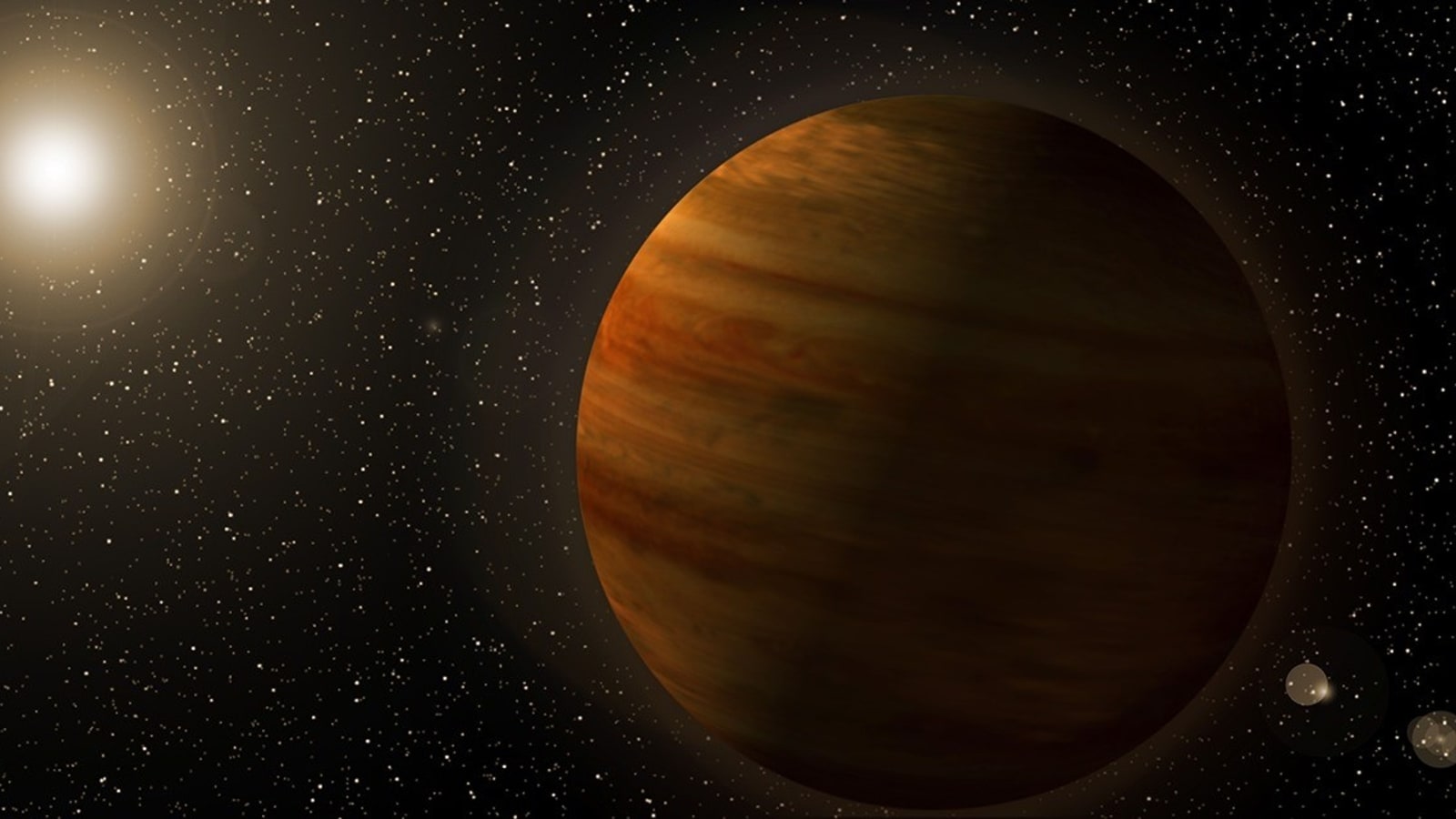
The media is swooning over yet another deep-space discovery. Headline writers are breathlessly repeating the narrative that finding a massive exoplanet tens of thousands of light-years away changes how we understand the cosmos. They call it a rare, exotic triumph of modern astrophysics.
They are completely missing the point. For another perspective, check out: this related article.
Finding a "Super-Jupiter" at a distance of 40,000 light-years is not an engineering miracle. It is a stark reminder of our current technological limitations. We are celebrating the cosmic equivalent of noticing a blazing stadium light from five miles away while remaining entirely blind to the thousands of smaller, more significant details right under our noses.
The obsession with massive, distant gas giants is warping public perception of space exploration and misallocating scientific attention. Similar analysis on the subject has been provided by Mashable.
The Selection Bias Fallacy
Mainstream coverage treats these discoveries as if we are mapping the universe representatively. We are not. What the public rarely hears about is selection bias, specifically the limitations of the transit method and radial velocity measurements used by probes like NASA's TESS or Kepler.
To find a planet 40,000 light-years away, that planet has to be utterly gargantuan. It must possess immense mass or block a massive percentage of its host star's light.
- What we actually found: A bloated, scorching ball of gas so close to its star that its year lasts only a few Earth days.
- What the media reported: A miraculous, rare discovery that advances our search for cosmic neighbors.
There is nothing rare about a Super-Jupiter. They are the easiest things in the universe to spot. Celebrating the detection of a massive gas giant at extreme distance is like claiming you have superior eyesight because you can see a bonfire on a distant mountain while tripping over a rock at your feet. It is a direct result of observational limitations, not cosmic scarcity.
The Light-Year Distraction
Let us look at the actual physics of a 40,000 light-year distance.
The data we are analyzing right now left that planet during the Upper Paleolithic period on Earth. Neanderthals were still walking the planet when those photons began their journey. From a practical data standpoint, that planet might not even exist anymore in the form we are observing.
More importantly, the signal-to-noise ratio at that distance is brutal. Standard data processing pipelines have to strip out massive amounts of interstellar dust interference, stellar variability, and instrumental noise just to extract a faint, dip-shaped graph.
I have watched research teams spend months arguing over whether a data dip was a genuine exoplanet or just a glitch in the detector electronics. When you push sensors to their absolute limit across tens of thousands of light-years, the margins for error skyrocket. We are betting massive amounts of prestige on statistical probabilities, all while ignoring the much harder, much more valuable work required closer to home.
The False Promise of Habitability and Scale
The public frequently asks variations of the same question: "Does this discovery bring us closer to finding life?"
The honest answer is an absolute, resounding no.
A Super-Jupiter is a chaotic, crushing environment of metallic hydrogen and atmospheric pressures that would liquefy human probes in milliseconds. Yet, publication after publication attaches artist renderings of beautiful, swirling blue marbles to these announcements, subtly hinting at habitability to drive clicks.
This habit of hyping up distant giants creates a toxic cycle for real science funding.
The Funding Loophole
- A space agency needs to justify its multi-billion dollar budget to a committee of politicians who do not understand orbital mechanics.
- The agency releases a highly sensationalized report about a massive, distant planet.
- Media outlets run wild with speculative graphics.
- The public gets excited about a useless gas giant 40,000 light-years away.
- Critical funding for local solar system exploration—like sending advanced ice-penetrating cryobots to Europa or Enceladus—gets sidelined because searching for microscopic life in our own backyard does not generate the same grand, sweeping headlines.
If we want to find actual signs of life, or even just understand stable planetary systems, we need to stop looking at the horizon through a muddy straw. We need to refocus on the rocky, small planets within a hundred light-years. Those are the systems where we can actually attempt atmospheric transmission spectroscopy with enough precision to detect true biosignatures like methane, oxygen, and ozone.
The Real Technical Challenge Ahead
The current approach is comfortable. It relies on automated algorithms flagging predictable dips in brightness from massive objects. It scales well for press releases, but it does not scale for genuine scientific breakthroughs.
The downside to shifting our focus is clear: looking for Earth-sized planets close by is incredibly tedious and yields fewer instant-gratification headlines. Rocky planets produce tiny signals. Detecting an Earth twin requires a level of instrumental stability that our current space telescopes struggle to maintain over long periods. It means dealing with the messy, unpredictable stellar activity of nearby M-dwarf stars, which frequently unleash flares that mask planetary signals entirely.
It is difficult, unglamorous work. But it is the only work that matters if the goal is actual exploration rather than astronomical bookkeeping.
Stop measuring the success of space probes by how far away their discoveries are. A planet found 40,000 light-years away is an inaccessible ghost. A rocky world thirty light-years away is a tangible target.
Demand better from the scientific narrative. Stop applauding the low-hanging fruit of cosmic giants, and start forcing resources toward the incredibly difficult, quiet work of analyzing the small, rocky worlds that actually have a story to tell.
Fire the public relations teams rewriting statistical anomalies into cosmic milestones. Turn the telescopes around. Look closer.


