The heavy oak door of the old town hall didn't rattle when the wind blew, but the glass inside it did. It was a thin, fragile pane, separating the quiet bureaucracy of local government from the sprawling, unpredictable life of the square outside. For decades, a invisible line ran right down the middle of that threshold. On one side stood the law, cold and indifferent. On the other stood faith, warm and deeply personal.
People knew where they stood. They knew the rules.
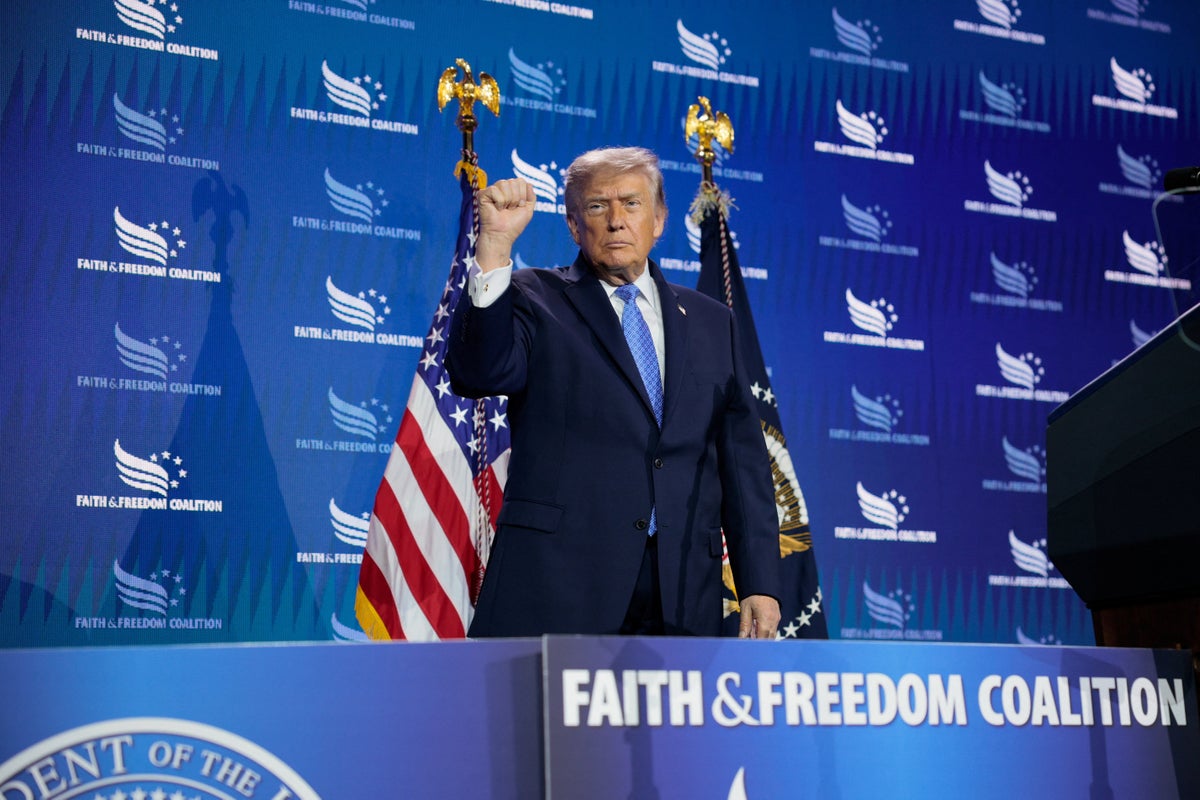
Now, a new directive from Washington is aiming to take a crowbar to that threshold. A high-level federal commission, appointed under the Trump administration, has issued a sweeping set of recommendations designed to dismantle the traditional boundaries between church and state. They call it building bridges. Critics call it a sledgehammer to the foundation of American pluralism. But away from the television studios and the shouting matches on Capitol Hill, the reality of this shift lands on the doorsteps of ordinary people.
Consider a small-town food pantry.
For years, Grace Fellowship operated out of a damp basement, funding its grocery distribution through bake sales and tithing. Under the new recommendations, federal grant money would flow directly into their accounts, no longer restricted by the old rules that required a strict separation between charity and proselytizing. On paper, it looks like a victory for efficiency. More money means more soup, more bread, more families fed.
But look closer at the line forming outside on a Tuesday morning.
David stands near the back of the queue. He is shivering. He hasn't held a steady job since the local textile mill folded two winters ago. He is also a devout agnostic, a man whose relationship with religion ended painfully in his youth. Under the proposed framework, the taxpayer dollars funding the soup in his bowl are tied to an organization that now has the legal backing to integrate mandatory prayer into the intake process. David faces a choice that feels less like freedom and more like coercion: feed his stomach or compromise his conscience.
The tension isn't new, but the velocity of the change is.
The Architecture of the Divide
Thomas Jefferson famously wrote about a wall of separation. It was never a wall built to imprison religion, but rather a protective dike designed to keep the muddy waters of government politics from corrupting the purity of faith, and vice versa. When the state begins to fund the church, the state eventually wants a say in how the church is run. Conversely, when the church gains the keys to the state's coffers, the temptation to use law enforcement to enforce dogma becomes intoxicating.
The commission’s report argues that the current system marginalizes religious organizations, treating them as second-class citizens when it comes to federal procurement and community development programs. They argue that if a secular non-profit can get a grant to build a playground, a house of worship should have the exact same right, even if that playground sits beneath a towering crucifix.
It sounds fair.
But fairness in a diverse nation of 340 million people is a slippery concept. The United States is no longer a monochrome society. A bridge built specifically to connect the state to one dominant religious tradition quickly becomes a barrier to everyone else. If a local government partners with a faith-based drug rehabilitation center that refuses to employ anyone who doesn't sign a specific statement of faith, a qualified counselor who happens to be Jewish, Muslim, or non-religious is effectively barred from a job funded by their own tax dollars.
The friction builds quietly, in places you wouldn't expect.
The Cost of Compliance
There is a quiet irony that advocates for church-state integration often overlook. Government money is never free. It comes wrapped in red tape, reporting requirements, and compliance audits.
Imagine Pastor Thomas. He has spent thirty years tending to a small, fiercely independent congregation in Ohio. He prides himself on the fact that his church answers only to God. When the new federal initiatives open up millions of dollars for faith-based youth mentorship, his board pressures him to apply. They win the grant.
Then the auditors arrive.
Suddenly, Pastor Thomas is spending his Thursday nights filling out federal spreadsheets rather than visiting the sick in the hospital. He has to prove that every dollar spent on basketballs and tutoring didn't accidentally cross the line into sectarian worship during government-funded hours. The state’s ledger books are now open on his desk, right next to the Bible. The independence he cherished is gone, traded for a slice of the federal budget.
The commission views this as a grand harmonization, a way to leverage the massive infrastructure of American churches to heal broken communities. Yet the history of such partnerships suggests a different outcome. When faith becomes an arm of the bureaucracy, it loses its prophetic voice. It becomes just another special interest group lobbying for its share of the pie.
The View from the Classroom
Nowhere are the stakes higher than in the public school system, the traditional battleground for the soul of the community. The commission’s proposals lean heavily into expanding voucher programs, allowing public funds to pay for tuition at private religious academies.
To a parent struggling in a failing school district, a voucher looks like a golden ticket. It offers an escape hatch, a chance to send their child to a school with discipline, uniforms, and high test scores.
But money is a zero-sum game. Every dollar that leaves the public school system in a backpack travels away from the children who remain behind. Those who stay are often the most vulnerable—the kids with severe learning disabilities, the ones whose parents can't afford the transportation to a distant academy, the ones who don't fit the behavioral profile required by a private institution's code of conduct.
The public school was designed to be the great mixing chamber of American life. It is the place where the son of a banker sits next to the daughter of an immigrant, where they learn to navigate their differences before they get to the voting booth. When the state funds the balkanization of education along religious lines, that mixing chamber shatters. We end up with silos. We get echo chambers wrapped in school colors.
The Unseen Shift
The debate is often framed as a conflict between believers and secularists. That is a mistake. Some of the most ardent defenders of the separation of church and state are people of deep, unshakable faith. They understand that a government big enough to establish a religion is big enough to dictate its terms.
The commission’s report is not a law yet. It is a blueprint, a declaration of intent from an administration determined to redraw the map of American civic life. The changes will not happen overnight with a dramatic stroke of a pen. They will happen incrementally, in the fine print of federal regulations, in the wording of municipal contracts, and in the quiet adjustments made by local school boards.
The glass in the town hall door remains thin.
Outside, the town square is filling up. People are walking past each other, heading to work, to the grocery store, to prayer, or to nothing at all. They manage to live together not because they agree on the nature of the universe, but because they agreed on a set of rules that allowed everyone to search for meaning on their own terms, without the government tilting the scales. If those rules change, the peace that felt so natural for so long might suddenly feel very fragile indeed.