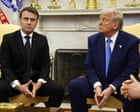
The air in the room was thick with the scent of expensive cologne and the heavy, electric hum of global tension. High above the streets of a world that feels increasingly fragile, a podium stood as the epicenter of a tectonic shift. It wasn't just a political speech. It was a divorce.
For decades, the relationship between the United States and Europe has been a marriage of convenience cemented by oil, blood, and shared history. But at a recent rally, the rhetoric shifted from cooperation to a cold, transactional ultimatum. Donald Trump’s message was stripped of diplomatic niceties: if Europe wants the oil that flows through the volatile veins of the Middle East, they shouldn't expect the American military to be the only one holding the line.
"Get your own oil."
Those four words carry the weight of a thousand shuttered factories and the ghosts of conflicts past. To understand why this matters, you have to look beyond the headlines and into the gas tank of a small hatchback in a village outside Berlin or a logistics hub in the heart of Ohio. We are talking about the literal energy that keeps modern civilization from grinding to a halt.
The Shield and the Spigot
Imagine a neighborhood where one house pays for the security guard that protects the entire street. For years, the U.S. has acted as that guard in the Persian Gulf. It is a grueling, expensive, and often thankless job. The American taxpayer shells out billions to ensure that tankers can move through the Strait of Hormuz without being seized or shelled.
The logic of the recent tirade is simple, if brutal. Why should American soldiers risk everything to protect a resource that fuels the European economy more than its own? The U.S. has become a net exporter of energy; it doesn't need the Middle East the way it used to. Europe, however, is a different story.
Think of a continent as a massive, hungry engine. It breathes in natural gas and drinks oil. Without a steady supply, the lights dim. The heating stops. The social contract begins to fray. When the U.S. suggests that Europe is "freeloading" on American military might while refusing to join the fray against Iran, it isn't just an insult. It is a threat to the very infrastructure of European life.
The Human Cost of Cold Shoulders
Let’s look at a hypothetical worker named Elias. Elias works at a chemical plant in Ludwigshafen. He doesn't care about geopolitical posturing or the nuances of the Joint Comprehensive Plan of Action. He cares about the price of feedstock. If the shipping lanes in the Gulf become a shooting gallery because the U.S. decides to pack up and go home, Elias’s factory closes.
On the other side of the Atlantic, there is Sarah. Her son is a machinist’s mate on a carrier currently stationed in the Fifth Fleet. To her, the "strategic importance" of the Gulf is a thin veil for the terrifying reality that her child is a target in a war that feels disconnected from her daily life in the Midwest.
When a leader stands up and says, "Get your own oil," he is speaking directly to Sarah. He is telling her that her son’s life shouldn't be the currency used to pay for Elias’s cheap electricity. It is a powerful, seductive argument. It plays on the primal instinct to protect one’s own and let the rest of the world fend for itself.
The Iranian Shadow
The tension isn't just about oil; it’s about the specter of a nuclear Iran and the varying definitions of "security." Washington often sees a binary world: you are either with us or you are against us. Europe, scarred by the proximity of the Middle East and the lessons of the Iraq War, tends to favor a more layered, often frustratingly slow diplomacy.
The "tirade" mentioned in the reports is a byproduct of this fundamental disagreement. The U.S. feels like it is doing the heavy lifting to contain a regional threat, while Europe reaps the benefits of stability without the political or military cost. It is a classic "free rider" problem, viewed through a lens of populist frustration.
But what happens if the guard actually leaves the post?
The Middle East is not a vacuum. If the American presence diminishes because Europe refuses to "pay their fair share" in blood or treasure, other powers are waiting in the wings. We are talking about a world where the security of the global energy supply is no longer managed by a Western alliance, but by a chaotic scramble of regional powers and opportunistic rivals.
The Fragility of the Status Quo
It is easy to dismiss political rhetoric as theater. We’ve become desensitized to the shouting. Yet, there is a visceral reality to the idea of a fractured West. The "Get your own oil" sentiment represents a breaking point in the post-WWII order.
We often think of global stability as a permanent fixture, like the mountains or the sea. It isn't. It’s a delicate web of promises, most of them kept out of fear or mutual benefit. When those promises are questioned—when the protector tells the protected to find their own way—the web begins to tear.
Consider the logistics of a Europe forced to secure its own energy lanes. It would require a massive buildup of naval power, a unified foreign policy that currently doesn't exist, and a stomach for intervention that many European voters simply do not have. The alternative is a desperate, individual scramble for resources, where every nation cuts its own deal with whoever holds the tap.
Beyond the Podium
The anger in the speech wasn't just about Iran or oil. It was about a perceived lack of respect. It’s the feeling of a partner who realizes they’ve been doing all the chores while the other person sits on the porch.
Whether that perception is fair is almost irrelevant. In politics, perception is the only truth that dictates policy. If the American public begins to believe that they are being played for fools, the mandate for global leadership vanishes.
The stakes are invisible until they aren't. They are invisible when you turn on your stove and the blue flame appears instantly. They become visible when that flame flickers and dies because a tanker was hit five thousand miles away and no one was there to stop it.
The conversation is shifting from "how do we lead the world?" to "why should we care?" That shift is the most dangerous development of our time. It replaces the messy, difficult work of diplomacy with a sharp, isolationist edge.
When the shouting stops and the cameras are packed away, the reality remains. We are all connected by these invisible threads of energy and security. You can tell someone to get their own oil, but in a globalized world, there is no such thing as "your own." There is only the supply we protect together, or the shortage we suffer alone.
The podium is now empty. The echoes of the tirade still bounce off the walls, leaving a lingering question that no one seems ready to answer. If the old alliances are dead, and the protector has walked away, who is left to keep the lights on when the sun goes down over the Gulf?
The world is waiting for an answer, but all it hears is the sound of a closing door.