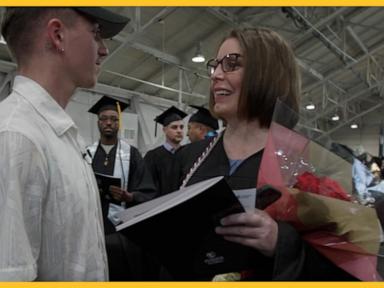
The Weight of a Graduation Gown
Canvas and polyester shouldn’t feel this heavy. When a non-traditional student zips up that gown, they aren’t just wearing a uniform for a ceremony; they are wearing every late-night shift, every skipped bedtime story, and every moment they felt the world was moving faster than they were. For a mother crossing that stage, the fabric carries the invisible weight of a household.
The air in a graduation arena is usually thick with a specific kind of humidity—a mix of industrial air conditioning and the nervous sweat of thousands. You hear the drone of names, a rhythmic, hypnotic march of syllables. It is easy to get lost in the sea of mortarboards. But for one woman, the day was missing a vital anchor. Meanwhile, you can find similar stories here: The Micro-Refrigeration Thesis: Decoupling Utility from Luxury in Personal Care Infrastructure.
She knew where he was. Or, at least, she knew the general coordinates of his absence. When your son is in the United States Army, his presence isn't measured in physical proximity, but in the strength of a Wi-Fi signal or the rare, crackling cadence of a long-distance phone call. You learn to live with a phantom limb. You celebrate milestones with a camera lens and a prayer that the connection doesn't drop before the "I love you" lands.
The Geography of Absence
Military families exist in a state of permanent, low-grade vertigo. You are here, but a part of your heart is moving through a desert, or sitting in a barracks halfway across the globe, or flying over an ocean you’ve never seen. It’s a specialized kind of grief that isn't quite loss—it's a suspension. To explore the bigger picture, we recommend the excellent report by Glamour.
Consider the logistics of a surprise. It requires a symphony of secrets. It demands that a soldier navigate the rigid bureaucracy of leave requests, flight delays, and the agonizingly slow pace of civilian traffic, all while maintaining the ruse. He wasn’t supposed to be there. The script of her life had already accounted for his absence. She had braced herself for the bittersweet sting of looking into the crowd and seeing a gap where her son should have been sitting.
She had done the math. She knew the deployment schedules. She knew the cost of a plane ticket and the rarity of time off. The logic of the situation dictated that he would be a voice on a speakerphone later that night.
But logic is a poor match for a son’s resolve.
The Moment the Script Broke
The ceremony proceeded with the clinical efficiency of an assembly line. Name. Handshake. Photo. Move. The rhythm is designed to keep the momentum going, to process the sheer volume of achievement before the sun goes down. She walked toward the center of the stage, her mind likely a blur of relief and exhaustion.
Then, the rhythm fractured.
A figure emerged from the wings. He wasn't wearing a gown. He was wearing the OCPs—the multicam pattern of the Army—that had become his second skin. The contrast was jarring. Against the sea of black academic robes, the camouflage stood out like a lightning strike.
She didn't see him at first. Recognition is a slow process when the brain has spent months rehearsing for someone's absence. We see what we expect to see. When we see the impossible, there is a momentary glitch in our processing.
Then, she turned.
The sound that left her wasn't a cheer. It was a guttural, primal recognition. It was the sound of a mother realizing that the geography of her world had just shifted back into alignment. She collapsed into him, and for a few seconds, the graduation, the degree, and the thousands of watching eyes ceased to exist. There was only the tactile reality of a uniform against a graduation robe.
The Invisible Stakes of the Return
We often treat these viral moments as fleeting bits of "feel-good" content. We scroll past them between political arguments and advertisements. But we miss the structural integrity of what is actually happening.
This wasn't just a "sweet moment." It was a collision of two different kinds of service.
One person had served her family by bettering herself, proving that it is never too late to reclaim an education that life had deferred. The other had served his country, sacrificing the comfort of home for a larger, often thankless duty. When they hugged on that stage, it was the union of two people who had both learned the hard way that the most important things in life are rarely easy.
The statistics tell us that military families face higher rates of stress and emotional strain than almost any other demographic. The "reunion" is the peak of a very long, very jagged mountain. Behind that hug were months of worrying about "the knock on the door." Behind that hug were letters that took too long to arrive and birthdays celebrated via blurry video chats.
Beyond the Viral Clip
What happens when the cameras turn off?
The viral video ends with the applause. But the reality is much deeper. The reality is the quiet dinner that follows, where the son tells stories that didn't make it into the letters. It's the mother looking at her diploma and realizing it represents not just her intellect, but the resilience of a family that stayed whole while being pulled apart by thousands of miles.
The true power of this story isn't the surprise itself. It’s the reminder that our lives are built on these fragile, essential connections. We spend so much time chasing "success"—the degree, the promotion, the accolades—that we forget these things are hollow without a witness. A graduation is a lonely affair if there is no one in the stands who remembers when you were too tired to keep going.
The son didn't just show up for a photo op. He showed up to be the witness. He showed up to say, "I saw the work you put in while I was gone."
The Echo in the Arena
As they walked off the stage together, the ceremony resumed. The next name was called. The assembly line started moving again. But the atmosphere had changed. The strangers in the stands weren't just watching a graduation anymore; they were reminded of their own "missing" people.
Everyone has an empty chair. Maybe it’s a soldier overseas, or a parent who passed away too soon, or a friend who moved across the country. We all carry the weight of someone who isn't there.
Seeing that gap filled—even for a moment, even for a stranger—is a form of catharsis. It’s a proof of concept. It suggests that despite the chaos of the world, despite the distance and the danger, sometimes the person we need most finds a way to stand right next to us exactly when the music starts.
The tassel was turned. The degree was conferred. But the real education happened in that three-second span when a mother realized her son was home.
The gown didn't feel heavy anymore. It felt like wings.