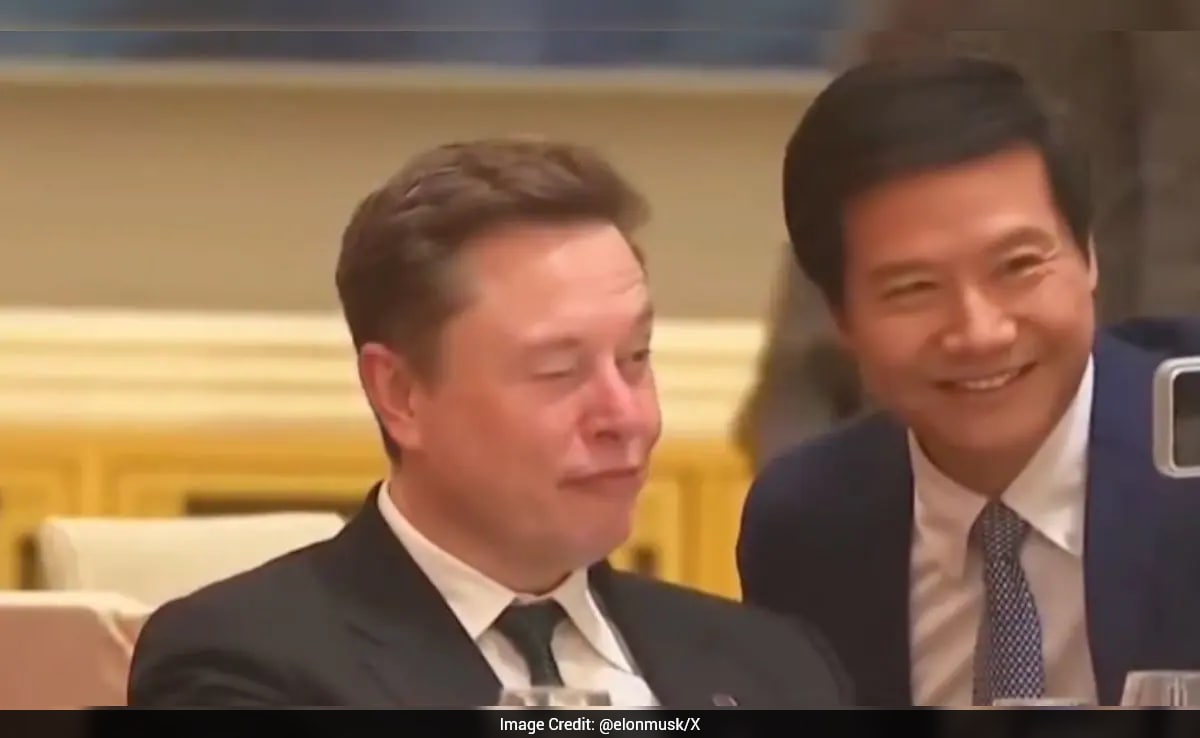
The media wants you to look at a funny face.
While Donald Trump and Xi Jinping sat down for a high-stakes state dinner in Beijing, the cameras caught Elon Musk making an animated, goofy facial expression. Within minutes, the internet did exactly what it was trained to do. Clickbait factories churned out articles mockingly analyzing the "bizarre gaffe." Pundits tut-tutted about a lack of decorum on the international stage.
They missed the entire point.
The lazy consensus treats this moment as a slip-up, an accidental breach of protocol by an eccentric billionaire who cannot contain himself. That narrative is comforting to people who want to believe the world is run by rigid bureaucrats adherence to 19th-century etiquette manuals. It is also entirely wrong.
Musk’s performance at that dinner was a calculated exercise in corporate statecraft. In a room suffocating under the weight of scripted, hyper-formalized political theater, a moments-long break in character did more to advance American commercial interests than three hours of boilerplate diplomatic talking points.
The Myth of the Sacred State Dinner
Traditional diplomacy is built on a flaw. It assumes that international relations are purely institutional—that two nations interact like monolithic gears grinding against each other.
When a media outlet wrings its hands over a tech CEO making faces at a state function, it operates under the assumption that strict decorum creates trust. It does not. It creates a shield. Chinese officials are masters of navigating hyper-formalized environments; they have spent lifetimes perfecting the art of saying everything while committing to nothing.
When an American executive walks into that environment and plays by the established rules, they are playing on away turf. They are letting the host dictate the emotional baseline of the room.
I have spent fifteen years advising multinational firms on cross-border operations, watching executives waste millions of dollars trying to blend into foreign bureaucratic structures. They mimic the local customs, they bow at the precise angle required, they nod solemnly at empty platitudes. And they get eaten alive. They leave the table with polite smiles and zero signed contracts.
Musk did the opposite. By refusing to adopt the plastic, stone-faced mask of a traditional diplomat, he shifted the power dynamic. He reminded everyone in that room that he does not answer to the State Department, nor does he answer to the Chinese Communist Party. He represents an independent, hyper-efficient economic superpower.
Breaking the Script is a Power Move
Psychologists and negotiation experts refer to this as behavioral disruption. When you enter a highly regimented environment and introduce a controlled element of unpredictability, you force the other side to recalibrate.
Consider how the Chinese leadership views American leadership. They see a political apparatus paralyzed by polarization, cycling through leaders every four to eight years, incapable of long-term planning. But they look at Musk, and they see a permanent fixture. He controls the satellite infrastructure keeping global communications alive. He controls the EV supply chain that every major economy is desperate to dominate.
When Musk makes a face at a state dinner, he isn't being a child. He is signaling that he is comfortable enough, and powerful enough, to ignore the script.
The Cost of Compliance vs. The Value of Disruption
| Diplomatic Approach | Core Objective | Long-Term Result in Foreign Markets |
|---|---|---|
| Traditional Decorum | Risk mitigation and protocol adherence | Marginalization, endless committee reviews, loss of leverage |
| Behavioral Disruption | Establishing independent leverage | Accelerated timelines, direct access to top-tier decision makers |
The downside to this approach is obvious, and I will be the first to admit it: it carries immense reputational risk if your balance sheet cannot back it up. If a mid-tier CEO tries this, they are ejected from the room and blacklisted permanently. You must possess undeniable, irreplaceable utility to pull off behavioral defiance on the global stage. Musk has it. The Chinese state needs Tesla's manufacturing ecosystem and SpaceX's engineering benchmarks just as much as Musk needs access to Chinese consumer markets and battery supply lines.
Dismantling the Bored Punditry
Look at the questions flooding internet search engines right now. "Is Elon Musk disrespecting China?" "Did Trump get angry at Musk's behavior?"
These are fundamentally flawed questions asked by people who view world events through the lens of a high school reality television show. They assume global superpowers make multi-billion-dollar policy decisions based on whether an American executive smirked during a toast.
Let’s answer the premise brutally honestly: China does not care about your feelings, and they certainly do not care about Elon Musk's facial expressions. They care about asymmetric advantage.
Beijing respects power, stability, and execution. They look at Western companies that issue endless press releases about corporate governance and social alignment, and they see weakness. They look at an executive who can build a Gigafactory in Shanghai in record time while casually defying political optics, and they see an entity they can actually do business with.
The New Era of Corporate Statecraft
The era of the faceless multinational corporation is dead. The idea that a business leader should be a blank slate, devoid of personality, designed to blend seamlessly into the background of a press conference, belongs to the 1990s.
Today, the line between private enterprise and national security is entirely blurred. Starlink changes the geometry of modern warfare. Tesla dictates global battery mineral supply chains. In this environment, a CEO is not merely a manager hiring personnel and hitting quarterly earnings targets. They are an independent head of state.
When you analyze events like the Beijing state dinner through this updated framework, the media's obsession with etiquette looks laughably outdated. They are reviewing a performance using a script that was thrown out a decade ago.
Stop looking at the face. Look at the leverage.