If you close your eyes in the center of Rome on a normal Tuesday, the city talks to you in a very specific octave. It is the guttural roar of a diesel bus grinding gears past the Colosseum. It is the sharp, impatient snap of heels on ancient travertine.
But on this particular morning, the soundscape shifted entirely.
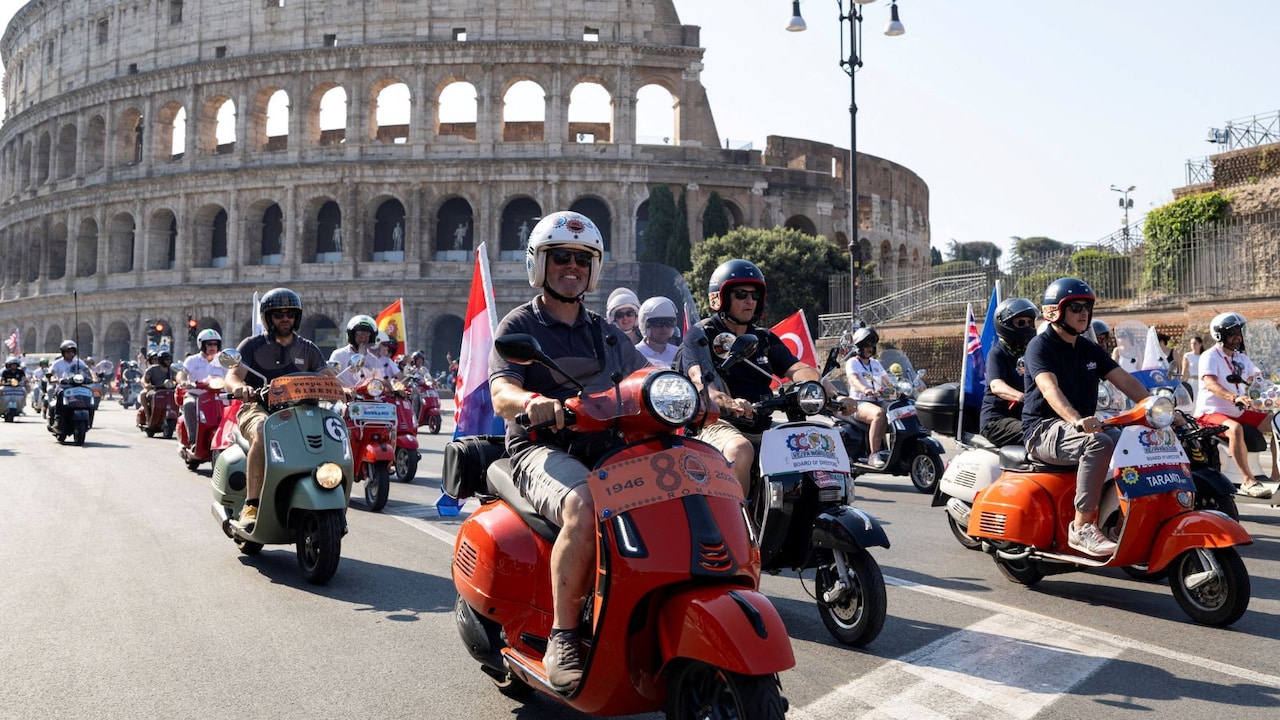
It began as a low, collective hum, vibrating through the soles of your shoes before it reached your ears. A metallic purr, crisp and rhythmic. It sounded like an army of iron hornets waking up from a multi-decade nap. Within an hour, the cobblestones of the Piazza del Popolo were entirely swallowed by a sea of pastel mint, chipped red lacquer, and polished chrome.
Ten thousand of them.
Ten thousand Vespas had descended upon the Eternal City, their small two-stroke and four-stroke engines coughing sweet-smelling exhaust into the Roman air. Ostensibly, they gathered to mark an anniversary—eighty years since a scarred post-war Italy patented a weird, pressed-steel two-wheeler meant to get a broken country moving again.
The cold statistics of the event tell one story. Media outlets reported on the sheer logistics: registration numbers from 55 countries, traffic detours slicing through the historic core, and the economic injection to local hospitality. But if you stood on the curb near the Vittorio Emanuele II monument as the pack throttled forward, you realized that counting the scooters was completely missing the point.
You had to look at the faces.
The Steel Wasp
Consider a hypothetical rider named Marco. He is seventy-two, his knuckles are stained with motor oil that never quite washes out, and he is sitting on a 1955 Vespa GS 150. The paint is original, showing the spiderweb cracks of a machine that has lived a real life. Marco is not a collector who hauls his toy in a trailer. He rode this machine across the Apennines to get here, his windbreaker ballooning behind him like a parachute.
To understand why Marco is weeping quietly behind his vintage aviator sunglasses as the crowd cheers, you have to understand what this machine actually did for his parents.
In 1946, Italy was a nation of rubble. Its factories were twisted skeletons of iron, bombed out during a war that left the population fractured and impoverished. Enrico Piaggio, an aircraft manufacturer forbidden by peace treaties from building airplanes, looked at his empty workshops and realized Italians desperately needed a way to get to work. He didn't want to build a motorcycle. Motorcycles were dirty, dangerous, and required grease-stained trousers.
He tasked Corradino D’Ascanio—an aeronautical engineer who notoriously hated motorcycles—with designing something different. D’Ascanio approached the problem from the sky down. He used a sparless, unibody steel frame, much like the fuselage of an airplane. He enclosed the engine to keep oil away from elegant clothes. He put the gears on the handlebar so riders wouldn't scuff the toes of their shoes.
When Piaggio saw the prototype, with its wide rear body tapering to a narrow waist and a high-pitched buzz, he muttered a phrase that became design history: "Sembra una vespa."
It looks like a wasp.
What followed was not just a commercial boom; it was an epidemiological shift in human freedom. For the first time, a working-class Italian family could buy freedom on an installment plan. The Vespa became the first democratic vehicle. It wasn't an elitist sports car, nor was it a heavy, agrarian tractor. It was nimble, light, and deeply human in its proportions.
A Gathering of Ghosts
As the massive convoy choked the avenues around the Roman Forum, the sheer variety of the machines became overwhelming. There were pristine, modern electric models whispering alongside early 1940s models that rattled like tin cans filled with bolts.
The beauty of a mass gathering like this lies in its defiance of time. Rome is a city built on layers of old lives—ruins built upon ruins. The swarm of scooters felt like an extension of that architecture. You weren't just looking at ten thousand vehicles; you were looking at ten thousand individual relationships.
Every dent in a steel leg shield is a story. This one was a slick corner in Florence in 1974. That scratched fender was an over-eager parking job during a summer downpour in San Remo.
The modern world tells us that transportation should be sterile. We isolate ourselves in soundproofed SUVs, insulated by climate control and giant digital screens, completely detached from the environment we pass through. The Vespa is the exact opposite of that philosophy. To ride one is to be vulnerable to the world. You smell the roasting espresso beans from the cafe on the corner. You feel the sudden drop in temperature when you dip into the shadow of an ancient stone archway. You suffer the rain, and you celebrate the sun.
When ten thousand people who share that specific vulnerability get together, the atmosphere changes. Strangers from Stuttgart were embracing mechanics from Palermo, speaking a broken dialect composed entirely of hand gestures and model numbers.
The Invisible Stakes
It is tempting to view an event like this as pure nostalgia, a colorful postcard designed for tourist consumption. But look closer at the shifting policies of European cities, and the underlying tension becomes clear.
Rome, like many historic capitals, is engaged in a quiet war against the internal combustion engine. Low-emission zones are expanding. Ancient alleyways are being closed off to combat the vibrations that slowly shake centuries-old foundations to dust. There is a very real, very terrifying possibility for these enthusiasts that within a generation, the sound of a two-stroke engine bouncing off Roman stone will be illegal.
This anniversary rally wasn't just a party. It was a protest.
It was a collective, beautiful roar against the homogenization of modern life. The riders were asserting that some objects possess a soul that cannot be synthesized by an algorithm or replaced by a shared-mobility app. A Vespa is not an appliance. You do not throw it away when the battery degrades. You fix it. You weld the steel. You adjust the cable. You hand it down to your daughter.
The Final Chord
By late afternoon, the sun had dropped low over the Tiber River, casting long, amber shadows across the cobblestones. The great mass of scooters began to disperse, splintering into smaller groups that dissolved back into the chaotic tapestry of Rome's daily traffic.
The roar subsided into that familiar, distant hum.
But if you watched from the crest of the Pincian Hill, you could see them for miles—tiny dots of color weaving through the heavy, stagnant lanes of modern cars. They moved like water through cracks in a stone wall. Eighty years after a desperate engineer tried to reinvent a broken country, his creation was still doing exactly what it was designed to do.
It was carrying people forward, light on its feet, completely unfazed by the weight of history.