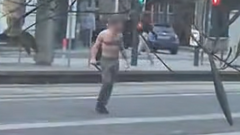
A 36-year-old man carrying multiple large blades launched a coordinated path of violence across the West of Edinburgh and Leith on Friday, June 19, leaving four people hospitalized and entire neighborhoods locked behind storefront shutters. The suspect has been arrested by Police Scotland following a multi-agency operation that flooded Leith Walk and surrounding arteries, but the geographical spread of the attacks indicates a significant timeline gap between the initial breach of public safety and the suspect's eventual detention. Armed officers, canine units, and emergency medical teams rushed to manage distinct crime scenes separated by miles, exposing critical vulnerabilities in urban rapid-response capabilities when confronted by a mobile, hyper-violent individual.
The public is left demanding answers about how an armed, topless assailant managed to traverse a major metropolitan area during peak Friday evening hours before being neutralized. Security camera footage and bystander recordings captured a pattern of escalating chaos that began in the western suburbs and terminated in a violent standoff in the dense commercial heart of Leith.
The Anatomy of an Urban Rampage
The evening transitioned from a standard weekend commute into a series of terrifying encounters across highly separated coordinate points. Initial reports surfaced from Telford Road, where a delivery rider was left severely injured on the pavement, surrounded by passing motorists who stopped to apply improvised first aid. Simultaneously, a separate perimeter was established miles away at Sighthill Park, which police swiftly cordoned off with high-visibility tape following a related assault.
The most acute point of public panic materialized on Leith Walk. Pedestrians fled into nearby businesses as the suspect strode down the middle of the street brandishing long knives. Eyewitness accounts and video evidence document the suspect attempting to smash his way through the glass facade of a local retail shop. Staff members managed to flee into a secure rear room, dropping the heavy metal security shutters just seconds before the glass shattered completely.
Emergency medical services deployed three distinct units along the route to manage the casualties. The four victims, suffering from varying degrees of trauma inflicted by the bladed weapons, were transported to the Royal Infirmary of Edinburgh. Police Scotland has maintained a heavy presence at each location to gather forensics, but the sheer distance between the West Edinburgh scenes and the Leith Walk arrest site highlights a tactical nightmare.
The Geography of Failure
Neutralizing a suspect who is actively moving across a city requires instant, predictive containment. When a violent actor utilizes transit corridors or moving vehicles to shift neighborhoods, traditional static policing parameters collapse.
In this instance, the perpetrator was able to execute strikes in the west, move through major thoroughfares, and terrorize a secondary community miles away. This pattern strongly mirrors past urban active-threat scenarios where emergency response structures struggled to communicate across disparate dispatch sectors. When a threat changes location every ten minutes, dispatchers face an overwhelming influx of contradictory civilian calls, which slows down the deployment of specialized tactical units.
The psychological impact on the community is compounded by the visual nature of modern violence. Hundreds of citizens watched the events unfold not just on the street, but through near-instantaneous uploads on localized social networks. This digital amplification creates an immediate atmosphere of siege, often outpacing the official communication channels of law enforcement.
The Operational Reality of Public Containment
Public safety officials often emphasize that situations of this nature are contained as quickly as humanly possible, but tactical realities dictate significant bottlenecks. Armed response vehicles face the exact same traffic congestion that slows down standard Friday night commuters.
Furthermore, the decision to deploy specialized firearms units or conduct a hard stop in a densely populated civilian zone like Leith Walk carries massive risks of collateral damage. Officers are trained to isolate a suspect before moving in, a protocol that prioritizes long-term resolution over immediate, high-risk confrontation. However, every minute spent establishing an ideal tactical perimeter is a minute where a mobile suspect remains a lethal threat to anyone walking the pavement.
The investigation must now pivot toward a meticulous forensic reconstruction of the suspect's timeline. Investigators are looking closely at how the individual moved between the west of the city and Leith, whether public transport was utilized, and if any early warning signs were missed by mental health or community monitoring networks.
The streets have been declared safe, and authorities have stated there is no ongoing wider threat to the population. For the residents of Edinburgh, however, the shattered storefronts and the images of blood on the pavement serve as a stark reminder of how fragile urban security truly is when a determined threat slips through the cracks of rapid response.