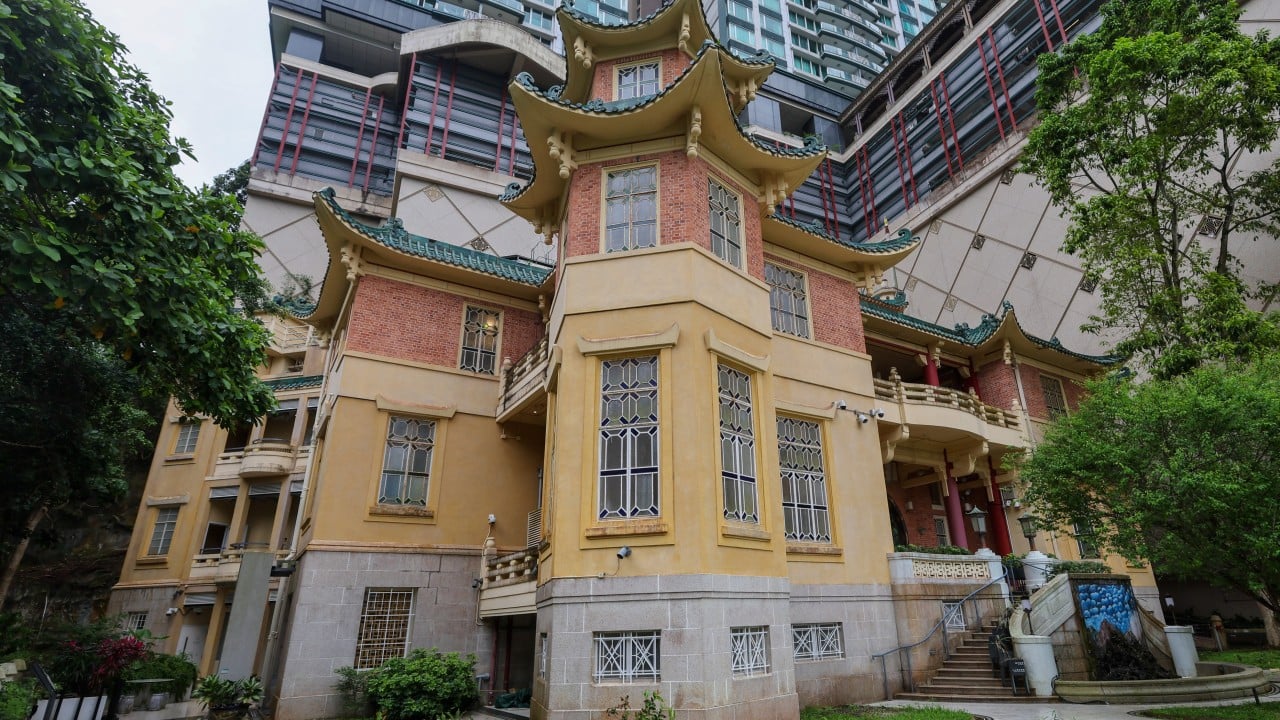
The survival of high-maintenance heritage assets depends on a shift from passive preservation to a self-sustaining commercial model. The transformation of Hong Kong’s 91-year-old Haw Par Mansion into a "cultural hub" represents a critical test of the Adaptive Reuse Lifecycle, where the objective is to reconcile historical integrity with the high OpEx (Operating Expenditure) inherent in 1930s architectural typologies. Success in this venture is not measured by foot traffic alone, but by the mansion’s ability to generate a yield that offsets the structural decay accelerated by Hong Kong’s sub-tropical climate.
The Tri-Pillar Framework of Heritage Viability
The transition of a private residence into a public-facing cultural asset requires the synchronization of three distinct operational pillars. If any pillar is misaligned, the project defaults into a "sunk cost" asset that requires perpetual government subsidies.
- Architectural Integrity vs. Regulatory Compliance: The mansion, built in 1935, adheres to pre-war building codes. Modernizing this space involves navigating the friction between preserving the original Tiger Balm King aesthetic—specifically the unique "Chinese Renaissance" style—and meeting 21st-century fire safety, disabled access, and load-bearing requirements.
- The Revenue Generation Engine: A cultural hub cannot exist on intent alone. It requires a diversified income stream—likely a mix of high-end events, educational workshops, and retail integration—that can absorb the "heritage premium" (the 30-50% higher maintenance cost compared to modern structures).
- Community Value Capture: For the site to remain relevant, it must provide a utility that the local market currently lacks. In the context of Wan Chai and Tai Hang, this means positioning the mansion as a sophisticated alternative to the sterile, glass-and-steel commercial centers found in Central.
The Structural Mechanics of the Haw Par Site
Haw Par Mansion is a four-story residence defined by its eclectic fusion of Western construction techniques and traditional Chinese ornamentation. The 2024-2026 revitalization phase focuses on the Internal Circulation Optimization. Unlike modern galleries designed for flow, 1930s domestic architecture is compartmentalized.
The primary bottleneck in such a transformation is Spatial Efficiency. The mansion’s layout—designed for private living—contains significant "dead space" in the form of wide corridors and ornate stairwells that cannot easily be converted into revenue-generating square footage. The strategic solution involves using these transition zones as experiential galleries, effectively turning the entire building envelope into a narrative tool.
Technical Constraints of the 1930s Envelope
- Lead-Based Finishes and Asbestos: Common in the era, these require specialized remediation that spikes the initial CapEx (Capital Expenditure).
- HVAC Integration: Retrofitting a centralized climate control system into a Grade I historic building without damaging original plasterwork or the iconic stained-glass windows is a high-cost engineering challenge.
- Moisture Infiltration: The mansion’s hillside location in Tai Hang creates a constant hydrostatic pressure against the foundation, requiring a permanent drainage and waterproofing strategy to prevent mold—the primary enemy of textile and paper-based cultural exhibits.
Categorizing the Programmatic Shift
The move from the failed "Haw Par Music" iteration to a broader "cultural hub" signals a pivot toward a Multi-Tenant Operational Strategy. A single-purpose tenant (like a music school) often lacks the cash flow diversity to handle the mansion’s overhead. The new model likely favors a curated ecosystem:
The Anchor Tenant Model
A primary cultural institution provides the brand equity and stable, albeit lower, rental yield. This anchor serves as the "trust signal" for the site.
High-Margin Event Spaces
The mansion’s ballroom and outdoor gardens are high-yield assets. The scarcity of private, historic outdoor space in Hong Kong allows for a pricing premium for luxury brand activations, weddings, and corporate summits. These events subsidize the free public access components of the hub.
The Educational Component
Workshops and seminars focusing on "heritage craft" or "East-meets-West design" serve two functions: they fulfill the social mandate required for government-backed revitalization and they drive weekday traffic, ensuring the site doesn't become a "weekend-only" ghost town.
The Cause-and-Effect of Heritage Branding
The "Tiger Balm" legacy provides a pre-built brand identity that modern developments spend millions trying to manufacture. This is the Heritage Dividend. However, this legacy carries a risk of "Museumification"—the process where a site becomes so frozen in its past that it fails to attract repeat visits.
The revitalization strategy must solve for the Repeat Visit Variable. If the mansion is perceived only as a static monument, it will suffer from the "Once-and-Done" tourist trap. To avoid this, the hub must implement a rotating exhibition calendar. The mansion itself is the hardware; the cultural programming is the software. Software must be updated frequently to maintain hardware value.
Comparing the Global Context: The Blueprints of Success
When analyzing similar projects, such as London’s Somerset House or Singapore’s CHIJMES, a pattern emerges regarding the Commercial-Cultural Ratio.
- Somerset House: Balanced a massive historic footprint by renting out office space to creative startups. This created a built-in community and a stable rent roll.
- CHIJMES: Leaned heavily into F&B (Food and Beverage). While commercially successful, it risked losing its "cultural" identity in favor of a lifestyle mall vibe.
The Haw Par Mansion project sits at a crossroads. Given its relatively smaller footprint compared to Somerset House, it cannot rely on large-scale office rentals. It must instead focus on high-density, high-value experiences. The risk here is the "Elitism Barrier"—if the hub becomes too focused on luxury events, it loses its community support, which is essential for long-term political and social license to operate in Hong Kong.
The Maintenance Cost Function
The long-term viability of the mansion is governed by a simple but brutal equation:
$$V = \int_{0}^{T} (R(t) - (M_s + M_v)) dt$$
Where:
- $V$ is the Net Value of the project over time.
- $R(t)$ is the Revenue generated at time $t$.
- $M_s$ is the Static Maintenance (keeping the building standing).
- $M_v$ is the Variable Maintenance (costs incurred by public usage/wear and tear).
In historic buildings, $M_s$ is non-negotiable and high. Therefore, the only way to ensure $V$ stays positive is to maximize $R(t)$ through high-turnover programming or to reduce $M_v$ through durable, high-spec interior interventions. Most heritage projects fail because they underestimate $M_s$, assuming it scales linearly like a modern office building. In reality, $M_s$ for a 91-year-old structure is prone to "Step-Function" increases—where a single structural failure (e.g., a roof leak damaging original murals) creates a massive, sudden financial liability.
Strategic Barriers to Execution
The primary threat to the Haw Par Mansion’s success is Bureaucratic Friction. In Hong Kong, heritage sites often fall under the jurisdiction of multiple departments (Antiquities and Monuments Office, Buildings Department, Lands Department). Each has different priorities.
The Lands Department may view the site through the lens of land-use efficiency, while the AMO views it through the lens of preservation. This creates a bottleneck in the approval process for any revenue-generating modifications. To overcome this, the management entity must act as a Strategic Liaison, translating the needs of a commercial operator into the language of a heritage conservator.
Another limitation is the Access Bottleneck. The mansion is located in a residential area with limited parking and narrow roads. Unlike the high-accessibility clusters of West Kowloon Cultural District, Haw Par requires a "Destination Marketing" approach. People must intend to go there; they won't stumble upon it. This necessitates a significant marketing budget, further squeezing the initial operating margins.
The Operational Playbook for 2026
To elevate Haw Par Mansion from a relic to a functional hub, the management must execute a three-stage tactical roll-out:
- The Stabilization Phase: Complete all structural remediation and ensure the building envelope is hermetically sealed against humidity. This is the "Zero-Failure" stage.
- The Beta-Launch Phase: Open the site for limited-capacity boutique events. This allows the operators to test the building’s "Stress Points"—how the floorboards handle heavy traffic, how the acoustics work in the main hall, and how the electrical grid handles modern lighting rigs.
- The Scaled Ecosystem Phase: Onboard the full suite of cultural partners. At this stage, the hub should move to a tiered access model: free public heritage trails on the lower levels, and premium, ticketed experiences or private memberships on the upper levels.
The mansion’s success will ultimately be a bellwether for how Hong Kong handles its remaining private heritage stock. If the "cultural hub" model fails here, it sends a chilling signal to private owners of historic villas: that the cost of preservation is higher than the value of the land, leading inevitably to the "Demolition-by-Neglect" cycle.
The final strategic move for the Haw Par operators is the integration of Digital Twins and AR (Augmented Reality). Because the physical structure is too fragile to support 10,000 visitors a day, the hub must use technology to "Virtualize the Asset." By allowing visitors to interact with the history of the Tiger Balm King through AR overlays, the site can increase its "Perceived Square Footage" without placing a single pound of additional pressure on the 91-year-old floor joists. This is the only way to scale a heritage asset in a high-density urban environment.