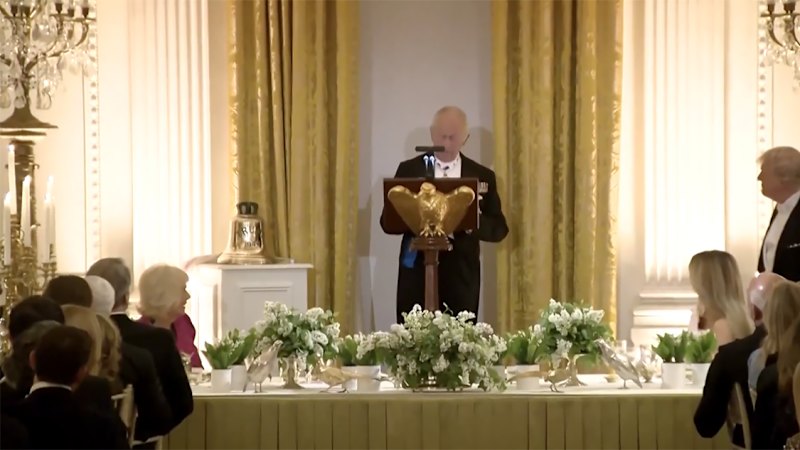
The air in the state dining room didn’t smell of salt or diesel, but for a split second, it should have.
When a King hands a President a piece of metal, the world usually sees a photo op. They see two men in tailored suits, the flash of cameras, and a polished artifact that looks like it belongs behind velvet ropes in a museum. But if you listen to the way a ship’s bell sounds—not the polite chime of a clock, but the deep, resonant clang that cuts through a gale—you realize this wasn't just a gift. It was a heavy, bronze heartbeat.
The object in question was the bell from the HMS Trump. To the uninitiated, it’s a relic of a decommissioned British frigate. To those who understand the language of the sea, it is the soul of a vessel that once patrolled the gray, churning waters of the North Atlantic.
The Weight of the Metal
Metal has a memory. In the naval tradition, the bell is the only part of a ship that truly speaks. It marks the passage of time. It warns of danger in the fog. It tolls for the dead. When King Charles III presented this particular bell to the American President, the gesture bypassed the usual diplomatic chatter. It spoke to a shared history of survival.
Think about the life of that bronze. It spent years bolted to a structure of steel, vibrating with the thrum of engines and the impact of waves. It felt the spray of the ocean. It was polished by the hands of sailors who were thousands of miles from home, young men and women who looked at that bell as the steady pulse of their daily lives.
The HMS Trump was a Duke-class Type 23 frigate. These ships weren't built for luxury. They were built for the "silent service" of submarine hunting. Imagine being a sonar operator in the belly of that ship, eyes strained against a glowing screen, while the bell above deck remained silent, a dormant sentinel. The ship was a hunter, and the bell was its voice, reserved for the moments that mattered.
A Legacy of Names
The name on the bell carries its own gravity. In the theater of international relations, names are rarely accidental. The HMS Trump was named after Admiral Sir Thomas Trump, a man whose career was defined by the grit of the 18th-century Royal Navy.
History isn't a straight line. It’s a messy, overlapping series of circles. By returning this bell to American soil, the British Monarchy wasn't just handing over a piece of equipment; they were acknowledging a loop in the narrative. They were tying the maritime heritage of the United Kingdom to the current leadership of the United States.
Consider the hypothetical sailor—let’s call him Miller. Miller would have stood watch near that bell during a mid-winter gale. He would have seen the ice crusting over the bronze. To him, the bell wasn't a "diplomatic asset." It was the thing that told him his shift was finally over. It was the sound of relief. When we see the President touch the rim of that bell in a warm, carpeted room, we are seeing a bridge between Miller’s cold reality and the high-altitude world of global policy.
The Invisible Stakes of a Handshake
Diplomacy often feels like a series of scripted gestures. We watch the motorcades and the handshakes, wondering if any of it actually changes the price of bread or the safety of our borders. But symbols are the mortar between the bricks of an alliance.
The UK and the US often talk about their "special relationship." It’s a phrase used so often it has almost lost its teeth. However, the exchange of naval heritage is a way of sharpening those teeth. It reminds both nations that their security has always been anchored in the sea.
The HMS Trump may no longer be cutting through the waves, but its bell now sits in a different kind of harbor. It serves as a reminder that even when ships are scrapped and crews are reassigned, the commitments made between nations are supposed to be as enduring as cast bronze.
The Craftsmanship of History
If you were to run your fingers over the engravings on that bell, you would feel the depth of the cuts. This isn't laser-etched plastic. This is the result of heat, pressure, and meticulous labor.
Naval bells are cast in a foundry, where molten metal is poured into a mold at temperatures that would liquefy a common coin. It’s a violent process that results in a singular, harmonious object. There is a lesson there for the observers of this gift. Alliances are often forged in the heat of conflict and the pressure of necessity. They aren't always pretty when they are being made, but the end result is something that can withstand the salt air of a century.
The President’s acceptance of the bell wasn't just a polite "thank you." It was an intake of breath. It was an acknowledgment that the weight of leadership involves carrying the history of those who came before.
Beyond the Fog
The ceremony took place against a backdrop of shifting global tides. To the casual observer, it was a footnote in a busy news cycle. But to the historian, or the veteran, or the person who simply appreciates the poetry of a well-timed gesture, it was a moment of profound clarity.
The bell represents a period of service that has ended, handed over to ensure that the memory of that service doesn't vanish. It is a transition from the active to the archival, from the deck to the pedestal.
There is a specific kind of silence that follows the tolling of a great bell. It is a silence that demands reflection. As the gift was exchanged, that silence seemed to settle over the room, momentarily drowning out the noise of politics and the friction of the modern world.
The metal is cold to the touch. It is heavy. It is unyielding.
It stands now as a silent witness in a new house, a piece of the North Atlantic moved to the Potomac, waiting for the next time someone needs to remember what it sounds like when two nations decide to move in unison through the dark.