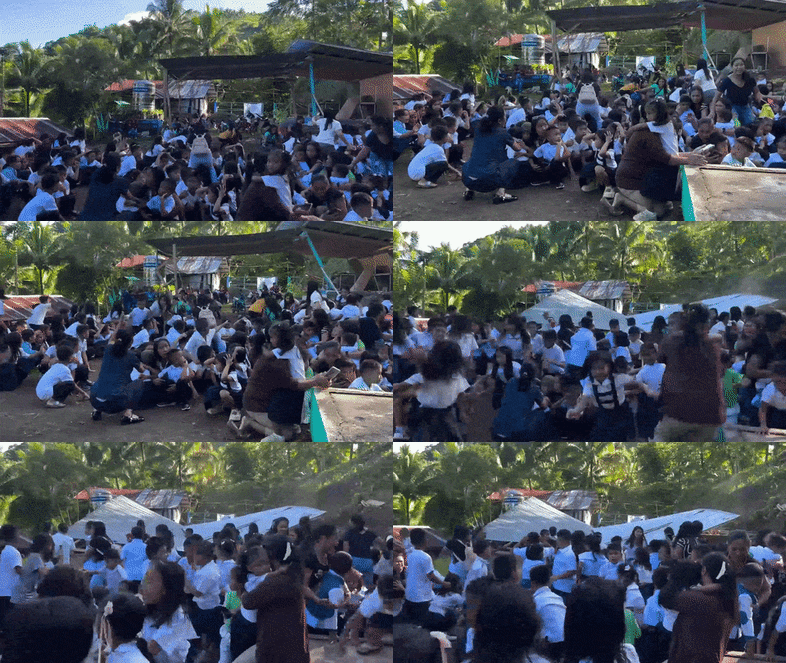
The coffee cup did not slide. It leapt.
In the regular, predictable rhythm of a Tuesday night in the southern Philippines, the world behaves according to a strict contract. Walls stay vertical. Floors remain parallel to the sky. Water stays inside its glass. But at precisely 10:37 PM, that contract was torn to shreds.
It started with a sound that didn't travel through the air, but through the bone. A low, subterranean growl that felt less like a noise and more like an accusation. Within three seconds, the concrete floor of a small bakery in Hinatuan became as fluid and unpredictable as the open Pacific.
This was the opening note of a 7.8 magnitude earthquake. To read that number on a screen is to process a sterile piece of data. To feel it is to understand complete powerlessness. A 7.8 magnitude event does not merely shake a house; it violently rewrites the geography of a community in a span of ninety seconds.
Consider Maria. She is a composite of the storefront owners along the coastal roads of Surigao del Sur, women who keep the lights on late into the night, counting inventory or wiping down plastic tables. When the tremor struck, her first instinct was not survival, but confusion. We are conditioned to trust the ground. It is the ultimate baseline. When the baseline betrays you, the human brain stalls for a critical, terrifying heartbeat.
The power grid failed instantly. Darkness in the tropics is heavy, but darkness during a major seismic event is absolute. It is a sensory deprivation chamber filled with the screaming of twisted metal, the shattering of glass, and the terrifying, rhythmic thud of concrete blocks meeting the earth.
The Mechanics of the Monster
To understand why the southern Philippines breaks so violently, you have to look beneath the turquoise water and the white-sand beaches. The archipelago sits squarely on the Pacific Ring of Fire. It is a poetic name for a brutal geological reality.
Here, the Philippine Sea plate is locked in a slow-motion, multimillion-year collision with the Sunda plate. They push. They shove. They grind. Mostly, they get stuck. For decades, the friction builds, storing energy like a massive, coiled steel spring compressed by a hydraulic press.
When the rock finally gives way, the release is instantaneous and catastrophic.
The energy unleashed by a 7.8 magnitude earthquake is difficult to conceptualize. It is roughly equivalent to the detonation of millions of tons of TNT exploding simultaneously miles beneath the surface. The waves travel outward in concentric ripples of destruction. Primary waves compress the rock like an accordion. Secondary waves arrive moments later, shearing the ground up and down, side to side. It is these secondary waves that turn stable buildings into piles of kindling.
As the shaking continued, the coastal communities faced a second, more insidious threat. The ocean began to retreat.
For those who live on the Pacific rim, a sudden drop in the tide after an earthquake is a death sentence written in the sand. It means the seabed has displaced a massive volume of water, and that water is currently gathering momentum out in the dark, preparing to return as a tsunami.
The Longest Night
The sirens began to wail across the coastal provinces. Alarms cut through the dust-choked air, ordering tens of thousands of people to run for high ground.
Imagine running up a hillside in total darkness. The ground beneath your feet is still trembling with aftershocks—some measuring above 6.0 magnitude on their own. Your bare feet hit sharp rocks and broken palm fronds. You are holding a child, or pulling an elderly relative who cannot move fast enough. Every few minutes, the earth lurching sideways threatens to throw you to your knees.
The fear of the water is a primal thing. In this part of the world, memories of past disasters are etched into the communal psyche. They know what the ocean can do when it loses its temper.
In the towns of Hinatuan, Bislig, and Tagum, the streets became rivers of flashlights. People moved in silence, a collective migration driven by pure survival instinct. There was no time to grab passports, money, or family heirlooms. The only currency that mattered in that hour was elevation.
By 2:00 AM, the initial tsunami waves began to strike the coast. Fortunately, nature spared the region the worst-case scenario this time. The waves measured less than a meter high in most areas, a mercy that kept the death toll from skyrocketing into the thousands. But the psychological damage was already done. The ocean, which usually provides food and tourism dollars, had become a monster watching from the dark.
The Morning After the Mirror Broke
Sunlight in the Philippines usually brings a vibrant explosion of color—the deep green of palm trees, the bright blue of the sea, the chaotic pinks and yellows of passing jeepneys.
The morning after the 7.8 quake, the light revealed a landscape washed in grey.
Dust from pulverized concrete hung in the humid air like fog. Major highways were split open, showing deep fissures that looked like open wounds in the asphalt. Bridges that had connected isolated fishing villages to regional hospitals were warped and impassable, their concrete supports snapped like toothpicks.
Regional hospitals were forced to move their patients outside. Intravenous drips were hooked to the branches of mango trees. Mothers who had given birth just hours before the quake lay on mattresses spread across parking lots, shielding their newborns from the rising heat of the sun. The buildings behind them stood intact but empty, rendered terrifying by the hairline fractures webbing across their facades.
The true cruelty of a major earthquake lies in its afterlife: the aftershocks.
A major quake is not a singular event. It is a fractured bone that continues to splinter. Hundreds of smaller tremors rattled the region over the next forty-eight hours. Every time the ground vibrated, a collective gasp ran through the displacement camps. A plastic tarp rustled. A piece of corrugated iron rattled. People jumped. The nervous system can only handle so much adrenaline before it begins to misfire.
The Architecture of Vulnerability
When we read about natural disasters in developing nations, it is easy to attribute the damage to bad luck. But look closer, and the story becomes one of economics and infrastructure.
In the rural areas of Mindanao, building codes are luxury items. A family building a home uses what is available: bamboo, light timber, or unreinforced concrete blocks held together by cheap mortar. These structures offer shelter from the rain and the sun, but they possess zero seismic resilience. They have no flexibility. When the earth moves sideways, they collapse straight down.
The disaster centers in Manila immediately pledged aid, scrambling military transport planes loaded with food packs, water purification kits, and emergency shelter. But a plane cannot land on a cracked runway. A supply truck cannot cross a collapsed bridge.
The immediate aftermath of a remote earthquake is always a race against isolation. Villages along the jagged coastline of Surigao became islands, cut off from electricity, clean drinking water, and communication. In the heat of the tropical sun, the lack of clean water quickly becomes a deadlier threat than the collapsing buildings themselves. Waterborne diseases do not care about seismic magnitude, but they thrive in the chaos left behind.
The Invisible Stakes
We measure disasters in metrics that fit cleanly into news tickers. We count the dead. We tally the injured. We estimate the infrastructure damage in millions of dollars.
These numbers are necessary, but they lie by omission.
They omit the fisherman who stands on the shore, looking at his shattered wooden outrigger boat. The boat is not just property; it is the sole barrier between his family and starvation. They omit the schoolteacher who looks at the collapsed roof of her classroom, knowing that it will take years for the government bureaucracy to rebuild it, leaving a generation of local children to learn under tarpaulins in the mud.
They omit the profound, invisible trauma of losing faith in the physical world.
To live through a 7.8 magnitude earthquake is to lose the innocence of taking stability for granted. For months afterward, the sound of a heavy truck passing on the road will cause hearts to race and palms to sweat. The mind creates ghosts out of every vibration.
As the days press on, the international cameras will pack up and move to the next crisis. The headlines will fade. The state of calamity will eventually be lifted by local politicians looking to project an image of recovery.
But beneath the surface, the rebuilding is a agonizingly slow, hand-over-hand climb. It is done by neighbors helping neighbors clear debris with their bare hands. It is done by families sleeping under plastic sheets in their front yards because they are still too terrified to step under a concrete roof.
The earth in the southern Philippines will eventually quiet down. The plates will find a temporary peace, locking themselves back into place, silent and tense, beginning the long process of gathering energy for the next time they decide to change the script.
A child's plastic toy, bright red and completely intact, sits in the middle of a mud-slicked street in Hinatuan. It is surrounded by the grey rubble of a two-story home. The toy is perfectly upright, as if waiting for someone to come back outside and play.