The wind along the Rio Grande does not care about passports. It sweeps across the river, kicking up the same pale dust on the southern bank as it does on the northern side, coating the leather shoes of church leaders and the worn sneakers of travelers in the exact same layer of grit.
On this particular afternoon, the desert heat felt heavy, almost solid. Hundreds of people gathered where the fence cuts through the earth, a massive structure of steel bars that attempts to slice a single ecosystem—and a single human community—into two distinct worlds. On one side stood the powerful, the robed leaders of an ancient institution. On the other side stood the vulnerable, those who had walked thousands of miles just to reach a barrier that said they did not belong.
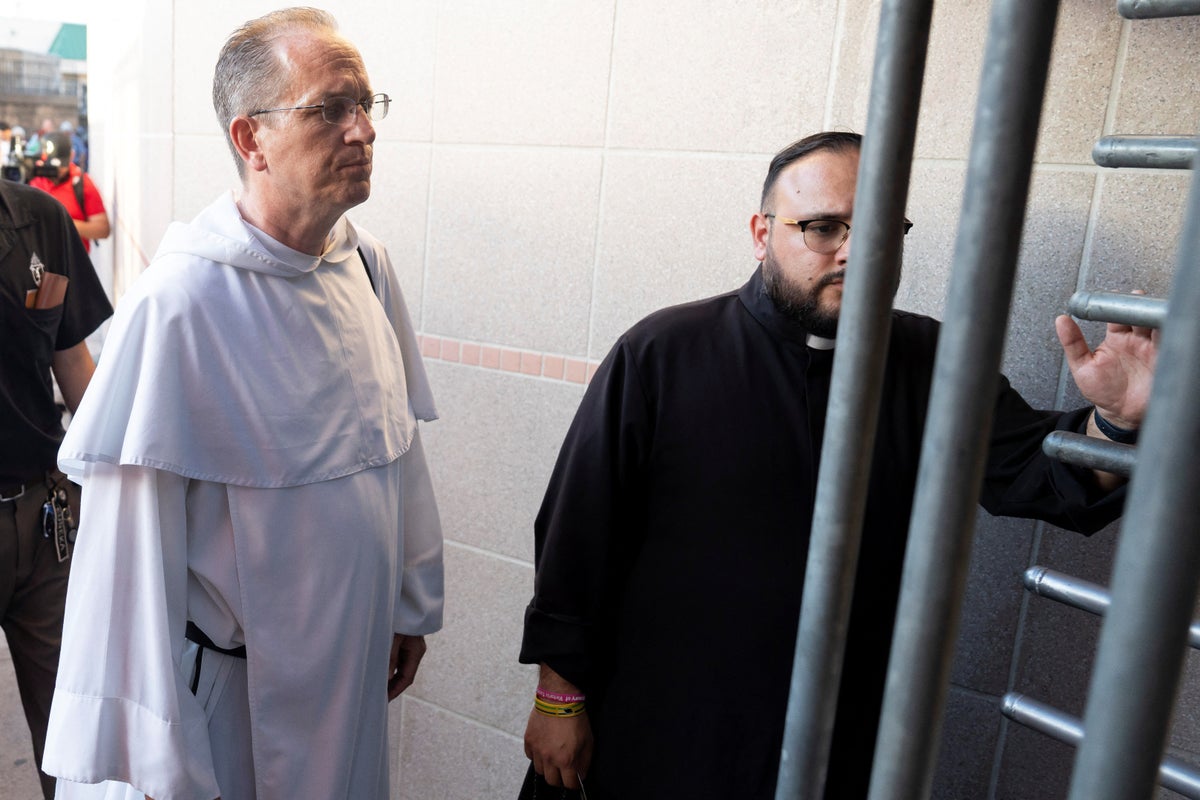
More than one hundred Catholic bishops from across the United States and Latin America met at this line. They did not come to debate policy or draft legislation. They came to stand in the dirt and perform an act as old as their faith, turning a geopolitical flashpoint into an outdoor sanctuary.
The Line in the Sand
To understand the weight of this gathering, you have to look past the political talking points that dominate evening broadcasts. Think of a mother holding her child’s hand, staring through the gaps in the steel mesh. She is not a statistic. She is not an invading force. She is a person who looked at her home country, saw an impossible future, and chose the terrifying uncertainty of the road over the guaranteed despair of staying put.
When more than a hundred religious leaders gather in one place, the logistics alone are staggering. But the true significance lies in the shared conviction that brought them there. Bishops from New York, California, Mexico, and Central America stood shoulder to shoulder. The gathering served as a physical manifestation of a belief that human dignity is not granted by a government stamp or a birth certificate.
The central event was a Mass, a communal prayer offered directly at the border wall. The altar was placed so close to the fence that, during the service, participants from both sides could reach through the steel slats to touch fingers. It was a stark, visual subversion of the barrier's purpose. The structure was built to divide, but for a few hours, it became a place of connection.
The messages delivered during the service were direct. The speakers called for an immediate shift away from enforcement-first strategies and demanded a system that prioritizes the safety, dignity, and legal rights of families fleeing violence and extreme poverty. They argued that the current approach does not just fail policy tests; it fails moral ones.
The Anatomy of a Journey
Consider the math of survival. The distance from America's southern border back to the heart of Central America is measured in thousands of miles, but the true cost is measured in loss.
To make that journey, a person must liquidate everything they own. They pay extortionate fees to smugglers, risk kidnapping by cartels, and endure days of dehydration under a sun that offers no mercy. No one undertakes this willingly because they want an easy path. They do it because the alternative is untenable.
The bishops used their platform to remind the public of these invisible stakes. When deterrence policies are tightened, the flow of people does not stop. It merely shifts to more dangerous terrain. It moves into the deep, trackless deserts where the lack of water acts as a silent executioner. The religious leaders argued that a civilized nation cannot use the threat of death as a regulatory mechanism for its borders.
During the homily, the language shifted away from the abstract terminology of migration management. The speakers talked about families. They talked about children. They reminded the congregation that, according to their shared scriptures, the definitive test of a society's morality is how it treats the stranger at its gates.
The Fractured System
The crisis at the border is often framed as a logistical problem, a matter of processing speeds, detention beds, and patrol hours. But the bishops pushed back against this clinical view, arguing that the system itself is built on a flawed premise.
Right now, the infrastructure is designed for exclusion rather than orderly processing. When individuals arriving at the border to seek asylum legally are met with immediate rejection, prolonged detention, or bureaucratic dead ends, the system breaks down. It creates a backlog of human suffering.
The gathered prelates called for a comprehensive overhaul that includes expanded legal pathways for migration, a more humane asylum process that treats applicants with respect, and an effort to address the root causes of migration, such as systemic corruption and economic devastation in home countries. They noted that until life becomes livable in the places these travelers call home, the northern migration will continue, regardless of how high the walls are built.
The ritual of Communion took on a heavy symbolism in this environment. Bread was broken on the northern side and passed through the iron bars to communicants waiting on the southern side. It was a simple gesture, but in the context of international politics, it felt radical. It insisted that the bonds of human community are thicker than steel and stronger than national anxieties.
Beyond the Rhetoric
The sun began to dip below the horizon, casting long, barred shadows across the desert floor. The service concluded not with a celebration, but with a quiet, solemn charge to the thousands who had gathered to watch and listen.
The challenge moving forward is translating the moral clarity of that afternoon into the messy reality of national policy. The bishops represent millions of citizens, and their collective voice carries a weight that cannot be easily dismissed by lawmakers. By framing the border issue as a humanitarian emergency rather than a security crisis, they are attempting to shift the national conversation.
As the crowds began to disperse, the dust settled back onto the earth. The bishops packed away their vestments, and the travelers on the other side of the fence returned to the temporary shelters that have become their holding pens. The wall remained, cold and unyielding in the twilight. But for a brief moment, the space around it had changed. The border was no longer just a line where a nation ends; it had become the exact spot where our collective humanity is put on trial.