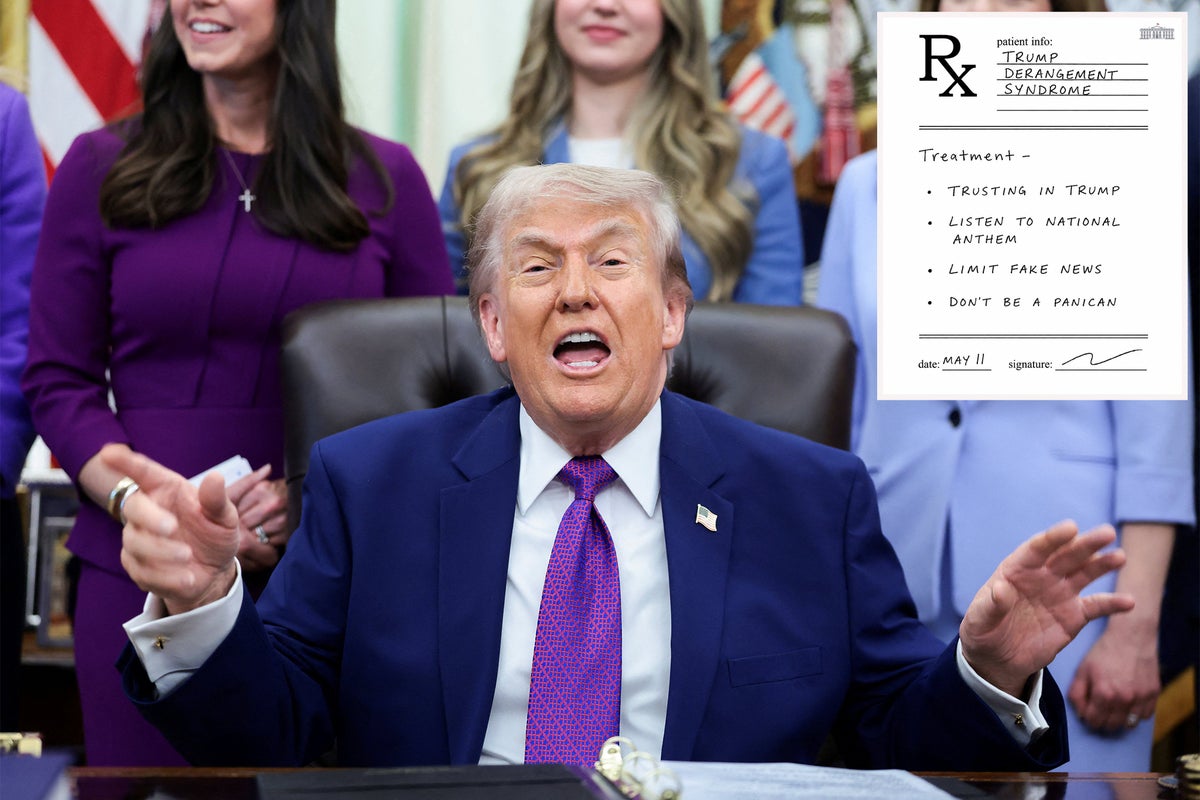
The screen glows with a harsh, artificial light in the corner of a darkened living room. On it, a man stands behind a podium, his voice projecting a mix of supreme confidence and calculated grievance. He calls himself the Greatest of All Time. He claims he is the victim of a medical phenomenon. Across the country, a father and daughter sit in silence, the space between them widening with every syllable uttered from the television.
This isn't just about a speech or a tweet. It is about the moment a political disagreement stops being a debate and starts being a clinical assessment. Meanwhile, you can explore related events here: The Endless Midnight and the Illusion of a White Flag.
When Donald Trump suggests that "Trump Derangement Syndrome" is a literal disease, he isn't just using a punchline. He is weaponizing a psychological metaphor to categorize millions of people as mentally unfit. It is a masterful, if brutal, rhetorical stroke. By framing dissent as a pathology, the argument shifts from "I disagree with your policy" to "Your brain is physically incapable of processing reality."
Consider a hypothetical citizen named Sarah. Sarah is a schoolteacher who spends her Sundays worrying about the cost of groceries and the tone of national discourse. When she hears the term "Derangement Syndrome," she doesn't feel debated. She feels erased. To her, the phrase acts as a shutter, closing the window of communication before she can even speak. If her anger is a symptom, then her reasons for that anger don't matter. To explore the complete picture, check out the detailed report by NBC News.
The president’s rhetoric that night followed a specific, rhythmic pattern. First, the self-elevation. The "GOAT" label—Greatest of All Time—is a term borrowed from the high-stakes world of professional sports, intended to signal an unassailable dominance. It leaves no room for second place. It suggests that the scoreboard is settled and any further play is merely a formality.
But the real power lies in what follows the boast: the diagnosis of the critic.
Medicalizing political opposition is a tactic with a long, shadowed history. It is a way to strip an opponent of their agency. If you are sick, you need a doctor, not a seat at the table. You need a cure, not a conversation. When this language enters the bloodstream of the public square, it changes how we look at our neighbors. We stop seeing fellow citizens and start seeing patients.
We see this play out in the smallest fractals of American life. It happens at the grocery store when a red hat meets a blue mask. It happens in the comment sections of local news posts where the word "deranged" is tossed around like a hand grenade. The human cost is a profound, aching loneliness. We are a nation of three hundred million people, many of whom feel they are living in a country where half the population has been diagnosed with a madness they don't believe they have.
The data points of the evening were clear. The president spoke of his achievements with the fervor of a man who believes the history books are already written. He pointed to the crowds and the polls as evidence of a singular truth. And then, he turned the lens on the "haters." By labeling their frustration as a disease, he offered his supporters a shield. They no longer had to engage with the substance of the critique; they only had to pity or fear the "infected."
The stakes are invisible but heavy. When we pathologize political leanings, we destroy the "common sense" that once held a diverse republic together. Democracy requires a shared reality. It requires the belief that, while your neighbor might be wrong, they are at least rational. Once you move that neighbor into the category of the "deranged," the social contract begins to fray at the edges.
The tragedy is that the metaphor works. It is sticky. It is easy to remember. It provides an instant explanation for the chaos of the modern world. Why is everyone so angry? They’re sick. Why is there so much division? It’s an epidemic.
But the reality is far more complex and far more human. The anger isn't a virus. It is the sound of people feeling unheard, or unrepresented, or afraid of a future they didn't ask for. It is the friction of two different versions of America rubbing against one another until the heat becomes unbearable.
Imagine that same living room again. The television is finally turned off. The silence that follows isn't peaceful; it is heavy with the things that cannot be said. The father looks at his daughter and wonders if she is "deranged." The daughter looks at her father and wonders if he has lost his way. They are staring at each other across a canyon that was dug with words and reinforced with "diagnoses."
The president’s claim that this is a "disease" is perhaps the ultimate expression of our current era. It is a rejection of the messy, difficult work of persuasion. It is much easier to dismiss a critic as a patient than to win them over as a voter. It is a shortcut to total certainty.
Yet, certainty is a cold comfort when it costs us the ability to see the humanity in the person across the aisle. We are living through a grand experiment in how much a society can stretch before it snaps. We are testing whether a nation built on "We the People" can survive when "the People" are convinced that their counterparts are clinically insane.
The lights go out in houses across the country. The debates continue in the digital ether, fueled by the same labels and the same certainty. The "GOAT" sleeps soundly, confident in his status and his diagnosis. But in the quiet hallways of our own homes, the disease isn't what the president thinks it is. The real ailment is the growing belief that we are better off without each other.
We are standing on a bridge that is being dismantled one brick at a time, and we are being told that the people on the other side are the ones holding the hammers. Maybe they are. Or maybe, like us, they are just trying to find a way to stand on solid ground in a world that feels like it’s shifting beneath their feet.
The screen flickers one last time before turning black. The reflection in the glass is of a person, tired and uncertain, wondering when the world became a ward and when we all became the monitored.