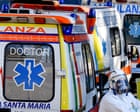
The headlines are predictable. They scream about "Angels of Death" and "Ambulance Killers" while the public clutches its collective pearls in a fit of performative outrage. An Italian ambulance driver stands accused of injecting air into the veins of terminal patients to profit from their funerals. It is a story designed for clicks, a narrative that feeds the hunger for a clear villain.
But if you think this is a story about one "evil" driver, you are falling for the lazy consensus. Also making waves lately: Finland Is Not Keeping Calm And The West Is Misreading The Silence.
The media wants you to believe this is an isolated glitch in an otherwise perfect system. They want you to focus on the individual monster so you don’t have to look at the rotting infrastructure behind him. I’ve seen this play out in healthcare systems across Europe and North America: when the machine fails, we sacrifice a cog to save the engineers. This isn't just about a local mafia-run funeral racket in Sicily. It is about the systemic failure of end-of-life care and the brutal economics of dying.
The Funeral Industrial Complex is the Symptom Not the Disease
The accusation is that the driver took a 300-euro kickback for every body delivered to a specific, mafia-linked funeral home. The shock shouldn't be that a driver is corrupt; the shock should be that we’ve created a system where the dead are more profitable than the living. Additional information into this topic are covered by Associated Press.
In many parts of the world, the "death industry" is a multi-billion dollar machine that thrives on the lack of transparency during the most vulnerable moments of a family’s life. When a patient dies at home or in transit, there is a vacuum of authority. Who calls the undertaker? Often, it’s the first person on the scene.
By hyper-focusing on the "air embolism" method of murder, we ignore the predatory nature of "ambulance chasing" in its literal form. We are obsessed with the how of the crime because the why forces us to admit that our healthcare oversight is a sieve. If a driver can kill five people—and some reports suggest dozens more over years—without a single medical examiner raising a red flag until a whistleblower speaks up, the "medical" part of the medical profession has already clocked out.
The Myth of the Unchecked Vigilante
We love the "lone wolf" narrative because it’s easy to fix. Fire the wolf. Jail the wolf. Problem solved.
Except it never is. For a driver to operate a "death ambulance" for years, there must be a culture of silence that reaches far beyond the driver’s seat. This requires a failure at every level of the clinical audit. Where were the doctors signing the death certificates? Where were the nurses who should have noticed the sudden, unexplained embolisms?
In a high-functioning healthcare environment, an air embolism is an massive red flag. It is a signature of incompetence or malice. The fact that these deaths were recorded as "natural causes" or "complications of terminal illness" proves that the system isn't just broken; it's complicit. We treat terminal patients as "already gone," which creates a blind spot large enough to drive an ambulance through.
The High Cost of Sanitized Death
People ask: "How could someone be so heartless?"
They’re asking the wrong question. The real question is: "Why do we make it so easy for the heartless to thrive?"
We have outsourced the dirty work of dying to low-paid, overworked contractors. In many regions, EMS services are privatized or franchised out to the lowest bidder. When you squeeze the margins on life-saving services, you shouldn't be surprised when the employees find other ways to supplement their income. This isn't an excuse for murder; it’s a cold assessment of risk.
If you pay a man a pittance to transport the dying, and a funeral director offers him a month’s salary to "speed up the inevitable," you have created a market for homicide. The moral high ground is expensive, and most regional health authorities aren't willing to pay for it.
Your "Safety Regulations" are Paper Shields
Every time a scandal like this hits, politicians rush to the cameras to promise "stricter regulations" and "more oversight."
It’s theater.
Regulations only work if there is an independent body to enforce them. In reality, the people doing the "oversight" are often the same ones benefiting from the status quo. I’ve consulted for hospital groups where "compliance" was a checkbox exercise handled by an intern.
True oversight would require:
- Mandatory Autopsies for EMS Deaths: Any death occurring in an ambulance should be treated as a forensic event by default.
- Decoupling EMS from Funeral Services: Immediate, heavy criminalization of any communication between first responders and funeral homes.
- Real-Time Biometric Monitoring: If we can track a UPS package’s temperature, we can track a patient’s vitals in a way that can't be doctored by a driver with a syringe.
But these solutions cost money. They require a level of transparency that "local interests" find distasteful. So instead, we get a trial of one man, a few weeks of outrage, and then we go back to pretending that the person driving the ambulance is a saint by default of their uniform.
The "Mercy" Defense is a Lie
Expect the defense to eventually lean into a "mercy killing" narrative. They will argue the patients were terminal, in pain, and that the driver was "relieving their suffering" while incidentally making a few bucks.
Don't buy it.
There is a massive difference between palliative care and a mob-funded hit. True euthanasia—a debate for another day—requires consent, dignity, and medical precision. Injecting air into a vein causes a terrifying, gasping death as the heart struggles to pump foam instead of blood. This wasn't mercy; it was a business model.
The "laziness" of the current reporting is that it treats this as a morbid curiosity from a foreign land. It’s not. The elements that allowed the "Ambulance of Death" to exist—lack of oversight, privatization of the dying process, and the invisibility of terminal patients—exist in your city, too.
Stop Looking for Heroes
We have a pathological need to view healthcare workers as heroes. This halo effect is dangerous. It prevents us from applying the same rigorous skepticism to a paramedic that we would apply to a banker or a politician.
When you assume the person in the high-vis jacket is a hero, you stop looking at their hands. You stop questioning why the "terminal" patient died ten minutes into a twenty-minute drive. You stop noticing that the funeral home was already backing into the driveway before the family even called.
The Italian investigation is a warning, not a campfire story. It is a localized eruption of a global systemic infection. If you want to ensure your loved ones don't become a line item in a funeral director’s ledger, stop trusting the uniform and start demanding the data.
Check the death certificates. Question the "sudden" declines. Demand to know why a specific funeral home was recommended. If the system won't provide the oversight, the family has to.
The "Angel of Death" didn't fly into that ambulance; he was hired, given a set of keys, and told by a silent system that nobody was watching.
Stop watching the trial and start watching the system. Your life—or your death—depends on it.
Demand a forensic audit of every private EMS contract in your district. Now.