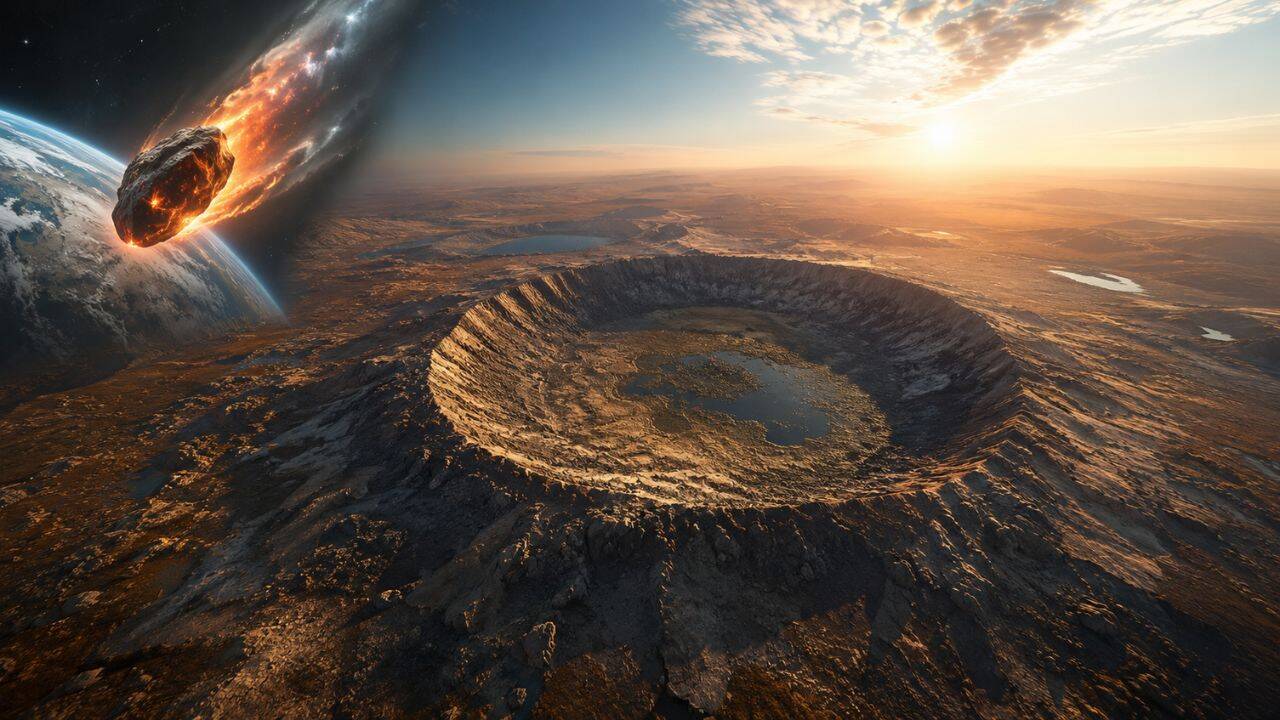
Geologists are not known for their dramatic outbursts. They spend their lives staring at rocks, speaking in a private language of silicate, gneiss, and slow, crushing time. But when you stand on the edge of the Maniitsoq structure in West Greenland, the silence changes. The wind coming off the Labrador Sea doesn't just feel cold; it feels ancient.
For decades, this jagged, deeply eroded stretch of land was considered just another complex geological puzzle—a messy knot of metamorphic rock formed by the slow, grinding pressures of a young Earth. Then a team of scientists looked closer. What they found wasn't the slow work of tectonic plates. It was the scar of a sudden, apocalyptic violence.
Three billion years ago, a giant rock slammed into the earth here. It didn't just dig a hole. It shattered a continent.
To understand what happened at Maniitsoq, you have to unlearn how you think about craters. When we think of an asteroid impact, we picture the Moon—crisp, circular bowls with neat rims, preserved perfectly in the vacuum of space. But Earth is alive. It breathes through volcanoes. It moves through plate tectonics. It washes itself with rain and grinds itself down with glaciers. Because of this constant cosmic recycling, finding an old impact crater on Earth is almost impossible. The famous Chicxulub crater in Mexico, the one that ended the reign of the dinosaurs, happened 66 million years ago. In geological terms, that was yesterday.
The Vredefort crater in South Africa was long considered the oldest known impact site, dating back two billion years. Maniitsoq pushes that boundary back by a full billion years. At three billion years old, this is the oldest known impact structure on the planet.
But you cannot see the crater bowl at Maniitsoq. It is gone. Gone, because three billion years of weather and ice sheets have scraped away the top twenty miles of the Earth's crust. What the scientists found in Greenland is the basement. They are looking at the roots of a mega-impact, the deep, internal plumbing of a disaster that occurred when the Earth was less than half its current age.
Imagine a specialized researcher—let’s call him Peter, a field geologist who spends his summers swatting blackflies in the sub-Arctic, looking through a hand lens at fractured quartz. For years, Peter and his colleagues mapped these rocks, trying to explain why the deep crust in this specific part of Greenland looked like it had been put through a blender. The rocks were crushed, melted, and injected with strange, glassy veins. Under a microscope, the mineral grains showed unique, parallel fractures—structures that only form when pressure climbs so fast and so high that the crystal lattices literally buckle.
Tectonics cannot do that. Only a cosmic hammer can.
The scale of the Maniitsoq strike defies easy description. The asteroid itself is estimated to have been roughly nineteen miles wide. If you dropped an object that large into the Atlantic Ocean, its top would still pierce the clouds, sitting higher than the cruising altitude of a commercial airliner. It was traveling at perhaps twelve miles per second when it hit the atmosphere.
When an object that massive hits a planet, it doesn't just push the ground out of the way. It compresses the rock ahead of it so severely that the solid earth behaves like a liquid. A shockwave travels downward, crushing everything in its path, while a corresponding release wave causes the rock behind it to vaporize. The heat generated would have been thousands of degrees, instantly melting thousands of cubic miles of the crust.
If you had been standing on the other side of the globe three billion years ago, you wouldn't have heard the sound immediately. But you would have felt the ground shake. The earthquake triggered by the Maniitsoq impact would have registered off any modern scale—a tremor so violent that it would have cracked open the seabeds across the world.
Consider what happens next: a wall of displaced air, a hyper-sonic hurricane, tearing outward from the impact zone, flattening everything across a featureless landscape. There were no trees to knock down, no forests to burn. The Earth at that time was a stark, alien world. The atmosphere was thick with methane and carbon dioxide, lacking the rich oxygen we breathe today. Life existed, but only in the oceans—simple, single-celled microbes floating in a iron-rich sea.
For those early organisms, the sky must have seemed to turn to fire. The impact ejected millions of tons of pulverized rock and soot into the stratosphere, blanketing the globe in a suffocating darkness that lasted for months, perhaps years. The oceans would have boiled near the strike zone, sending massive tsunamis radiating across the globe, washing over the barren, rocky shields of the first micro-continents.
Yet, this isn't just a story about ancient destruction. It is a story about how we know what we know.
The discovery of Maniitsoq was met with intense skepticism in the scientific community. That skepticism is the lifeblood of good science. When a team led by Boris Shmulaev published their findings, other geologists immediately began looking for alternative explanations. Could these deformed rocks have been caused by an ancient mountain-building event? Could the intense heat have come from a deep-seated volcanic plume rather than a falling star?
To prove an impact that occurred three billion years ago, you have to find the calling cards that only an asteroid can leave behind. The scientists found them in the chemistry of the rocks. They discovered anomalous concentrations of nickel, cobalt, and platinum-group metals scattered through the crushed zones—elements that are rare in the Earth’s crust but common in iron meteorites. It was the chemical signature of the vaporized assassin, left behind like gunpowder residue at a crime scene.
They also found massive zones of pulverized rock called impact breccias, where giant blocks of granite had been shattered into fragments and then glued back together by melted rock. These weren't the neat, orderly layers of sedimentary stone or the banded ribbons of tectonic gneiss. This was chaos captured in stone.
Why does a three-billion-year-old bruise on the face of Greenland matter to us now?
It matters because we live on a planet that hides its history. When we look out at the moon, or Mars, or the cratered moons of Jupiter, we see a solar system that is violent and heavily scarred. The Earth looks serene by comparison, wrapped in its blue oceans and green forests. But Maniitsoq is a stark reminder that our home has lived the same dangerous life as every other rock in the cosmos. We are simply better at cleaning up the mess.
Understanding these ancient impacts helps us piece together the puzzle of our own survival. During the first two billion years of Earth's history, giant impacts weren't rare anomalies; they were a regular feature of the planetary environment. They delivered water, mixed the chemical ingredients of the early crust, and repeatedly reset the conditions for life. Some scientists believe that the intense heat and fracturing caused by strikes like Maniitsoq might have actually created deep, hydrothermal environments where early life could find shelter and thrive, protected from the harsh ultraviolet radiation of a young sun.
The scar in Greenland is a window into a time when the rules of our world were still being written. It tells us that the ground beneath our feet is not an eternal, unchanging stage, but a survivor of a long, cosmic bombardment.
The sun sets late in the Greenland summer. The light hits the grey, weathered slopes of Maniitsoq at a low angle, casting long shadows across the valleys. If you walk these ridges today, you will find no plaques, no visitor centers, no signs marking the spot where the sky tore open. There is only the rock, cold and indifferent to the brief, fragile history of the humans who have finally learned to read its wounds.