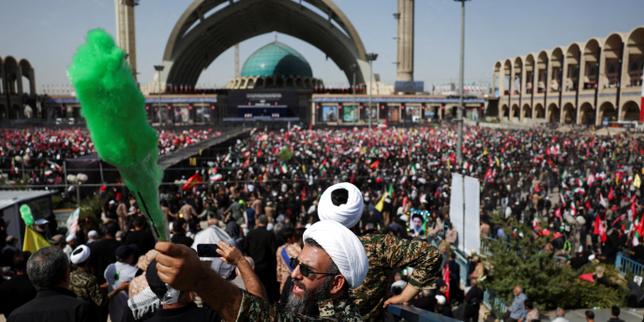
State television requires a very specific kind of grief.
When the inevitable day arrives and the broadcast networks of the Islamic Republic shift their programming to endless loops of Quranic recitations, the cameras will already know where to point. They will find the weeping clerics. They will pan across seas of black chadors. They will frame the vast, geometric symmetry of public squares filled with men beating their chests in synchronized sorrow.
The official images of the funeral of Supreme Leader Ali Khamenei will be broadcast to the world as a testament to absolute unity. A nation in mourning. A religious state honoring its supreme political and spiritual guide.
But the lens is a liar.
To understand what those images actually mean, you have to look beyond the frame. You have to look at the silent living rooms across Tehran, the frantic backroom negotiations in the holy city of Qom, and the heavily guarded military installations scattered across the desert. State funerals in authoritarian systems are never simply about burying the dead. They are massive, orchestrated theatrical productions designed to mask the terrifying vulnerability of a power vacuum.
Consider the historical echo. The last time Iran buried a Supreme Leader was in the blistering June of 1989. Ruhollah Khomeini, the charismatic architect of the Islamic Revolution, had died. The resulting funeral was a display of chaotic, unbridled hysteria. Ten million people flooded the streets of Tehran. Fire trucks had to spray water over the crushed, suffocating masses. At one point, the surging crowd intercepted the wooden coffin, tearing at the burial shroud for holy relics, sending the patriarch's body tumbling to the pavement. Helicopters had to be called in to rescue the corpse.
That was a different era. That was a nation mourning a messianic founder.
Ali Khamenei is not Khomeini. He has ruled for more than three decades—the longest-serving head of state in the Middle East—not through undeniable magnetic charisma, but through the cold, calculated mechanics of bureaucracy, patronage, and force. He is the institutionalizer of the revolution. He is the man who survived assassination attempts, a devastating war with Iraq, crippling international sanctions, and massive internal uprisings.
So, when his casket is finally paraded through the streets, the mourning will be tightly controlled. There will be no chaotic mobs tearing at the shroud. The Islamic Revolutionary Guard Corps (IRGC) will ensure the choreography is flawless.
Let us construct a hypothetical observer to understand the true stakes of this impending broadcast. We will call him Amir.
Amir is twenty-four years old, an engineering graduate driving a battered Saipa Pride as an unregistered taxi through the choking smog of south Tehran. He was born two decades after the 1979 revolution. He has never known another Supreme Leader. For Amir, Ali Khamenei is not a revolutionary hero; he is simply the severe, spectacled face staring down from billboards at every major intersection. He is the voice on the radio dictating the boundaries of Amir's life.
When the funeral broadcast floods the airwaves, Amir will not be on the street beating his chest. He will be sitting in traffic, calculating how many more hours he needs to drive to afford a kilo of meat. He lives in a macroeconomic nightmare. Official inflation hovers around forty percent. The national currency, the rial, is a ghost of its former value.
Amir represents the quiet, overwhelming majority of Iran. Over sixty percent of the country is under the age of thirty. They are a highly educated, deeply connected generation trapped inside a theocratic fortress. They communicate through encrypted apps and illegal VPNs. They bled in the streets during the protests of 2009, 2019, and the sweeping Mahsa Amini uprising of 2022.
For Amir, and millions like him, the images of the funeral will not evoke sorrow. They will evoke a sharp, breathless anxiety. The death of the Supreme Leader is not the end of the regime; it is the pulling of a pin from a grenade.
The real narrative of the funeral happens entirely off-camera.
Think of Iranian politics as a massive, grinding tectonic plate. For thirty-five years, Khamenei has sat at the fault line, absorbing the friction between competing factions—the ultra-conservative clerics, the pragmatic technocrats, and the sprawling military-industrial complex of the IRGC. He has balanced them, played them against each other, and maintained absolute authority.
When he is gone, that friction is released.
According to the constitution of the Islamic Republic, the successor is chosen by the Assembly of Experts, a body of eighty-eight aging Islamic scholars. They are tasked with convening, debating, and selecting the next Supreme Leader. The broadcast will undoubtedly show them sitting in their grand parliamentary hall, stroking their beards, engaged in solemn democratic-clerical duty.
This, too, is theater.
The Assembly of Experts does not possess the actual power to anoint a leader in a vacuum. The true kingmakers wear olive-green uniforms, not clerical robes.
Over the last two decades, the IRGC has mutated from a revolutionary militia into a sovereign entity within the state. They control the ports. They run the telecommunications networks. They manage vast, untaxed corporate conglomerates. They command the ballistic missile silos and oversee the network of proxy militias—Hezbollah in Lebanon, Hamas in Gaza, the Houthis in Yemen—that project Iranian power across the Middle East.
The generals of the IRGC will not allow a group of elderly theologians to jeopardize their empire. The successor will be a man who understands the new reality: the clerics may read the Friday prayers, but the Revolutionary Guard holds the guns and the gold.
This hidden reality makes the funeral broadcast a vital instrument of state security. The images of millions of mourners are not produced for the domestic audience, who already know the truth of their own exhaustion. The images are produced for Washington. For Tel Aviv. For Riyadh.
A state funeral is a geopolitical warning. The rhythmic chanting, the military parades accompanying the casket, the sheer volume of bodies in the street—all of it is designed to project an impenetrable shield of stability. It is a message broadcast across the Persian Gulf: Do not test us. We are united. We are ready.
The stakes of this transition ripple far beyond the borders of Iran.
The man who inherits the black turban inherits a nuclear program spinning centrifuges at sixty percent purity, just a technical leap away from weapons-grade material. He inherits a shadow war with Israel that has increasingly spilled out into the open light. He inherits an alliance with Moscow, supplying drones that rain down on Eastern European cities.
The world will watch the state television feed looking for clues. Who is standing closest to the coffin? Which IRGC commander is leading the prayers? Which political factions have been pushed to the second row? Sovietologists used to watch the Red Square parades to determine who was in favor and who was facing the gulag. The modern intelligence analyst will watch the geometry of the Iranian funeral.
Yet, despite the billions of dollars spent on internal security, despite the absolute monopoly on state media, the regime cannot control the silence.
The cameras will eventually turn off. The broadcast will end.
The millions of bussed-in mourners will return to their provincial towns. The black banners draped over the brutalist concrete of the Azadi Tower will begin to fray in the biting Tehran wind. The foreign dignitaries will board their private jets and disappear into the airspace over the Gulf.
What remains is a country waking up to a void.
A heavy, suffocating quiet will settle over the capital. The street sweepers will emerge in the predawn light, pushing brooms across asphalt littered with discarded plastic water bottles and trampled portraits of the deceased leader. They will work methodically, clearing away the physical debris of a historical epoch. And as the sun rises over the Alborz mountains, illuminating a city of fifteen million people holding its collective breath, the true battle for the survival of the republic will finally begin in the dark.