The air inside the community center in a small town outside Clacton smelled of damp coats and cheap instant coffee. It was a Tuesday evening, the kind of grey, nondescript night where most people are hunched over a microwave meal or scrolling through a phone. But forty people had gathered here, sitting on mismatched plastic chairs, their faces illuminated by the harsh buzz of fluorescent lights. They weren't there for a hobby or a local grievance about bin collections. They were there because they felt like ghosts in their own country.
For decades, the political geography of Britain was a predictable grid. You were Red or you were Blue. You lived in a mining town with a deep-seated loyalty to the Labour movement, or you lived in a leafy shire where the Conservative rosette was as permanent as the parish church. It was comfortable. It was stable. It was a world where the people in London knew exactly which levers to pull to keep the machinery of the state humming along. If you enjoyed this piece, you should check out: this related article.
That machine has broken.
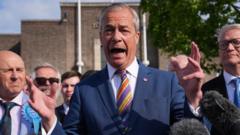
The rise of Reform UK is not merely a data point on a bar chart or a spike in a polling average. It is the sound of floorboards splintering under the weight of a disillusioned public. Nigel Farage, a man who has spent more time in television studios than in the halls of traditional power, looks at these cracks and sees an opportunity. He calls it a shift. He calls it a surge. But to the people in that community center, it feels more like a long-overdue reckoning. For another perspective on this event, refer to the latest update from NBC News.
Consider a man named Arthur. He’s a hypothetical composite of the voters I’ve spoken to across the post-industrial north and the neglected coastal towns of the south. Arthur worked in a factory that closed in 1994. He watched the high street change from a bustling hub of independent shops to a repetitive sequence of vape stores, betting shops, and boarded-up windows. When he turns on the news, he hears politicians talking about "macroeconomic stability" and "net-zero targets." To Arthur, these aren't goals; they are alien dialects spoken by people who have never had to worry about the cost of a bus fare.
Arthur didn't leave his party. He feels his party left him. This is the emotional core of the Reform movement. It’s a rebellion of the ignored.
The Mathematics of Discontent
While the narrative is fueled by emotion, the skeleton of this movement is built on cold, hard numbers. In the recent elections, Reform UK didn't just participate; they cannibalized. In seat after seat, the vote share for the traditional right-wing establishment disintegrated. The Conservative Party, long thought to be the most successful electoral machine in the Western world, found itself fighting a war on two fronts. They were losing the centrist, suburban voters to the Liberal Democrats and the angry, working-class voters to Reform.
The numbers tell a story of a fragmented nation. When a third party secures millions of votes but only a handful of seats due to the First Past the Post system, a specific kind of pressure builds. It’s like steam in a sealed pipe. The more the official results deviate from the popular will, the more the "invisible stakes" grow. The stake isn't just who sits in Parliament; it's whether the public believes Parliament represents them at all.
Farage knows this. He plays the system like a cello, vibrating the strings of resentment. He doesn't need to win a majority to change the country. He only needs to be the person standing in the wreckage of the old consensus, pointing at the elites and saying, "I told you so."
The Great Disconnect
There is a profound irony in the way the Westminster bubble reacts to these shifts. The immediate response is often one of shock, followed by a frantic attempt to label the voters. They are called "protest voters." They are called "reactionaries." They are analyzed like a strange new species of insect discovered in the garden.
This condescension is the fuel that keeps the Reform engine running.
Imagine a bridge. On one side, you have the professional political class—people who went from elite universities to research roles to safe seats. They see politics as a series of policy tweaks and communications strategies. On the other side, you have the people who live with the consequences of those policies. They see the lack of GP appointments, the rising cost of rent, and the feeling that their cultural identity is something to be managed rather than celebrated.
The bridge between these two worlds has collapsed.
Reform UK has set up a ferry service. They aren't offering a complex, 400-page manifesto of nuanced solutions. Instead, they offer a feeling. They offer the sensation of being heard. In a world of polished, focus-grouped political speech, Farage’s bluntness feels like honesty to a person who has been lied to for twenty years. It doesn't matter if the numbers in his own proposals don't always add up; what matters is that he acknowledges the pain in the room.
The Invisible Stakes of a Three-Way Fight
We are entering a period of political volatility that Britain hasn't seen since the 1920s. Back then, the Liberal Party was the titan of the age, only to be swept aside by the rising tide of Labour. We are seeing the same tectonic plates grinding together now.
The stakes are invisible because they don't appear in the daily headlines about tax cuts or immigration quotas. The real stake is the survival of the two-party system itself. For nearly a century, the UK has been governed by a duopoly. This provided a certain level of predictability. You knew what the "other side" looked like. You knew the boundaries of the debate.
Now, the boundaries are gone.
If Reform UK continues to grow, the Conservative Party faces an existential choice: do they move further to the right to reclaim those voters, or do they try to hold the center ground? If they move right, they alienate the moderate professionals who keep the economy running. If they stay in the center, they leave the door wide open for Farage to become the true opposition.
Labour, meanwhile, watches from the sidelines with a mixture of glee and terror. A split right-wing vote is a gift for their electoral prospects, but a fractured society is a nightmare to govern. It is hard to build a "national mission" when a significant portion of the population views the entire political establishment as a hostile entity.
The View from the Pub
I spent an afternoon in a pub in a town that had just seen a massive swing toward Reform. It wasn't a den of radicalism. It was just a pub. There was a dog sleeping by the radiator and a football match muted on the screen.
I spoke to a woman named Sarah. She’s a nurse. She’s worked for the NHS for fifteen years. She’s tired.
"I've voted for everyone," she told me, staring into her lime and soda. "I voted Labour when I was young because my dad did. I voted Tory because I wanted my taxes lower. I voted for Brexit because I thought things would change. Nothing changed. The waiting lists got longer. My pay stayed the same. The town looks worse every year."
She isn't a "Faragist" by trade. She doesn't have a poster of him on her wall. But she’s reached a point of exhaustion where she’s willing to vote for anyone who promises to smash the windows of the building that’s been trapping her.
"At least he's different," she said.
That phrase—at least he's different—is the most dangerous sentence in British politics. It is the white flag of a democracy that has failed to provide meaningful choices. It is the moment where the "how" of policy stops mattering, and the "who" of the messenger becomes everything.
The Echoes of the Past
History suggests that when a large group of people feels disenfranchised, they don't just go away. They don't eventually "see sense" and return to the fold of the mainstream parties. They wait. They find new leaders. They find new ways to make their presence felt.
The Reform surge is not a flash in the pan. It is the result of a slow, decades-long erosion of trust. You can see it in the way people talk about "London" as if it’s a foreign city. You can see it in the way the traditional media is viewed with suspicion. You can see it in the digital underground, where memes and short-form videos carry more weight than an editorial in a national broadsheet.
The mistake the establishment makes is thinking this is about Nigel Farage. It isn't. Farage is the lightning rod, but the storm has been brewing since the 2008 financial crisis. It was charged by the austerity years, supercharged by the Brexit deadlock, and finally unleashed by a cost-of-living crisis that made people feel like they were drowning while the people in charge argued about which brand of life jacket to throw.
The Sound of the Shift
To understand what is happening, you have to look past the podiums and the press releases. You have to look at the silence that follows a political speech in a town that hasn't seen investment in a generation. You have to look at the way a young man in a "Red Wall" seat looks at his future and sees nothing but a gig-economy job and a room in his parents' house.
Reform is a symptom, not the disease.
The disease is a lack of belonging. It’s the feeling that the national story no longer has a character named "You" in it. When a person feels like they have no stake in the status quo, they have no reason to protect it. They will vote for the person who promises to upend the table, even if they don't know what’s going to happen to the dinner.
The shift Farage talks about is real. It’s a move away from the politics of "management" toward the politics of "identity and grievance." It’s a shift from the boardroom to the street corner. It’s a shift from the rational to the visceral.
As the sun set over that community center, the meeting broke up. The people filed out into the cold air, buttoning their coats. They didn't look like revolutionaries. They looked like neighbors. They chatted about the weather and their kids as they walked to their cars.
But as they drove away, they left behind a political landscape that had been irrevocably altered. The old maps no longer work. The landmarks have moved. The ground is still shaking.
Somewhere in a grand office in Whitehall, a strategist is looking at a spreadsheet, trying to figure out how to win these people back with a 2% tax tweak or a new slogan. They are looking at the numbers. They should be looking at the floorboards. They should be listening to the sound of the wood beginning to snap.