Look at a world map and you will see countries named after men, tribes, directional markers, and mythical gods. Amerigo Vespucci got two continents. Colombia honors Christopher Columbus. The Philippines carries the name of King Philip II of Spain.
But out of 193 United Nations member states, exactly one is named after a verifiable, historical woman. Don't forget to check out our recent article on this related article.
That country is Saint Lucia.
If you think Ireland fits the bill, it doesn't. Eire comes from Eriu, a mythical Celtic goddess, not a human being who actually breathed air. Same goes for countries like Athena-inspired Greece. Saint Lucia stands entirely alone in this category. The history behind how this Caribbean island secured its name involves shipwrecked French sailors, a blind martyr from Italy, and a massive charting error by European colonizers. To read more about the context here, Travel + Leisure provides an excellent summary.
Understanding this history changes how you look at global geography. It also exposes how heavily skewed our world map is toward male historical figures.
The Shipwreck and the Missing Martyr
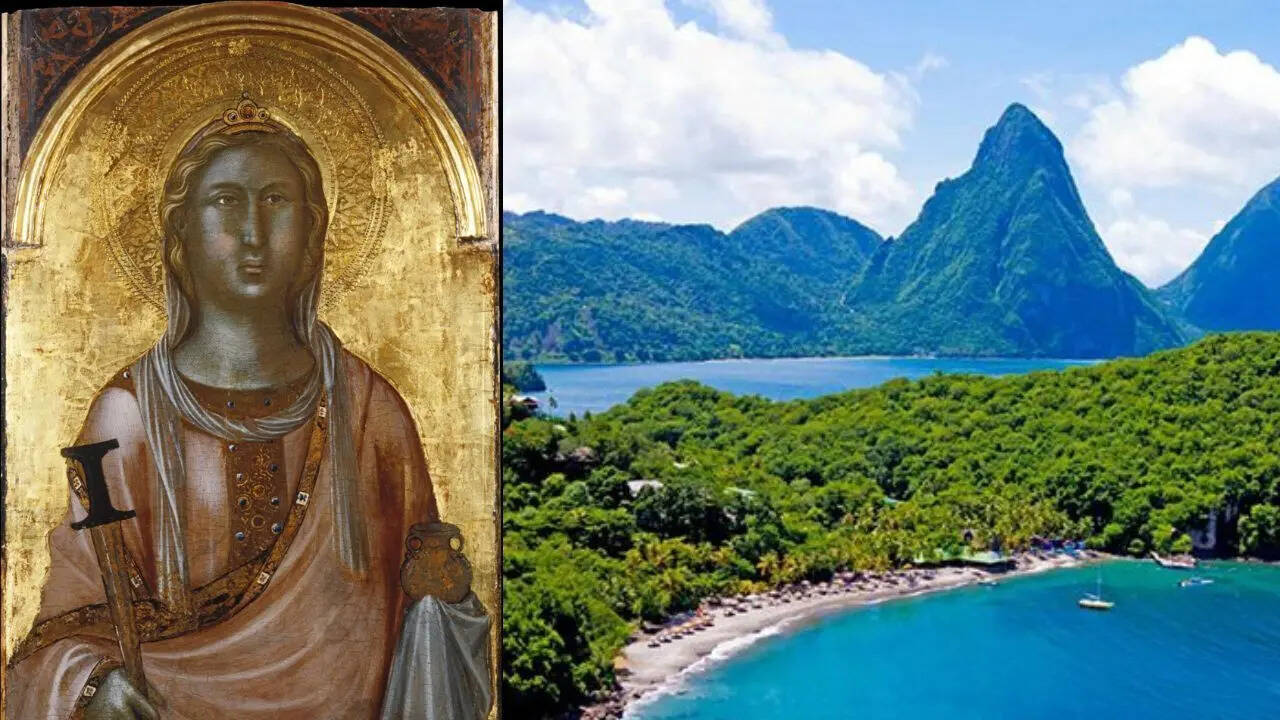
The story starts in the year 304 AD in Syracuse, Sicily. A young Christian woman named Lucia refused to marry a pagan nobleman. She distributed her dowry to the poor, which enraged her suitor. The Roman authorities arrested her, tortured her, and eventually executed her. She became Saint Lucy, the patron saint of the blind and those with eye ailments.
Fast forward nearly 1,200 years.
According to local historical tradition in Castries, the island's capital, French navigation blew off course. A group of French sailors ran into a storm and shipwrecked on the island on December 13, 1502. That specific date happens to be the feast day of Saint Lucy. Grateful for their survival, the sailors dubbed the island Sainte Alousie.
It stuck.
The British later took control of the island and anglicized the name to Saint Lucia. But the French connection remained embedded in the soil, the patois language, and the local culture.
What the Maps Get Wrong About Christopher Columbus
Walk into almost any souvenir shop in the Caribbean and you will read that Christopher Columbus discovered the island on his fourth voyage in 1502.
He didn't.
That's a myth perpetuated by lazy textbook editing over the centuries. Modern historians and the Saint Lucia National Trust have found zero evidence that Columbus ever set foot on the island. Juan de la Cosa, a Spanish cartographer who sailed with Columbus, drew up a famous world map in 1500. He actually skipped the island entirely, though later Spanish documents from 1511 mention Sancta Lucia within the Spanish realm.
The real credit belongs to those anonymous French sailors who needed a miracle and used a woman's name to mark their salvation.
The Battle for the Helen of the West Indies
Naming the island was the easy part. Keeping it was a bloody, chaotic mess.
During the 17th and 18th centuries, Saint Lucia changed hands between the French and the British a staggering 14 times. Seven times French, seven times British. The island became known as the "Helen of the West Indies," a nickname comparing its strategic beauty to Helen of Troy, the woman whose face launched a thousand ships.
Why did they fight so hard over a small volcanic dot in the ocean?
- The Sugar Trade: Sugar was the oil of the 18th century. Saint Lucia’s fertile soil made it an absolute goldmine for colonial powers willing to exploit enslaved labor.
- The Natural Harbor: Castries features a deep-water harbor that allowed massive warships to hide, refit, and ambush enemy fleets.
- The Pitons: These twin volcanic plugs served as perfect natural navigation landmarks for ships crossing the Atlantic.
The British finally secured permanent control in 1814 through the Treaty of Paris. Yet, despite over a century of British rule before gaining independence in 1979, the island never lost its French-inspired name. It stayed Saint Lucia.
Why the Rest of the World Map Excludes Women
The fact that only one country honors a real woman tells you everything you need to know about who drew our maps.
European explorers, mapmakers, and monarchs were almost exclusively men. When they wanted to honor someone, they looked to their kings, their financial backers, or themselves. On the rare occasions they chose a female name, they defaulted to queens who never visited the land, like Virginia for Queen Elizabeth I, or they chose religious figures like the Virgin Mary for El Salvador.
Saint Lucia represents a weird glitch in colonial history. It represents a moment where a regular woman's legacy outlasted the egos of emperors and kings.
How to Track This History on the Ground
If you visit the island today, don't just sit on the beach drinking rum punch. You can actually track the physical remnants of this Anglo-French tug-of-war.
First, head up to Pigeon Island National Landmark. It’s an old military fort where British Admiral George Rodney fortified his fleet to spy on the French naval base in nearby Martinique. You can walk through the ruined stone barracks and see the old cannons still pointing out to sea.
Second, look at the towns. You will drive through Soufrière, which is pure French, and then pass through Dennery or Vieux Fort. The street signs in Castries alternate between English names like William Peter Boulevard and French names like Bourgeois Street.
Your next step if you want to understand how geography dictates modern culture is to dig into the linguistic divide. Pay attention to how locals speak. While English is the official language, the street language is Saint Lucian Creole, a beautiful French-lexified patois. It’s a direct living artifact of the sailors who named the island nearly 1,700 years after Saint Lucy lived. Look up the local cultural festivals, specifically the Feast of Saint Luce on December 13, where the island celebrates its unique naming day with lanterns and festivals of light. That is where you see the real history, away from the cruise ship docks.