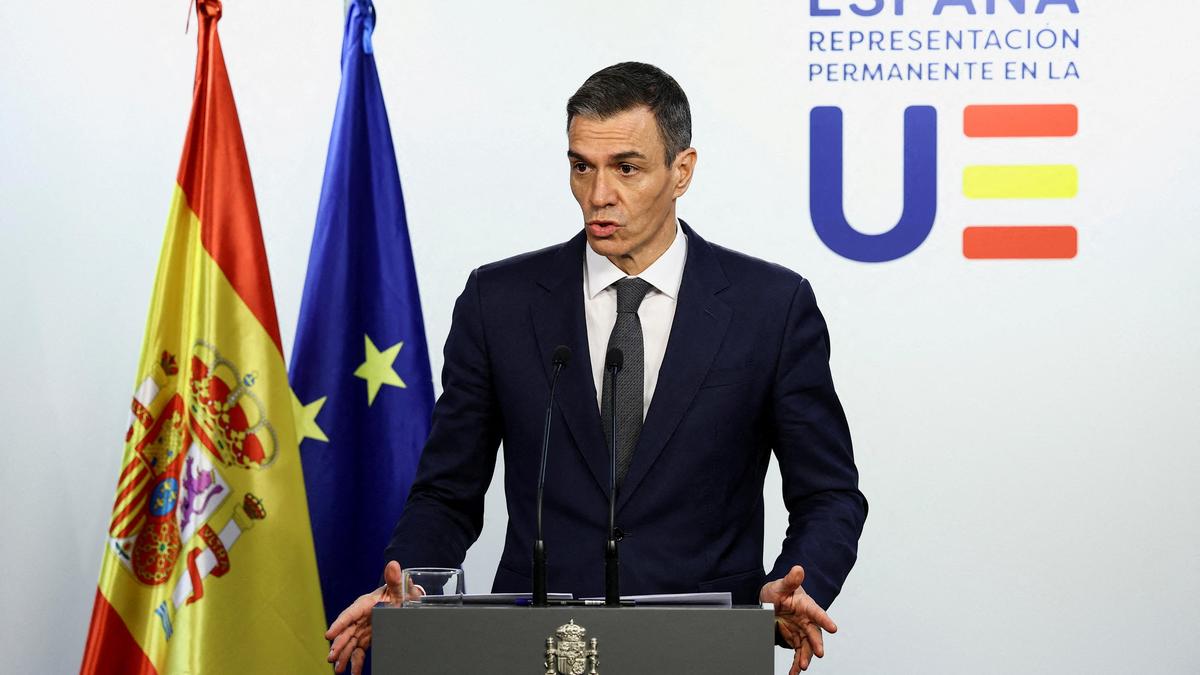
The polished mahogany table in the Moncloa Palace usually reflects the soft, amber light of a Madrid afternoon. But today, the reflection is fractured by the weight of a choice that could redefine a nation’s dinner tables and its dignity. Pedro Sánchez sits there, a man caught between the devastating machinery of modern warfare and the unforgiving gears of global trade.
He is looking at a map of the Middle East, then at a spreadsheet of olive oil exports to the United States.
To the casual observer, these two things have nothing in common. One is a matter of missiles and ancient animosities; the other is a matter of supermarket shelves in Ohio. However, in the brutal, transactional theater of 2026, they are the same currency. Donald Trump has made the exchange rate clear: Spanish support for a military campaign against Iran in exchange for the survival of Spain's agricultural soul.
Sánchez has chosen the harder path. He said no.
The Invisible Ghost in the Olive Grove
Consider a farmer named Mateo in Jaén. He doesn't follow the intricate movements of carrier strike groups in the Persian Gulf. He follows the rain. He follows the ripening of the Picual grapes. His family has tended the same sun-drenched hills for four generations, surviving civil wars, droughts, and the slow creep of modernization.
For Mateo, a "trade threat" isn't an abstract headline. It is the sound of a bank officer’s pen clicking. It is the possibility that the bottle of liquid gold sitting in a warehouse will suddenly cost 40% more at the American border, making it an ornamental luxury rather than a kitchen staple. When the White House threatens tariffs, they aren't just attacking a government; they are reaching across the Atlantic to dim the lights in Mateo’s farmhouse.
This is the lever Trump is pulling. It is an old tactic polished for a new era. By tying military cooperation to economic survival, the administration is betting that the hunger of the Spanish economy will eventually outweigh the conscience of the Spanish state.
Spain has long positioned itself as a bridge—a European power with a Mediterranean heart and a deep, historical memory of what happens when the Middle East catches fire. Sánchez isn't just being stubborn. He is looking at the ghosts of 2003, remembering the mass protests in the streets of Madrid when Spain followed the United States into Iraq. He knows that blood is harder to wash off than red ink.
The Math of Defiance
The numbers are staggering. Spain’s exports to the U.S. reached record highs last year, fueled by a hunger for European luxury goods, wine, and footwear. A blanket tariff would act like a sudden, violent frost. Economists estimate that a full-scale trade war could shave a significant percentage off Spain’s GDP growth, potentially stalling a recovery that has been years in the making.
But there is another set of numbers.
The projected casualty lists of a direct conflict with Iran. The cost of a barrel of oil if the Strait of Hormuz is choked by naval mines. The millions of refugees who would inevitably look toward the Southern European coast as their homes vanish in a cloud of dust.
Sánchez is performing a grim piece of arithmetic. He is weighing the certain pain of a trade war against the catastrophic uncertainty of a regional conflagration. It is a lonely calculation. While other European leaders offer measured, lukewarm statements, the Spanish Prime Minister has planted his flag in the soil of total opposition.
He argues that a strike on Iran would not be a surgical correction but a systemic collapse. He speaks of "strategic autonomy," a phrase that sounds like academic jargon until you realize it actually means the right to say "not in our name" without being starved into submission.
A Dialogue of the Deaf
The tension between Washington and Madrid isn't just about policy; it's about a fundamental clash of worldviews.
From the Oval Office, the world is a series of deals. You provide the muscle; we provide the market. It is a world of zero-sum games where loyalty is measured in troop deployments. To the current U.S. administration, Spain’s refusal is a betrayal of an alliance, a sign of weakness that must be corrected through the "America First" toolkit.
From Moncloa, the world is a fragile web of institutions and hard-won stability. For a country that transitioned from a dictatorship to a modern democracy within living memory, the rule of international law isn't a suggestion. It is the floor.
When Trump tweets about "disloyal partners" and "fair trade reciprocity," Sánchez responds with the quiet, persistent language of diplomacy. He spent the week speaking with leaders in Paris and Berlin, trying to build a bulkhead against the coming economic storm. He is searching for a "third way," but the space for such a path is narrowing by the hour.
The Ripple Effect in the Supermarket Aisle
We often think of geopolitics as something that happens in bunkers and situation rooms. We forget that it happens in the grocery store.
If the tariffs land, the American consumer becomes an accidental soldier in this shadow war. That bottle of Sherry, those canned white asparagus, the high-end ceramic tiles for a kitchen remodel—they all become casualties. The prices climb, the demand drops, and the connection between two cultures is severed by a digital signature on a tariff decree.
The cruelty of the trade threat lies in its precision. It targets the very regions of Spain—Andalusia, Extremadura, Valencia—that are most vulnerable to economic shifts. It is designed to create internal pressure, to turn the Spanish people against their own leader. The goal is to make the cost of peace so high that war starts to look like a bargain.
The Weight of the Sun
Sánchez remains a polarizing figure at home. His critics call him a gambler, accusing him of risking the nation’s prosperity for a moral high ground that few others are willing to defend. They point to the rising unemployment figures in the south and ask if a "firm stance" is worth a bankrupt family.
His supporters see something else. They see a rare moment of backbone in a geopolitical landscape often defined by folding. They see a leader who understands that if you let a larger power dictate your foreign policy through your grocery bill, you aren't a partner. You are a client state.
The standoff is far from over. The ships are still moving toward the Gulf. The tariff lists are still being drafted in Washington. And in Spain, the sun continues to bake the olive groves, indifferent to the storm brewing across the ocean.
Sánchez walked out onto the balcony of the palace recently, looking toward the Sierra de Guadarrama. He didn't look like a man who had won. He looked like a man who had accepted the price of his own conscience.
There is a specific kind of silence that follows a "no" spoken to a giant. It is not the silence of peace, but the heavy, charged silence that precedes a strike. Spain is waiting for that strike, watching the horizon, knowing that while the oil might stop flowing and the markets might crash, some things are not for sale.
The olives are bitter this year. They taste of iron and the sea.